Posts

Showing posts with the label geography

Peanuts PDFs; UK map; Midwestern wedding

All of the Peanuts strips, PDF format, $25. Offer ends in 12 days.

♦ ♦ ♦ ♦ ♦

My UK wall map – a Christmas gift from my father-in-law – has been framed at last in a heavy, wooden contraption from Goodwill. Karin, the handy one, did the framing. My idea is to hang the map next to the TV so that we can check it when we watch homicidal/​agricultural/​veterinary programs, e.g. our latest, The Highland Vet.

Current reading: François Mauriac, Genetrix; Sue Townsend, Adrian Mole: The Prostrate Years (the last book in the series). And lots of other books.

♦ ♦ ♦ ♦ ♦

I should describe the wedding we attended on Sunday. Samuel bore the rings with aplomb. The much younger flower girl lagged behind, so Samuel retraced his steps, grabbed some petals, and strewed them for her. All else went according to the script: the brief vowing ceremony; the post-vowing, pre-dining interlude for photos; the popcorn and donut tables; the soda and liquor booths; the dinner rolls, sweet corn, and mashed potatoes; the couple’s dance, the bride’s dance with her father, and the groom’s with his mother; and the Cha-Cha Slide. There was no removal of the garter with teeth – none we stayed for, anyway. When we left, I was dead-tired. I’d held squirmy Abel for several hours. It was as wearying as if I’d spent the day moving house.

Samuel and Daniel loved the Cha-Cha Slide; their grandpa danced it with them. That ex-DJ was in his element. I’ve not met a more ardent ritual-relisher.

A long-awaited stroll; a latitude, hydrological divides, and other fancies

Snow: mostly melted. Temperatures: in the fifties (F); sixties tomorrow. I take Abel and Daniel strolling. Daniel jumps in all the puddles. He soaks the insides of his boots. I don’t know what he’ll wear if we go out again very soon.

Abel, in the stroller, leans forward, his head as near to the ground as he can get it, as if he were peering into tidal pools.

I halt to check if he’s all right; Daniel races ahead.

♦ ♦ ♦ ♦ ♦

Fun fact I just learned: Canada’s lowest latitude passes through South Bend just a few blocks north of Toad Hall.


(Toad Hall is our house.)

I could pinpoint the location, stroll there, and hop back and forth over the line. “Now I’m south of all of Canada. Now I’m north of a little of Canada.”

I suppose the urge is due to having grown up near the equator.

♦ ♦ ♦ ♦ ♦

I could do this with the nearby drainage divide, too. “Now I’m daining into the Great Lakes. Now I’m draining into the Gulf of Mexico, I mean the Gulf of America.”

It seems a less arbitrary line since it has a basis in physical rather than political reality – until I remember that the Great Lakes drain into the St. Lawrence River and thence into the Atlantic, which encompasses the Gulf of Mexico (I mean, America). So that, ultimately, the distinction between these drainage basins is artificial.

Of course there’s a physical difference between draining one way and draining the other, but if you mark all such differences you end up with insignificant, postage stamp-sized drainage basins.

Artifice – human purposiveness – seems inescapable if much geography is to be done at all.

I remember checking out geography Ph.D. programs when I was very young. There was the respectable but daunting meteorology specialization; all else seemed postmodern free-for-all. A bitter disappointment to someone who’d vaguely entertained the thought that his vocation might consist of memorizing picturesque but unimpeachable facts, e.g. that Czechoslovakia’s capital is Prague.

World Cup groups

… have been drawn. Gratifyingly, there are no weak groups: all are groups “of death.” Literal death.


Just kidding. These are not the groups. (Besides, the tournament has been expanded from 32 to 48 teams.)

(I should acknowledge that I didn’t create this image; I found it on the Internet.)

The actual groups are these:

Group A
Mexico
South Africa
South Korea
TBD: Czechia, Denmark, Ireland, or North Macedonia

Group B
Canada
TBD: Bosnia & Herzegovina, Italy, Northern Ireland, or Wales
Qatar
Switzerland

Group C
Brazil
Morocco
Haiti
Scotland

Group D
USA
Paraguay
Australia
TBD: Kosovo, Romania, Slovakia, or Turkey

Group E
Germany
Curaçao
Ivory Coast
ECUADOR

Group F
The Netherlands
Japan
TBD: Albania, Poland, Sweden, or Ukraine
Tunisia

Group G
Belgium
Egypt
Iran
New Zealand

Group H
Spain
Cape Verde
Saudi Arabia
Uruguay

Group I
France
Senegal
TBD: Bolivia, Iraq, or Suriname
Norway

Group J
Argentina
Algeria
Austria
Jordan

Group K
Portugal
TBD: DR Congo, Jamaica, or New Caledonia
Uzbekistan
Colombia

Group L
England
Croatia
Ghana
Panama

Locations and times have been decided, too. Ecuador will play in: Philadelphia, against the Ivory Coast; then, Kansas City, against Curaçao; and lastly, East Rutherford, New Jersey, against Germany (in what will be Ecuador’s first World Cup rematch; the countries first played in 2006).

Our Aunt Linda in K.C. is keen to host any relations who’ll attend the Curaçao game. But tickets are rapaciously expensive. I can’t imagine I’ll attend unless I win a sweepstakes out of a cereal box.

Besides, if I travel to K.C., I’ll have to spend precious hours away from the television. I’ll miss Japan vs. Tunisia or some other partidazo.

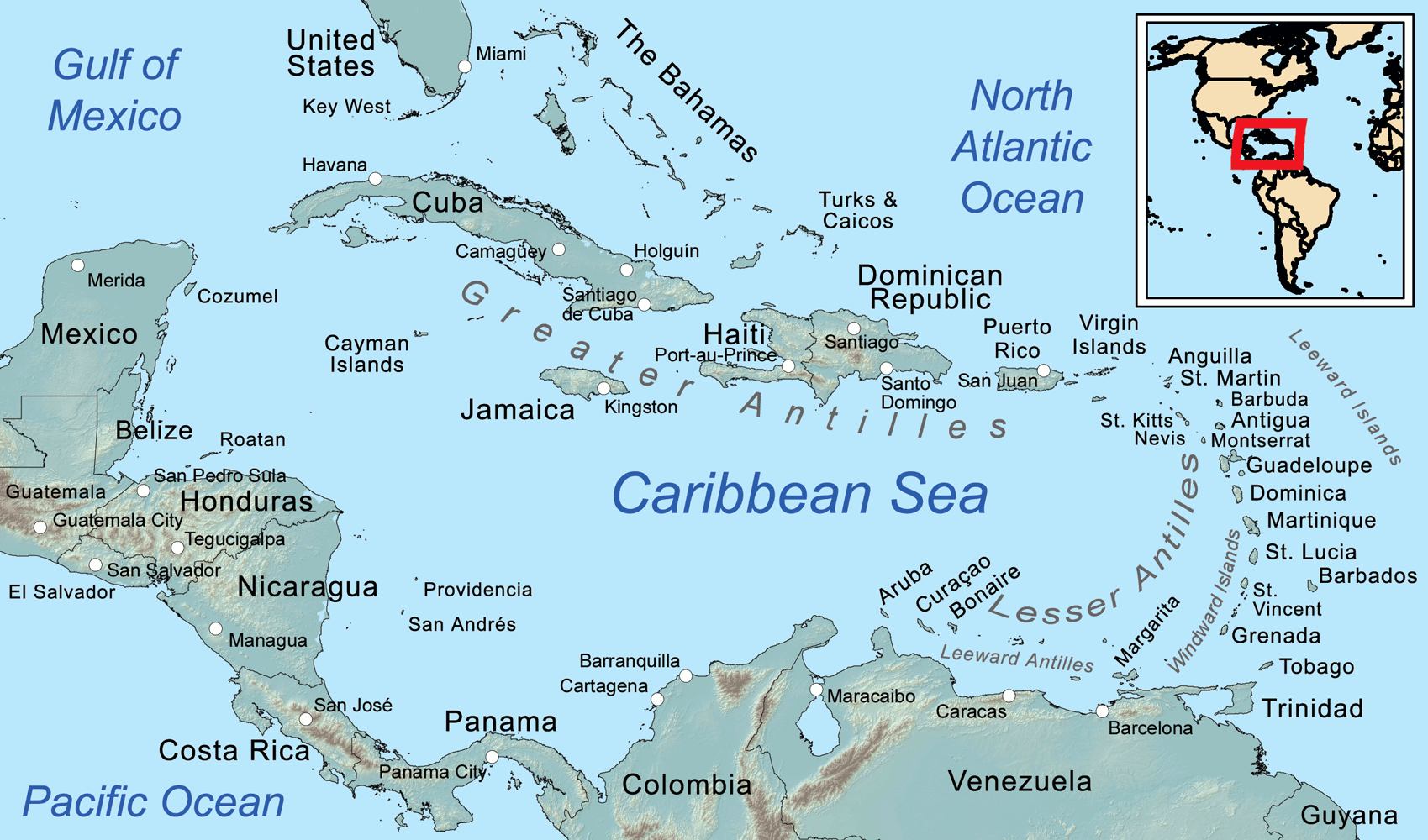
A note on Curaçao, the smallest nation ever to qualify for a World Cup. This hardly ever happens, but … I didn’t know Curaçao’s location on the map. I knew that Curaçao is one of the Dutch Antilles, but, mentally, I grouped it with islands southeast of Puerto Rico. Actually, it’s off the coast of Venezuela – practically in South America.

I’m ashamed not to have known this. In my defense, Curaçao became a sovereign nation only in 2010.

Rules for blogging

“Is this your ‘fall gothic’ blog look?” Karin asks.


Nah, I just compulsively reformat and revise, as regular readers know.

The most significant change is that the section-separating diamonds (♦ ♦ ♦ ♦ ♦) are now tomato-colored, not orange. This would be tricky to implement globally rather than one entry at a time. So I haven’t done it all yet.

Some of my rules for blogging:
  • Get the formatting right
  • Corollary: learn the necessary HTML
  • Get the prose right
  • Revise style unstintingly
  • Revise substance sparingly
  • Post ten times per month (this constrains revision)
  • Tell the truth
  • Use free fonts
  • Don’t try to make money
  • Don’t track pageviews (I do see what countries my readers and reader-bots come from, but I can’t distinguish between them)
  • Allow comments from human beings, not bots (right now, I’m failing to allow comments at all)
  • Don’t worry about who reads (exception: Madame)
  • Don’t worry if your wife doesn’t always read
  • Don’t worry if people who once read don’t now
  • Don’t worry if your content is utterly trivial
  • You have almost nothing to say
  • This blog is for exercise
  • Just follow your very long nose; then retrace and clean up
  • Write more like a Briton than like a gringo
  • Corollary: some convolution is acceptable
  • But emulate your stylist-heroes (e.g., Agatha Christie, Evelyn Waugh)
  • If, in overall conception, you must emulate someone, let it be Pepys
  • Read more Pepys so you know what you’re talking about
  • The Shorter Pepys should suffice
  • But it might not
I’ve posted some 1,300 entries here since 2013, and before that I posted on Xanga for almost ten years, so I can speak with some authority.

“Engagement”

This is nicely put by Marco, who was a few years ahead of me at school.


It’s Cunningham’s “Law” (somebody comments). Wikipedia:
[Ward] Cunningham is credited with the idea: “The best way to get the right answer on the Internet is not to ask a question; it’s to post the wrong answer.” This refers to the observation that people are quicker to correct a wrong answer than to answer an unanswered question.
It’s (kind of?) interesting to ponder the ethics of asserting a falsehood in order to elicit the truth. Lying is wrong. (Ditto for other kinds of dishonesty.) But, plausibly, there are exceptions (e.g., to keep persecutors from tracking down their victims). What about the following case? A lie sparks crowd-sourced inquiry and, thereby, is predictably truth-conducive in the long run.

And mightn’t it matter in what institutional setting the lie is asserted? Police interrogators lie to elicit the truth, with society’s blessing. And if I publish an academic paper that asserts a thesis that’s almost certainly false – so that other scholars in this publish-or-perish economy are spurred to publish rebuttals explaining why the thesis is false – am I doing a bad thing? Don’t I advance respectable epistemic goals? (And is it so terrible if I elicit the truth in this manner for non-epistemic reasons: to get hired, promoted, grant-funded, etc. – i.e., for money – so that I can feed my children and mentor college students, who are as innocent as babes?)

But I see what Marco means. I do encounter the sort of thing he describes. I found a particularly shameless example tonight.


Most of the commenters were like, What happened to the state of New York? The Ivy League is dumb.

They made some troll richer by commenting, is what happened.

The most dangerous college towns in the USA

Ithaca is no. 6. I used to hear rumors but never thought the town was that bad. I also used to see people getting arrested across the street from where I lived, but that was outside a bar and therefore to be expected. Besides, it was on the same corner where I once saw the Vienna Boys’ Choir climb into a bus. The Choir’s beatific presence contributed to the overall mildness of the place.

Gainesville is no. 1 in crime. Not too surprising. Now and then, I see Gainesville in crime documentaries. Gainesville even had its own “Ripper.”

I’m inordinately loyal to, even fond of, Bloomington (no. 10). I’ve never been there. Sometimes, I walk along its streets on Google. I hang out in Assembly Hall or outside Scott Russell Sanders’s house; I avoid notorious “Cutter” districts.

At this point, you’re probably asking what counts as a college town. Is Memphis a college town? Is St. Louis? They have universities and lots of crime. Albuquerque? Atlanta? Baltimore? Boston? Chicago? Los Angeles? New York? Philadelphia? Washington, D.C.?

Seattle? (Think: Bundy.) Salt Lake City? (Ditto.) Tallahassee? (Ditto.)

Is South Bend a college town? Maybe not, since Notre Dame is its own city. But see the murder-writings of Ralph McInerny (where there’s smoke, there’s fire). Or this sad movie.

According to the group that did the study,
a total of 26 U.S. college towns were selected based on the following criteria: The institution [the university] is a central feature of the city, meaning it materially influences local demographics and infrastructure.
Top- and bottom-ten lists don’t mean much in a field of just twenty-six.

The case against living in las Malvinas

… a.k.a. the Falklands.


Argentina came within a point of qualifying for the World Cup, defeating Uruguay, who fell in the standings. Ecuador rose to second place. We’d dropped to fifth because Brazil and Paraguay won their games; but then we beat Venezuela, 2–1, in what should have been a cakewalk but became rather fraught when Venezuela scored.

Enner scored twice for Ecuador but missed a penalty kick, as is his way. Other outstanding players were midfielder Pedro Vite and goalkeeper Hernán Galíndez. The latter dislocated his finger; Pervis pulled it back into place.

Five games remain for each team. We’ll play on Tuesday, in Santiago. The Chileans are last.

Karin took Samuel to the emergency room last night because we worried that he had appendicitis. He didn’t, thank goodness. Today we’re all much happier.

On the “51st state”

Winter, for practical purposes, has ended.


Trump’s bizarre second term keeps lighting up the blogosphere. Will or won’t he annex Greenland and Canada? Is he serious? Who knows? Does he know if he’s serious?

What’s eye-opening, to me, is how seriously Canadians regard this bluster. But then Canadians have long feared annexation in one guise or another. There’s quite a literature on this. I never knew!

This book by George Grant is a notable example.

I’m tempted, now, to re-read Charles Taylor’s philosophy in light of the imperialist threat.

This list of Canada’s “most important” books (part one; part two) also is worth consulting. (Grant’s book is #41.) We may as well read what Canadians have to say, before we conquer them.

♦ ♦ ♦ ♦ ♦

In the hullabaloo I’d forgotten that outstanding YouTube channel, Un mundo inmenso. Its latest video is about Bangladesh. Speak of a neglected nation! Did you know that one of every twenty people on Earth is Bangladeshi? That the country is cricket- and soccer-mad? That Argentina’s soccer team has more fans in Bangladesh than in Argentina? (Big deal, cosmologists would say: the size of the universe guarantees that Argentina’s fans are many times more numerous on other planets …)

The Gulf of America, pt. 2


For the text of the executive order, click here.

Renaming the Gulf has one thing going for it, historian Greg Grandin comments.

♦ ♦ ♦ ♦ ♦

Re: oil spillage. This afternoon, while I was bottle-feeding Abel, Daniel got his mitts on our sesame oil. Let’s just say that the kitchen, hallway, and bathroom smell delicious now.

Actually, Daniel and Samuel were pretty good today. I’d worried because it was Karin’s first day back at work – my first full day alone with all three boys.

Daniel took a turn bottle-feeding Abel. He kept getting him to smile.

Abel has dimples.

Update: Samuel and Daniel both poured out the sesame oil. Samuel confessed.

They poured much of it onto Karin’s potted mint plant. That poor thing is subjected to unimaginable abuse. Yet it survives.

Names on the land

(Titled after this book.)

By now you’ve probably heard of President Trump’s orders to rename Mt. Denali “Mt. McKinley” and the Gulf of Mexico “Gulf of America.”

Genius!


He could have done better, though. How about “Mt. ExxonMobil McKinley?” “Gulf Oil Gulf of America?” Or, concessively, “Gulf MX Gulf of America?” For, say, twenty years, with renewal options?

I’ve been looking at maps of various countries’ administrative divisions, translated literally. Here’s Argentina – omitting the Malvinas and the Antarctic claim – with provincial names in English.

(Click to enlarge.)


The provinces’ actual names:


Etymology is fascinating. Did you know that “Mendoza” (cold mountain) is from the Basque language? That the origin and meaning of “Córdoba” are uncertain? (The above translation is just somebody’s guess.)

You may have known that “Formosa” means beautiful. Q: Beautiful, how? A: Shapely.

As for “La Rioja,” it’s not riverland, exactly; the name is for a place in Spain, which is named for the Río Oja. Or maybe it’s for the wine.

How the sausage is made

(The sausage being flan.)


Look at all that sugar!

♦ ♦ ♦ ♦ ♦

Old Ecuadorian friends came to town. I went to my parents’ and grandparents’ houses and listened to several hours of esmeraldeño Spanish – the best kind of Spanish.

One of these friends recently married a Mexican. This led to many jokes because Ecuador and Mexico aren’t getting along right now.

♦ ♦ ♦ ♦ ♦

Samuel asked me to draw Africa. He then surprised me by adding a very decent Eurasia to it.


He marked out China, India, the Republic of Georgia, Madagascar … and Japan, which isn’t where you’d think; it seems to have joined Russia’s Arctic islands. I asked him if he was sure. He was. “This is Honshu, this is Hokkaido. …” “Japan seems to have migrated,” I said. He thought this hilarious. “Japan migrated! Japan migrated!” he went around shouting.

Unfortunately, he left his map and his pens lying around, and Daniel came along and scribbled over the drawing. Samuel was very sad until I showed him the photo I’d taken. Now he gets such a kick, looking at his map on the computer screen.

Borders; World Cup prospects; a bargain; a first mowing

Samuel has been asking me to (a) “write” (i.e., draw) countries, (b) write down their names, and (c) “write” any “connecting” (bordering) countries. Not so bad when the country is Ireland or Spain; pretty taxing when it’s Russia. Or France, which is much more than just Metropolitan France.

Some facts:

Because France magically borders countries in Europe and (via its Guiana) South America, every World Cup winner but one – England – is part of an unbroken chain of land-adjacent World Cup winners.

Habilitate the sea borders, and England joins the chain.

All the finalists also form an unbroken land-or-sea-adjacent chain. (Sweden and Germany share sea borders, as do Italy and Croatia.)

So do all the semifinalists but South Korea. (Russia/​USSR borders Poland by land and the USA by sea; Serbia/​Yugoslavia touches Bulgaria, which touches Turkey; and Morocco, Africa’s sole top-four finisher, borders Spain.)

The moral: If your country is several steps away from the chain – if you’re in, e.g., Malaysia, Australia, or Subsaharan Africa – you won’t get to the last stages, not for a good while anyway. India probably is too far removed as well. Sure, only China lies between it and Russia, just as only one country (North Korea) lies between top-four-finisher South Korea and Russia, but goodness, you’d have to slog over the Himalayas and through Tibet and Siberia and over all of European Russia and make the leap to Kaliningrad just to get as close to the center as Poland, which last played a semifinal in 1982.

These are my profound thoughts this evening.

♦ ♦ ♦ ♦ ♦

Our next-door neighbor, Mike, buys stuff in abandoned storage units and sells it at flea markets and garage sales. Today, he sold to me, for $2, a copy of Janson’s History of Art, which I’d been pining after for decades. I never could bring myself to order that beast of a book through the post.

It may not be the wordiest volume I’ll ever read, but it’ll probably be the heaviest.

I looked at the pictures with Samuel. I left him alone with the book for two minutes, and he started to color in it. He was bitter when I removed it to a high shelf.

♦ ♦ ♦ ♦ ♦

I mowed for the first time this year and now am sore.

A fire-pit

I’ve added Olympic National Park (Washington) to the previous entry’s list.

To see a map of the Olympic Rain Shadow, click here and scroll down. The rain shadow covers Victoria, British Columbia, a place that seemed curiously arid when I visited fifteen years ago; now I know why.

Speaking of Olympian mountains, I learned that Olympus Mons, on Mars, is about as large as Poland.

♦ ♦ ♦ ♦ ♦

We bought a portable fire-pit for burning the wood that accumulated in our yard these last two years, and for placing our lawn-chairs around, roasting wieners in, grilling cucumbers over, etc.

Samuel’s much-studied book, Cooking with Foil, would have been useful had he not torn out the pages.

Not that we’d’ve been guided by it anytime soon. We’re unable to keep a fire going longer than five minutes. Certain twigs and sections of rotten logs burn, and the rest just don’t.

Last night, Daniel wandered off with the poker, and we crept around in the dark, looking for it with our phone-flashlights. No luck. We searched again today and were about to give up when Karin lowered her eyes and noticed it in plain view.

Poker or no poker, we are hapless.

Karin tried stimulating the fire with her breath; she extinguished it. I told her she should never carry the Olympic torch. (Not that I’ve kept the fire going any better.)

Our lawn-chairs sank pretty far down into the mud.

♦ ♦ ♦ ♦ ♦

This aftertoon I watched forty-one-year-old Pepe, of the immortals, in the UEFA Champions League. He played well. He’s a thug, but I like him; as John Huston says in Chinatown, “Politicians, ugly buildings, and whores all get respectable if they last long enough.” I watched through a thicket of climbing, niggling children. Daniel begged to watch “hungry planets” on YouTube, and Samuel, who is susceptible to advertising, kept asking for Heineken.

Awakenings; parks; Seusses; Mitfords, pt. 6

Warm-ish temps; constant rain patter. There’s nothing quite like reading Beowulf on the sofa, then dozing off, then waking – gradually and painfully – to the 1⁠-2⁠-3 punch of Modern Talking’s “Geronimo’s Cadillac,” “Brother Louie,” and “Cheri, Cheri Lady.” (The other songs in the queue were more soothing.)

♦ ♦ ♦ ♦ ♦

Karin obtained a puzzle with “thumbnail” sketches of the U.S. National Parks. Samuel spent hours gazing at the sketches and deciding which parks to visit. He’s keen on the Channel Islands (California).

I rose in his esteem by telling him which parks I’ve been to or seen from afar:

Acadia
Arches
Bryce Canyon
the Gateway Arch, glimpsed from I⁠-⁠70
the Grand Canyon, glimpsed from aircraft
Joshua Tree
Kings Canyon
Olympic, viewed from Vancouver Island (as in this photo, but not from so high up)
Mt. Rainier, viewed from Seattle (and see, again, the photo taken from Vancouver Island; I didn’t see this mountain during my stay)
Sequoia
Zion

I promised to go with Samuel to the Indiana Dunes. Poor boy, he rarely leaves the house, let alone the city.

He and Karin put the puzzle together last night, and this morning Daniel tore it up.

♦ ♦ ♦ ♦ ♦

ThriftBooks had a Seuss sale, and I bought a few of the immoral, discontinued titles (they were in a single omnibus, hee, hee), as well as I Had Trouble in Getting to Solla Sollew, which I’d been haunted by but hadn’t looked at since age four. It didn’t disappoint. I still don’t know how it concludes, though, because Daniel keeps slamming it shut before we reach the end. But I can guess.

As for the immoral ones, I re-read Mulberry Street and found mentions of a Rajah riding an elephant and a Chinese man using chopsticks.

♦ ♦ ♦ ♦ ♦

I finished The Pursuit of Love (1945), Nancy Mitford’s fifth and best-loved novel. At last, some contrition. Aristocrats celebrated … and punished: not for being aristocrats, but for making un-aristocratic marriages.

Isla Cromartie

My new Chromebook arrived a day early. What with the Scottish TV I’ve been watching, I named her Isla Cromartie.

The good: compared to my previous Chromebooks, Isla is built like a tank.

The bad: she loses power faster. And she has a touchscreen for Samuel and Daniel to interfere with. Perhaps this feature could be disabled.

She is a Dell. I considered naming her Adelle. Also: Philadelphia, after Philadelphia Bobbin, a character in Nancy Mitford’s Christmas Pudding.

It’s unlikely but possible that one day I’ll sire girl-triplets: Philomena (“Mena”), Philippa (“Pippa”), and Philadelphia (“Dee”). Karin hopes not.

♦ ♦ ♦ ♦ ♦

The Drake Passage, in a nutshell (National Geographic).

♦ ♦ ♦ ♦ ♦

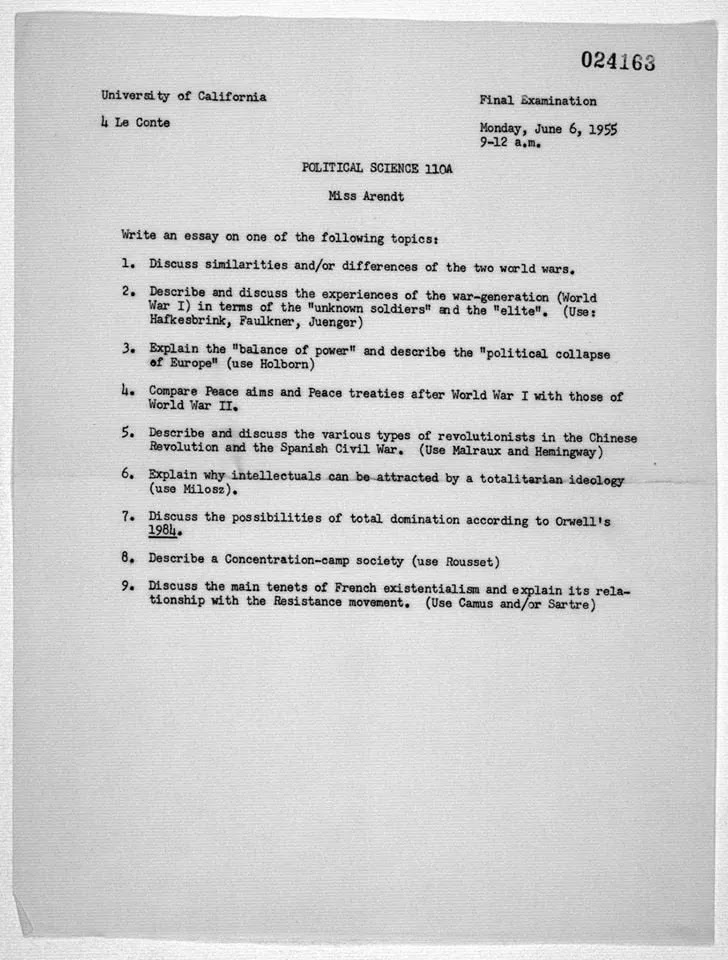
An exam from a class taught by Hannah Arendt in 1955. (Click on the image to make it sharper.)


When I was growing up and aspiring to become an academic (among other things), I read a few books from the 1970s and ’80s – whatever I could find in Ecuador – on how to teach in college. These books had sample exams. One basic type was Arendt’s: Here is your chance to demonstrate what you have learned.

For the student who’d learned little, there was nowhere to hide. For one who’d at least absorbed a few key lessons, arriving at a decent launching point for subsequent, mostly unguided study, this was an arena in which to shine.

I was enamored.

This was not what my exams were like in college or graduate school.

If memory serves, just one exam, a take-home from my second semester of college, was remotely like Arendt’s.

Ascension Island

Congrats to Liga de Quito for winning the Copa Sudamericana, and especially to Alexander Domínguez for blocking three of Fortaleza’s penalty kicks. Domínguez also tended goal when Liga previously won this tournament, in 2009.

Stephen says this is Domínguez’s finest hour, but I still prefer the epic time-wasting of 2021.

♦ ♦ ♦ ♦ ♦

I have nothing much to relate – the weekend has been low-key (the best kind of weekend) – so here is an oldish video by Un mundo inmenso that I’d somehow never viewed until tonight. It’s about Ascension Island, an out-of-the-way, volcanic, Guernsey-sized British territory in the South Atlantic.


Plenty of weirdness here. Best thing – or worst, according to one point of view: Charles Darwin had the idea of importing non-native plants to moisten the air a bit. One of the mountains ended up turning green, but its ecosystem isn’t up to the ecological purists’ standards.


The U.S. has a military base on the island. Apparently, quite a few of the Britons are getting edged out. Which they resent. They’re only temporary residents, but some have been on Ascension for many years, and like their Northern Atlantic counterparts they feel connected to “their” land.

I looked up the island’s job board to see about moving my family there, but only one job was posted, in waste management, and it wasn’t ideal, requiring various special driver’s liscences as well as unmarriedness. Besides, the vacancy was closed.

I guess we’ll stay in South Bend.

On holiday; Bolivia 1, Ecuador 2; Brazil 1, Venezuela 1

A satisfactory little vacation in Austin. I’ve done what I said I’d do, except I haven’t ridden the bus.

I’m about to finish reading my second book.

David took me to a good Colombian restaurant in East Austin, the seedy-but-gentrifying part of town. He lives in a much-nicer-but-also-gentrifying part of town. I gather there are other neighborhoods that leave his in the dust.

My legs are sore because yesterday I hiked through a stony, scrubby forest. I’m no birdwatcher, but I was delighted when a roadrunner crossed my path. It was an idyllic morning – except that the freeway traffic near the forest was very loud.

Back where Ana & David live, we did a little tour of the Halloween decorations.


Ada, my neice, is a chatterbox. She is keen to describe all the neighborhood calaveras (skulls). She tells us about Ellison, her imaginary older sister.

George, my nephew, likes to be read to and to dribble the soccer ball around the house.

We watched Ecuador play awfully against Bolivia. To our intense relief, Ecuador scored the winning goal in the last minute. Afterward, David and I listed four or five players whom we never want to see again. The commentator was a nice man from South Africa or maybe New Zealand who clearly knew little about South American soccer or soccer in general. By the end of the game, even he was remarking on how poor these players were, and David and I were warming up to him.

The other notable result was that Venezuela rescued a point in Brazil thanks to a late bicycle-kick goal. The Brazilians were very angry.

Disasters

Sad news from Morocco: 2,900 killed by an earthquake. Sadder news from Libya: 11,300 killed by Storm Daniel. In Libya, dams broke, and there was considerable flooding.

Libyan watering projects have long been vexed. The country’s infrastructure is discussed in this two-year-old video by Un mundo inmenso:


There are no rivers in Libya, the video says. Well, it depends on what is meant by river. Libya’s Derna region has long been vulnerable to flooding, a fact which, to outsiders, might seem mysterious or paradoxical. It isn’t so to desert dwellers for whom the concept of a wadi is old hat.

♦ ♦ ♦ ♦ ♦

Pray for Samuel tonight. He may have eaten a few berries of toxic bittersweet nightshade. What I’m sure of is that he put some into his mouth and spit them out. (He insists they were delicious.)

He shows no ill effects, but their onset may be delayed as long as nineteen hours post-ingestion.

Europe vs. South America; a new phone for Karin; mischief

I just realized: of all the World Cup winners, Argentina has the second-fewest people; only Uruguay is smaller. Spain boasts more souls than Argentina, and so did the old West Germany – even the West Germany of the 1950s.

Contrary to popular belief, Europe vs. South America isn’t mainly a contest of old vs. new, rich vs. poor, sophisticated vs. naïve, scientific vs. intuitive, central vs. peripheral, networked vs. disconnected, etc. (and not all of those dichotomies correctly describe the two regions, anyway). No, it’s mainly just bigger countries vs. littler ones.

♦ ♦ ♦ ♦ ♦

Daniel has been throwing things into the toilet. He clogged it up for a couple of weeks. We had to hire a plumber.

Last week, he threw Karin’s phone into the toilet. Karin bought a new phone.

Tonight, Karin and the children have been taking selfies and filtering them through TikTok. I’ve never heard Samuel laugh so hard for so long.


One more. No, it isn’t Daniel’s face on Samuel’s t-shirt; the filter gave a new face to Thomas the Tank Engine.


I had no idea a phone could do this sort of thing.

A bonus poem

⎯⎯⎯⎯⎯⎯⎯⎯⎯⎯
Look at these trophies.
See how my trophies gleam in the sunlight.
See how they shine.
What do you think it took to become
English hammer-throwing champion nineteen sixty-nine?
Do you think in that moment, when my big moment came,
That I treated the rules with casual disdain?
Well? Like hell!
As I stepped up to the circle, did I change my plan?
Hmm? What?
As I chalked up my palms, did I wave my hands?
I did not!
As I started my spin, did I look at the view?
Did I drift off and dream for a minute or two?
Do you think I faltered or amended my rotation?
Do you think I altered my intended elevation?
As the hammer took off, did I change my grunt,
From the grunt I had practised for many a month?
Not a jot, not a dot did I stray from the plot.
Not a detail of my throw was adjusted or forgotten.
Not even when the hammer left my hands
And sailed high up, up above the stands, did I let myself go.
No! No! No! No! No! No! No! No! No! No! No! No! No! No!

If you want to throw the hammer for your country,
You have to stay inside the circle all the time,
And if you want to make the team,
You don’t need happiness or self-esteem,
You just need to keep your feet inside the line.

Sing, children – two, three, four!
If you want to throw the hammer for your country,
(Habinot est magitem.) [Suitable is more.]
You have to stay inside the circle all the time.
(Circular! Magitem! Magitem!) [More! More!]
And if you want to teach success,
(Aaah …)
You don’t use sympathy or tenderness.
(Tenderness …)
You have to force the little squits to toe the line!

Sing, Jenny – two, three, four!
If you want to throw the hammer for your country,
(Regotem … Regotem varia magitem …) [To guide … To guide variety more …]
You have to stay inside the circle all the time.
(Tempero es te iste is.) [Thee are to control it.]
Apply just one simple rule –
To hammer-throwing, life, and school –
Life’s a ball, so learn to throw it.
Find the bally line, and toe it,
And always keep your feet inside the line.

Now get out.
⎯⎯⎯⎯⎯⎯⎯⎯⎯⎯

From Matilda the Musical; lyrics by Tim Minchin.

♦ ♦ ♦ ♦ ♦

Samuel, in a pleading voice: “Soccer on Peacock?”

John-Paul: “Tomorrow we will watch some soccer on Peacock.”

Samuel: “We will watch Netherlands versus Japan.”

John-Paul: “We will watch Croatia versus Argentina.”

Samuel, happy: “We will watch Croatia versus Argentina.”

He has a deck of cards with flags, country names, and capitals on them. He likes to put two cards opposite each other and announce the soccer matchup. “Denmark versus North Korea.” Or else: “Germany versus Thailand.”

That’s the spirit.

His Spanish pronunciation is improving, too.