Posts

Showing posts with the label Lewis (Michael)

Political things

I receive unsolicited emails from an agency called “Conservative Direct.” The latest one announces an online course on “totalitarian” novels, taught by the president of Hillsdale College.

Texts: 1984, Brave New World, Darkness at Noon, That Hideous Strength.

Conservatives and liberals may inhabit different echo chambers, but at least they read some of the same books.

(Extracting different lessons from them, of course.)

What else is “common ground?” Johnny Cash, I’ve been told.

♦ ♦ ♦ ♦ ♦

I thought this sociological piece on Elon Musk was insightful.

Too often, I see people denouncing Musk as a numbskull. He’s not that. I see other people praising his management style to high heaven. That’s wrong, too.

He succeeds at cutting costs when (a) he understands the industry (especially, its technology) and (b) he owns the stakes and assumes the risks for certain key decisions. But that doesn’t make him a good person for deciding how to cut costs across something so multiform, with so many “stakeholders,” as the U.S. government.

(He may or may not be evil, but that’s not what the piece is about.)

♦ ♦ ♦ ♦ ♦

What does the government do? I look forward to reading these essays.

Reading report

Due to all the snow, it’s time to list the most entertaining books I’m reading.

(1) Henry Fielding, Tom Jones. This’ll last forever. I average just one or two little chapters each day. I believe there are over two hundred. Daniel, roughhousing, caused me to drop the unread paperback I’d owned for twenty years; the cover and spine broke. The cover of my replacement copy shows Tom leching. I haven’t gotten there in the story. Tom is still an infant nearly a hundred pages in. He’s clearly on his way to ignominy, due to the circumstances of his birth. I plan to alternate between Fielding and Richardson: Tom Jones; Pamela; Joseph Andrews and/or Shamela; and, finally, the grandmommy, Clarissa. Wish me luck.

BTW, Daniel says dozens of words but just started saying “no!” this week. It’s his favorite word.

Back to the books.

(2) Michael Lewis, Going Infinite, about Sam Bankman-Fried. One chapter per day, most days. It’s a library book, so I can’t dawdle over it indefinitely.

(3) Nancy Mitford, Highland Fling (just completed) and now Christmas Pudding. Delightful. The scenes of old nobles and ex-military shooting grouse are especially compelling. I may race through all these novels and Mitford’s aristocratic histories and then finish reading the journalism and memoirs of her sister, Jessica, which I began some years ago and then put off. I think I’ve got the correct order now. One ought to read Nancy to appreciate Jessica, not vice versa.

(4) H. Rider Haggard, King Solomon’s Mines. I read half of this many years ago. I enjoyed it but am a chronic unfinisher of books. Until I’m not. It can take decades.

(5) Dolores Hitchens, Sleep with Slander. I read Sleep with Strangers in October. This second novel is ten times better. The private eye is hired to track down a young adoptee who may or may not be suffering abuse. The search should be straightforward. But everyone lies to the P.I. – even the people who have the child’s interest at heart. I dread what’s to come.

I regret to say I’m dragging my feet over the not-very-entertaining Coriolanus. It does have this going for it, that although the hero’s friends and enemies alternately tediously praise and condemn him, he isn’t very interested; he shows up, hears some praise or condemnation, and then is like, I’m bored with you morons, and exits. The Shakespeare-hating Sam Bankman-Fried might have enjoyed this. No, probably not.

Cat hospital

For gentle entertainment, I recommend Cat Hospital, a documentary TV series from Ireland. It’s exactly what it sounds like. Cute kitties; cute pet owners; cute veterenarians and volunteers; cute Irish accents. Lots of greenery.

Cats look funny when they’re anaesthetized.

Sometimes, Karin & I try out a movie or a show, and after fifteen minutes we decide it’s trash (tonight’s disaster was The Staircase, with Toni Collete and Colin Firth). To recover, we watch a nice episode of Cat Hospital.

♦ ♦ ♦ ♦ ♦

I finished reading The Premonition. I got madder the more I read. Is it very widely known that the Trump administration flew illegal immigrants from Texas to California to strain California’s public health system? I guess it is (though perhaps the story wasn’t previously told with quite the same emphasis). I’d never heard of this travesty; then again, lots of important news gets past me.

In this book, this episode is just an aside, a minor misdeed.

The book really is about the characteristic failings of bureaucracies. Two chapter titles summarize a couple of the key points.

“The L6”: The person who is capable of solving a problem is buried at the sixth level of the hierarchy (give or take a couple of levels).

The person at the top is pretty useless.

“Plastic Flowers”: Lots of effort goes into “dressing up” a bureaucracy, hiding its deadness, making it look nice. Making the top level look nice.

I already have another COVID book on my docket: Peter Baldwin’s Fighting the First Wave.

An anniversary outing

Happy wedding anniversary to Karin & me – our sixth. My Aunt Ruth and her husband, my Uncle Tim, visited from Spain; they looked after Daniel and Samuel so that Karin & I could go on a little date. We went to Kroger and Goodwill. Because of the latest COVID surge, we got takeout instead of eating in a restaurant. We would’ve eaten at a park, but today was rainy. We took our food home and ate it in front of our guests and sons.

Uncle Tim liked Samuel’s murals (wall scrawlings). He kept talking about the pictures he saw in them. (Whenever he looks at a Rorschach test, he immediately sees dozens of pictures, I gather.) He wanted to take Samuel’s crayons and draw his own embellishments upon the murals, but we wouldn’t allow him to; Samuel can do with less encouragement.

♦ ♦ ♦ ♦ ♦

I’m reading The Premonition, Michael Lewis’s COVID book, another of his tales of “mavericks” outperforming “experts” by looking at statistics and ignoring red herrings, social pressures, etc. The previous book I read by Lewis, The Fifth Risk, was about how the government keeps disaster at bay. The Premonition, so far, is about how it’s a wonder that the government prevents disaster at all, so unbudgeable is its bureaucracy. If a few brave statisticians didn’t do their statistics in obscurity, on their own time, in defiance of CDC orthodoxy, the country would crumble to pieces. The book has a couple of nice stories about George W. Bush and Barack Obama. In the mid-2000s, Bush read John M. Barry’s history of the flu pandemic of 1918, decided the country needed to prepare for another pandemic, and set wheels turning which generated a containment strategy. Then, in 2009, a swine flu was detected in Mexico, California, and Texas.
What’s the worst case? asked the new president [Obama].

Nineteen eighteen, said Carter [Obama’s lone holdover from Bush’s pandemic containment team].

What happened then? asked Obama.

Thirty percent of the population was infected, and two percent died, said Carter. In the current situation, you’d be looking at two million dead.
Bush was a terrible president, but I’m grateful that he read books.

1996, the best year in movie history, pt. 32: The rock

R.I.P. Sean Connery.

People declared him, in 1999, to be the “Sexiest Man of the Century.” And until today he was “Scotland’s Greatest Living National Treasure,” according to some European betting company I’d never heard of.

♦ ♦ ♦ ♦ ♦

My high school friends had great enthusiasm for Connery’s movie The Rock. They’d say things like, “It’s so sad what happens to that Ferrari. And to that beautiful Hummer.”

The movie has car chases, explosions, fighter jets, machine gun fights, handgun fights, hand-to-hand fights … and three dudes: Connery, Nicolas Cage, and Ed Harris. It’s not unlike that scene in The Office in which three employees stand around the water cooler agreeing that they’re all “alpha” males. The characters played by Cage, Connery, and Harris must learn to acknowledge one another as fellow badasses who are worthy of mutual respect.

This would be no small feat. One of these characters is a terrorist. Another is a jailbird. Most shamefully, the Cage character is a nerdy scientist.

Never mind that this scientist is a “field” agent, not a “desk” agent, for the FBI. Never mind that his job is to disarm chemical weapons.

He still has trouble remembering to carry a gun.

Only recently did he impregnate his girlfriend.

He is assigned to San Francisco to deal with what turns out to be a threat to national security. Unwisely, he brings along his girlfriend and unborn child, putting them in harm’s way.

♦ ♦ ♦ ♦ ♦

PRAY TELL, what is this threat to national security?

A dozen or so members of the U.S. Armed Forces have gone rogue. They’re led by a USMC general – Harris – who is acknowledged by all parties to be thoroughly honorable; and yet he and the other rebels have taken some innocent tourists hostage in the disused prison on Alcatraz Island (“the Rock”).

Worse, they’ve stolen four rockets filled with pellets of a lethal gas.

They make two demands:

First, that the government officially recognize one hundred military heroes who’ve died while performing tasks of a clandestine nature.

Second, that it pay reparations to the heroes’ families.

If these honorable, terroristic demands are not met, the rockets will be launched. The poison gas will kill 70 or 80 thousand San Franciscans – as well as Cage’s girlfriend and unborn child.

♦ ♦ ♦ ♦ ♦

So much for Cage and Harris. Enter Sean Connery.

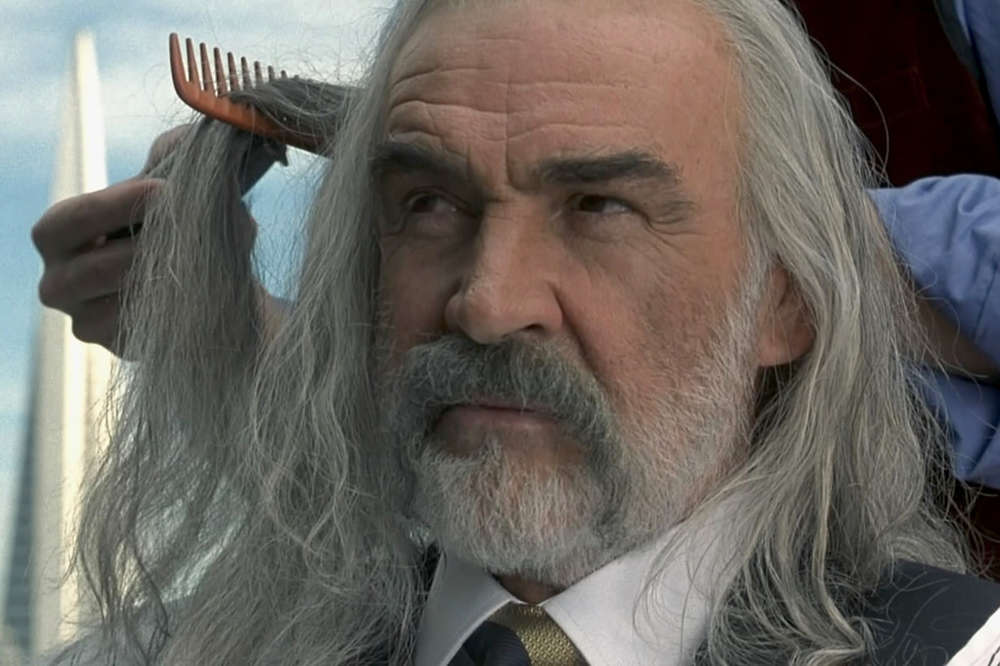
His character has made a distinguished career as an escape artist. But now he’s under lock and key in an ultra-modern federal prison. He spends his days reading philosophy and Shakespeare and growing out his hair …


… until the FBI comes asking for his help. You see, many years ago, he was the only prisoner to escape alive from the Rock. Now he’s the only person who can find his way through Alcatraz’s maze of tunnels. Only he can guide Nicolas Cage and the team of impatient Navy SEALs who have been tasked with neutralizing the chemical weapons and rescuing the hostages.

The Bureau doesn’t like Connery one bit. He’s too cocky and too British. He knows too many U.S. government secrets. But, in this situation, he’s indispensible.

Whether he can get along with Cage is another matter.

They expertly hurtle wisecracks at one another. This is the best thing about the movie.

It’s almost worth the two hour, sixteen minute runtime. Almost.

♦ ♦ ♦ ♦ ♦

Let’s skip ahead:

Car chase …

Car crash …

San Francisco streetcar crash …

Explosion …

Scuba diving peril …

Gunfight …

So, there are a lot of action sequences, but they aren’t very gratifying. In a good action sequence, you can see why each character comes to make each move. The action sequences in The Rock are mostly haphazard. The protagonists point and shoot at nameless enemies who may as well be zombies. Complications don’t emerge from the logic of the situation. They are random. They are often played for laughs. (Consider the early chase sequence in which a little old lady crosses the street in front of a speeding car.)

The Rock is dressed up as an action movie, but, fundamentally, it’s a buddy comedy. Its physical wit is undistinguished.

Its verbal wit is better.

In the bowels of the Alcatraz prison, after the SEALs have all been killed, Connery and Cage achieve mutual understanding:
CONNERY: Are you sure you’re ready for this?

CAGE: I’ll do my best.

CONNERY: Your “best!” Losers always whine about their best. Winners go home and ---- the prom queen.

CAGE: Carla was the prom queen.

CONNERY: Really?

CAGE [cocking his gun]: Yeah.

I would’ve said that the poison-gas scenario is ridiculous, except I’ve been reading Michael Lewis’s book The Fifth Risk. It’s about how the U.S. government keeps in check lots of security threats comparable to the one in this movie. (It’s also about how the current administration has been foolishly defunding scientific research that most politicians don’t even begin to understand.)

So, it turns out, the movie is probably more realistic than most people would have guessed.

♦ ♦ ♦ ♦ ♦

The Rock was the high point of Michael Bay’s directorial career. His Armageddon (1998) was worse. I haven’t seen his Transformers series, but I gather those movies were much, much worse.

So, even the lousy movies of 1996 were much better than their more recent counterparts.

(Link.)

Thank you, Sir Sean. Thank you.

Rest in peace.

P.S. See, also, my review of DragonHeart.