Posts

Showing posts with the label FIFA (organization)

Body-text fonts, pt. 53: Equity

… which is Matthew Butterick’s update of the classic Ehrhardt typeface.

Equity (darker version; lighter version) is excellent – and underused. I’ve seen it “out in the wild” only in books by Butterick or by his enthusiasts: e.g., in Bryan A. Garner’s Legal Writing in Plain English.


(Of course, Ehrhardt already is good enough for most uses. Perhaps Equity is superfluous.)

♦ ♦ ♦ ♦ ♦

Equity is this month’s featured font because private equity is in the soccer news. Infantino is trying to make room for investors – Trump associates! – to buy a substantial share in FIFA’s tournaments.

Some FIFA member nations expect to benefit from the deal. Others – those that have no trouble paying for their soccer operations – staunchly oppose ceding business control to outsiders.

The European nations have resolved, unanimously, to boycott all FIFA competitions unless Infantino’s proposal is withdrawn or voted down.

I hope they get their way – without the boycott. I am not taken with Europe’s “principles.” Europe has a long history of thinking itself too good to play with anybody else.

Tim Vickery, in this video, explains:


Vickery’s diagnosis and proposal are very nearly my own, and so I’ll leave the matter there. But this is not to treat it lightly. The World Cup’s continuance is in danger.

Surely the Second Coming is at hand.

♦ ♦ ♦ ♦ ♦

P.S. Tens of thousands of Moroccans illegally crossed into the tiny Spanish semi-exclave of Ceuta yesterday. Spain and Morocco, along with four other countries, are slated to host the 2030 World Cup together.

Canada 0, Morocco 3; Mexico 2, England 3; USA 1, Belgium 4

So, the co-hosts of this rotten World Cup have been eliminated, pop-pop-pop, in the same early knockout round, and I couldn’t be more pleased; I’ve waited eight years for this moment. Canada, I fault only for having joined a corrupt alliance. (I didn’t much like how the Canadian team played, but put let’s put that aside.) Mexico, I fault for having long ago entered into faustian hosting arrangements with the United States, in this World Cup and in other tournaments; for having greedily sought to host the World Cup a third time, ahead of countries that haven’t had a turn; and for gross inhospitality. All of Ecuador cheered when England beat Mexico. I certainly did, even though I cheer for England as little as possible (just three times since the 1998 World Cup).

As for the USA, well, it may not be gracious to “pile on,” but certain matters must be addressed. If you don’t know the immediate context, you can read about it here or in countless other sources.

Know this, at least: a certain U.S. politician admitted – bragged – that he’d interfered in a supposedly neutral disciplinary process.

As it turned out, the meddling hurt rather than helped the intended beneficiary. The U.S. team already was out of sorts when it took to the field against the Belgians. Those opponents carved up the U.S. with professional, surgical precision – until the last minutes, when the ball was trickling into the U.S. goal every which way; then, they unleashed the “Trump” dance.


It’s gratifying to see on-field retribution. But the urgent lesson is that stricter and more explicit rules against political interference must be adopted, or else matches themselves will lose whatever credibility they once had. (Today, undue controversy surrounded Argentina’s victory over Egypt.)

Moreover: in a better world, certain FIFA officials would be impeached. And a certain country would be barred from the World Cup, for at least as long as the Chileans were barred in the early 1990s for their procedural violation.

It might be objected that in the present case, the politician’s meddling backfired, and so no harm was done. I couldn’t disagree more. A legal analogy: specific instances of bribery, intimidation, or jury tampering might backfire; but they should be punished anyway, because such offenses corrode the integrity and the trustworthiness of the court.

Mexico 2, Ecuador 0; Portugal 2, Croatia 1; predictions

Still he was a pius man in his way and found relief in prayer.
(Daisy Ashford, The Young Visiters)

We lost because Mexico was the home team. It pretty much boils down to that.

Mexico shouldn’t have hosted this tournament, but that’s a topic for another day.

♦ ♦ ♦ ♦ ♦

To my dismay, I’ve been driven very close to embracing a conspiracy theory.

Not because Ecuador lost, but because of how Portugal beat Croatia. A penalty kick was bogusly awarded to the Portuguese; later, Croatia’s tying goal was disallowed due to a tiny spike on a chart. The spike indicated an otherwise undetectable touch registered by a chip inside the ball.

Not even video review could corroborate it.

It’s not that I don’t believe the technology works. It’s that I’m not convinced that this chart isn’t a fabrication.

(It doesn’t help that this technology’s only other beneficiary has been Real Madrid, for a notorious judgment that decided a Champions League series.)

Or, to retreat just a little, a Croatian who chose to doubt the chart would be within his rights.

♦ ♦ ♦ ♦ ♦

Enough lamenting (for now). These are my predictions for the rest of the tournament (see the bracket). I may revise them after the round of 16, should Spain lose to Portugal, Norway to Brazil, or Colombia to Switzerland.

The Belgium/​USA match is hard to predict, too, but its winner shouldn’t last longer than one more round.

Morocco over Canada

France over Paraguay

Belgium over the USA

Spain over Portugal

Norway over Brazil

Mexico (at home again) over England

Colombia over Switzerland

Argentina over Egypt

France over Morocco

Spain over Belgium

Norway (unless undone by Miami’s heat) over Mexico (no longer at home)

Colombia over tired-looking Argentina

France over Spain

Colombia over Norway

Spain over Norway (or vice versa; it’s just a consolation match)

France over Colombia

Body-text fonts, pt. 49: ITC Garamond

The Iranians are trying to have their World Cup games moved from the U.S. to Mexico.

Good. Luck.

♦ ♦ ♦ ♦ ♦

Six-year-old Samuel, whom we don’t allow to use social media, has been talking about giving up social media for a week. 🙄

Not for Lent’s sake. For a Klondike bar. (“What would you do for a Klondike bar?”)

♦ ♦ ♦ ♦ ♦

Chubby ITC Garamond is this month’s typeface. (This link is to the darker version, and this link is to the lighter version.)


My children are less “Charlie Bucket,” more “Mike Teavee.”

R.I.P. “Minnie”

… a.k.a. Cinnamon Sprinkle, a.k.a. Cinnamon Sparkle: Cornell’s beloved miniature horse, who arrived on campus the year I moved away. (See, also, this earlier piece.)

Now that’s the kind of alumni reporting I’d like more of.


Had I known Minnie was at Cornell, I would have taken Karin to see her when we traveled to campus for my PhD defense.

♦ ♦ ♦ ♦ ♦

Happy New Year. Today, the USA attacked Venezuela and captured its head of state.

All day long, I worried about geopolitics, not least about soccer.

What will FIFA do about the World Cup? It would be consistent to ban the USA, since Russia is banned for attacking Ukraine.

If only.

What will CONMEBOL do about the Copa América? The USA is a hosting candidate but has just attacked a CONMEBOL member.

I went on Facebook to see what my “friends” are saying about the attack.

The Ecuadorian church leaders are silent. I don’t object to that. Not everything needs to be discussed.

Other Ecuadorians are making jokes about Venezuelans. Many Venezuelan refugees live in Ecuador. The jokes hint that now is the time for Venezuelans to return en masse.


(A Venezuelan says goodbye to her Ecuadorian sugar daddy.)

My U.S. “friends” who used to live in Ecuador are debating whether the coup is a canny U.S. foreign policy move; whether it’s good for Venezuela; whether Venezuelans, in preponderant numbers, support it; whether Maduro was entitled to rule; and whether “individualism” is better than “collectivism.”

I’ve seen none of these “friends,” none of them, say anything like this:

The geopolitical order is an order of sovereign states. An order of sovereign states forbids particular states from unilaterally attacking other states and deposing their leaders, even bad leaders.

It’s amazing how this simple norm, so dear to Latin Americans – including Venezuelans (even, I daresay, opponents of Maduro) – appears not to figure in ex-missionaries’ thinking.

What were they doing in Ecuador, all those years?

Not reading the room, it would seem.

A World Cup venue

British tabloids have reported – although, as far as I know, FIFA hasn’t confirmed – that the 2026 World Cup final will be played in Arlington, Texas.

Well, why not. A bloated stadium to cap off a bloated World Cup.

“Is Arlington, Texas, the largest city in the US without mass public transit?

“Yes. …

“Voters have rejected proposals to create public transit three times since 1980.”

Too bad. I guess I’ll have to ride an Uber to the game.


Another good anti-war essay

Karin: “Did you trim your mustache today, Sweetie?”

John-Paul: “No, Sweetie.”

Karin: “I thought you might have left it long, to show your support.”

John-Paul: “You mean for Andy Reid?”

Karin: “Yes, ha, ha.”

John-Paul: “Yes, that’s right, and that’s why I got fat again, too.”

♦ ♦ ♦ ♦ ♦

Tonight’s essay, by Richard Norman, is “The Case for Pacifism.” It takes the “skeptical” approach: it argues, first, that in the absence of a compelling justification, large-scale killing can be presumed to be wrong; and then that the best purported justifications of large-scale killing are not compelling enough. Finally (pp. 208 and 209), it addresses the lingering conviction that there are situations in which fighting nonetheless cannot be avoided:
If we can pin down the sense of the statement “We have no choice,” we may be in a position to understand why pacifism remains difficult to accept. …

When people say that one sometimes has no choice, what they mean, I think, is that by refusing to fight, say, against aggression, or indeed against internal oppression, one is acquiescing in a very great evil, and by acquiescing in it one is tacitly endorsing it. Morally speaking, faced with that evil, we have no choice but to resist it, and if the only way to resist it is to fight, then we have no choice but to fight.

Now this reading of the situation might be challenged. … One might say: “I have not acquiesced in Nazism. I refuse to engage in military resistance to it, … but that does not mean that I accept Nazism. I reject it wholeheartedly, I will give no support to it, and if the Nazis order me to cooperate with their crimes I shall disobey even though I may be shot.” …

Nevertheless, even if many people had thought and acted thus, it could remain true that, in an important sense, Nazism had not been resisted. This is because resistance to a social phenomenon such as aggression or oppression must, if it really is to count as resistance, take a socially identifiable form. … What forms of resistance are available will therefore depend upon the institutions and traditions of the community; and if the only recognised and organisable form of resistance is military resistance, then not fighting will mean not resisting. This, I think, is the significant sense in which people could say “We have no choice but to fight.”
This is another case of a pacifist explaining more clearly than do most “bellicists” (war apologists) how warring might continue to seem good, or necessary, to do, even after the usual justifications alluding to rights and harms have run out of steam.

Norman’s reconstruction of this bellicist argument has other applications. The same pattern of reasoning helps to make sense of a popular “anti-racist” claim: that failing to actively resist racism is itself a form of racism: that a person who merely refrains from engaging in racial discrimination, disrespecting, harming (etc.) and does not actively try to prevent or counteract others’ racism is himself guilty of racism. The underlying idea, as in the case of war, is that refraining from doing an evil without trying to prevent or counteract others’ doing it is a form of acquiescence, and that acquiescence in this evil is tacit endorsement of it. Each of these steps might be contested; here I just want to point out that insofar as “anti-racism” and advocacy of war both rely on this pattern of thought, they are structurally similar, and there is a prima facie tension in endorsing “anti-racism” together with pacifism; indeed, there would seem to be a tension between accepting pacifism and insisting on the viciousness of failing to promote a number of causes. Pacifists who, by temperament or habit, are militant activists need to examine themselves closely.

I said last time that I’d discuss “the encroachment of politics upon the sporting world.” It seems to me that the best argument for stripping a locale of its opportunity to host or participate in a sporting event is the same sort of argument that Norman advances on behalf of warring, and that whether the argument succeeds in a given situation depends on whether the above-delineated sequence of steps should be accepted in that situation. If Qatar, say, commits an injustice outside of sport, does allowing it to host the World Cup amount to acquiescing in that injustice? If so, does this amount to tacitly endorsing the injustice? How does allowing Qatar to host the World Cup compare, as a matter of tacit endorsement of injustice, with traveling to Qatar, trading with Qatar, maintaining diplomatic relations with Qatar, and so on? I suggest that this is a useful framework for assessing the widespread, knee-jerk disparagement of Qatar’s World Cup (and FIFA) that has taken place during the last dozen years.

Ecuador 2, Qatar 0; England 6, Iran 2; tornadoes

I had to wait twenty years to see Ecuador play for the first time in a World Cup. I lived through five World Cups before Ecuador ever qualified for one. Oh, the shame and helplessness of those years.

Samuel and Daniel saw their very first World Cup game yesterday, and Ecuador played in it.

Ecuador scored the first goal after three minutes. Stephen and I jumped up and yelled and celebrated. Samuel and Daniel were startled. They cried.

Then the goal was disallowed because a player was offside.

Stephen and I couldn’t see the infraction – not even after the replay was shown. I gather that 99% of the world couldn’t see it, either. That doesn’t mean it didn’t exist. Offside is decreed by technology now. Good thing, because if a human referee had decided that we were offside on that play, FIFA and the host nation would have lost all credibility.

In any case, fútbol-wise, Qatar was doomed. Ecuador was better by about ten miles. The only question, at that point, was whether the referee would permit Ecuador to win.

Then, after twelve minutes, he awarded Ecuador a penalty kick. (He couldn’t have done otherwise, really.) He should have shown Qatar’s goalie a red card, but, understandably, he let the host nation off the hook.

Enner Valencia, who had been missing his penalty kicks in recent games, calmly scored. Stephen and I were quiet this time.

The rest of the game was a walk-through for Ecuador. The Qataris were rattled and simply awful. The Ecuadorians were more cautious than I should have liked. Valencia scored again later in the half, and then Ecuador rested. Or tried to; Qatar kept on fouling.

The Ecuadorian supporters could be heard cheering. Many Qatari supporters left at halftime.

In this video, one of the soberer analysts on U.S. television describes the Qatari exodus. Some of the numbers he cites seem off, but the lesson is clear enough.


How valuable was this victory? We got the points. We regained some confidence after a series of lackluster practice games. Our main scorer regained his form. Were we good? Impossible to say. Qatar was so, so bad. We could have tried harder to score more goals, but it was crucial to rest and calm down. The games against the Netherlands and Senegal will be very hard.

This analysis is fair.


For one day, we led the whole world in the standings – something which also happened during the 2006 World Cup. Then, this morning, England beat Iran 6 goals to 2. Iran looked miles and miles better than Qatar.

Here is Un mundo inmenso’s take on this World Cup.


Now, something different. Samuel asked to watch more tornado videos, so I put on Netflix’s series Earthstorm. It has the best tornado footage I’ve seen. I highly recommend it.

We are punished

Less than a fortnight before Ecuador is due to play in the World Cup, the Court of Arbitration for Sport (TAS) has ruled on the Byron Castillo case.

Castillo’s Ecuadorian citizenship has been reaffirmed, for the obvious reason – cited earlier by FIFA – that it’s up to the Ecuadorian government whether Castillo is a citizen. It was legitimate for Ecuador’s soccer team to field Castillo. No points earned in the 2022 World Cup qualification tournament are to be deducted. Ecuador will play in this World Cup, as scheduled.

But the TAS also has ruled that Castillo was born elsewhere and earlier than his passport says. So, although his citizenship and his eligibility to play are not objectionable, his documentation is. What is more, the TAS explains, the Federación Ecuatoriana de Fútbol (FEF) “is liable for an act of falsification … even if the FEF was not the author of the falsified document but only the user.”

The TAS grounds this on FIFA’s Disciplinary Code (the 2019 edition, presumably), article 21, paragraph 2:
An association or a club may be held liable for an act of forgery or falsification by one of its officials and/or players.
As punishment, Ecuador will be fined and must begin the next World Cup qualification campaign with a three-point deficit. That’s the equivalent of a three-draw or single-victory head start for each of Ecuador’s competitors. (Goal differential – and other tiebreakers – aren’t affected.)

♦ ♦ ♦ ♦ ♦

How sensible is this ruling? For argument’s sake, assume that Castillo – or his parents or other representatives – indeed gave false information so that he could obtain his citizenship papers.

The TAS’s ruling is consistent with the letter of FIFA’s Disciplinary Code. But a lesser punishment, or no punishment, also would have been consistent with the Code. An association may be held liable, the Code says. That is, punishment is optional; it should be determined on a case-by-case basis (and, eventually, by precedent).

Now, to take the word “may” so seriously is to interpret the Code rather literally; but then, a ruling against Ecuador depends on a severely literal reading of the Code. (Think of this as a “pound of flesh” sort of case.) As it is written, the Code says nothing about whether it matters if the party in question deliberately “used” a falsified document. But it seems that deliberate “use” was the Code’s target: it’s what the rule-makers evidently wished to discourage or punish (see paragraph 1 of the Code’s same article). And the TAS hasn’t determined whether Ecuador intentionally “used” a falsified document – at least, this isn’t stated in the ruling.

It behooves the authorities to be lenient on this occasion. The TAS is now imposing a harsh punishment for what hasn’t been proven to be anything worse than an unintended error. But this sets a fearsome precedent. How many other clubs or countries might be found similarly liable for failing to reject a false claim in this or that player’s papers? More than a few. And if this case becomes a precedent – as it must, if judgments are to be consistent – other cases would demand punishment than those involving “uses” of eligibility-determining falsifications. The present ruling makes it explicit that Castillo took the field eligibly. Ecuador’s punishment is for falsification, full stop – not for falsification-in-order-to-field-an-ineligible-player.

For insance, precedent would dictate that:

If a player lies about his birthday (height, weight, address, criminal record, etc.) but not his parentage, birth country, or any nationality-determining facts;

and if the falsehood is printed on his papers;

and if his country’s soccer association, acting in good faith, or in compliance with its national government, treats those papers as proof of the player’s citizenship;

then the soccer association must be harshly punished.

♦ ♦ ♦ ♦ ♦

There’s at least one other, perhaps more egregious, problem with this ruling. Again: FIFA’s Disciplinary Code only states that an association may be held liable for the offense of falsification. The Code doesn’t require FIFA to hold an offender liable; precedent, or some other consideration, would have to be adduced to generate such a requirement. Indeed, in its June ruling, FIFA refrained from holding Ecuador liable.

In so doing, FIFA acted in conformity with its Code. As far as I can see, then, without precedent, there is no basis for a higher court to overturn FIFA’s ruling; it was within FIFA’s discretion to rule as it did.

We are sued, pt. 2

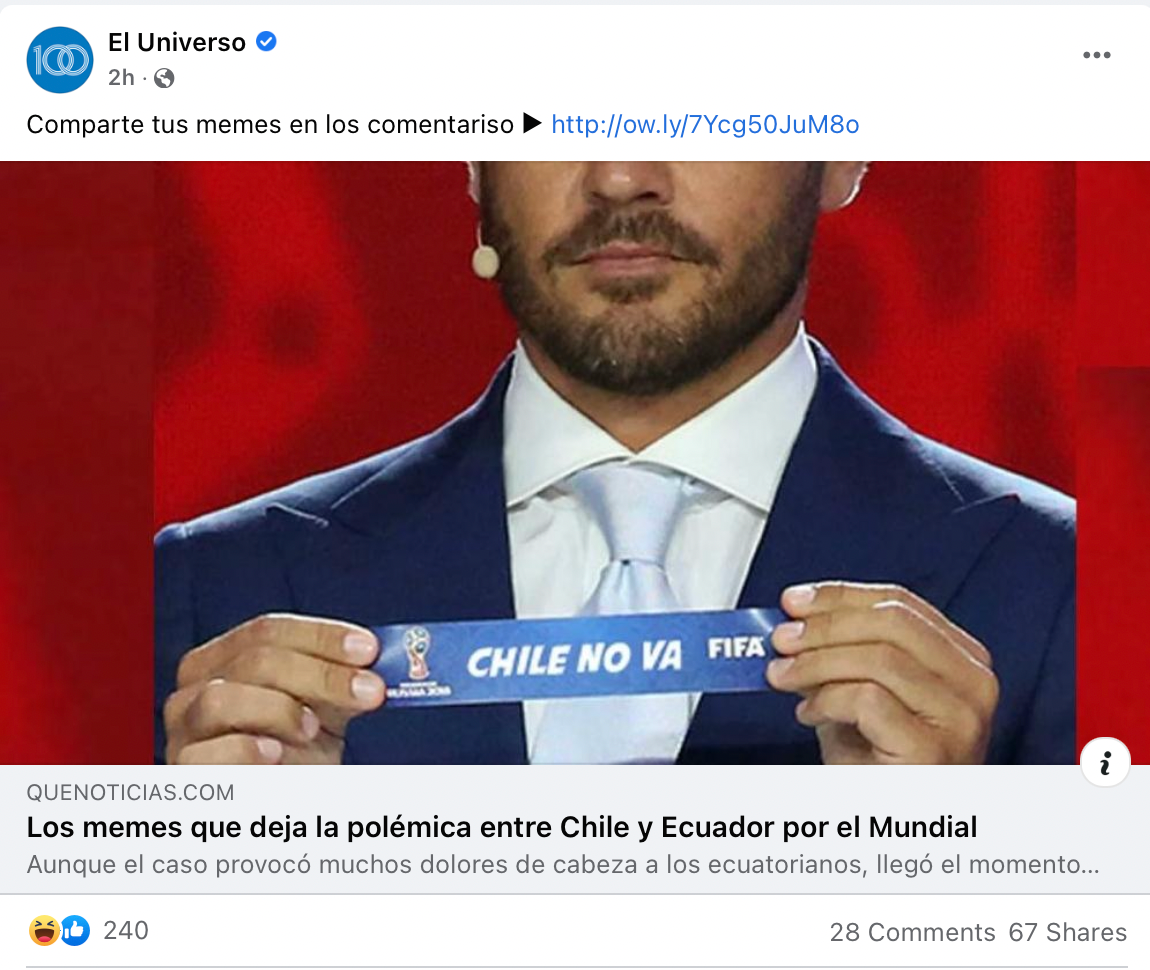
FIFA has judged in favor of Ecuador and Byron Castillo, and against Chile.


These are the reasons: (1) FIFA doesn’t oppose nations’ citizenship rulings, and Castillo had obtained the relevant documents from the Ecuadorian government; (2) Ecuador had previously consulted FIFA about including Castillo in its roster; and (3) Castillo had played for Ecuador’s youth teams, affiliating himself with Ecuador in FIFA tournaments.

I take it that each of these reasons establishes a strong presumption in Ecuador’s favor. (1) or (2) might even be regarded as conclusive.

Case closed.

Well, not quite. Chile could ask FIFA’s board of appeals to review the case. Or Chile could appeal to the Court of Arbitration for Sport, more commonly known by its French initialism, TAS. It was the TAS that ruled for Chile and against Bolivia during the 2018 World Cup qualification cycle.

But it seems likely that Ecuador, not Chile, will play in this year’s World Cup.

As will Iran.


(Stephen shared most of these links and memes with me.)

Castillo intends to counter-sue the Chilean soccer federation.

♦ ♦ ♦ ♦ ♦

R.I.P. Vangelis (d. May 17) and Julee Cruise (d. June 9). Two musicians of whom I’m fond, not least because they’ve so often lulled my sons to sleep.

We are sued

It’s time to discuss the lawsuit that Chile has brought against Ecuador and our starting right-back, Byron Castillo. This suit jeopardizes our participation in the World Cup.

Castillo is accused of having lied about his nationality. Ecuador is accused of having fielded him ineligibly in eight World Cup qualification games.

What if Castillo and Ecuador are judged to be at fault?

Ecuador would forfeit all the points earned in those eight games, or else would be disqualified outright. And perhaps banned in the future. Which would be the worst outcome of all.

♦ ♦ ♦ ♦ ♦

Who would benefit, then?

Here are two possibilities.

(1) The most obvious one is this. The Chileans, having been awarded the five points that they failed to earn in two games against Ecuador, would ascend to fourth place and qualify for the World Cup. Ecuador, points-poor, would have its qualification rescinded.

The precedent for this outcome was set during the qualification cycle of the 2018 World Cup. Chile and Peru were awarded points deducted from the Bolivians, who had fielded an ineligible player.

(Peru, not Chile, ultimately qualified.)

(2) Other nations with more clout than Chile also covet Ecuador’s place. One possible scenario involves Ecuador being disqualified outright and Italy qualifying for the World Cup.

But isn’t Italy in a different confederation?

Yes.

Wasn’t Italy eliminated by North Macedonia, even before the last European playoff round?

Yes.

Then why Italy?

Because the Italians are the world’s best-ranked eliminated team. By this criterion, they’re the most deserving eliminated team. More deserving than North Macedonia, the team that beat them.

If this reasoning sounds ad hoc to you, well, it is. But I’m not surprised that this option is being discussed.

It wouldn’t be the first time FIFA’s (highly dubious) rankings played such an important role.

♦ ♦ ♦ ♦ ♦

All right, so much for the possible consequences. What merit have the charges?

They have been described elsewhere. Their gist is this. Castillo is alleged to have been born in Colombia, not Ecuador. There is an Ecuadorian birth certificate for Byron Castillo Segura; but, also, there is a prior Colombian birth certificate for Byron Castillo Segura.

I have seen this accounted for. The explanation is not described in the linked article, though perhaps it is alluded to in the title (“Could Ecuador Really Be Thrown Out of the World Cup Over ‘Ghost’ Castillo’s Identity Scandal?”). Castillo’s brother was born in Colombia and died young. A few years later, Castillo was born in Ecuador and given the same first name, but not the same middle name, as his brother.

Ecuadorian officials have long been uncertain about Castillo’s earliest documents. They investigated the matter for several years. Finally, in 2021, they cleared him to play for Ecuador.

What’s beyond dispute is that Castillo has lived in Ecuador, as an Ecuadorian, since he was very young; that he has had up-to-date citizenship documents for some years; and that the government recognizes him as a citizen.

♦ ♦ ♦ ♦ ♦

This is the fourth time the Chileans have sought a judicial ruling that would usher them into a World Cup.

In the cycle of 1971–1974, this tactic worked, but in those of 1987–1990 and 2015–2018, it backfired spectacularly.

“Chile: Entering through the Window?” – a YouTube video that expains this history. (Spanish only, I’m afraid.)


From what I’ve seen, the world isn’t favorably impressed with Chile.

♦ ♦ ♦ ♦ ♦

What really bothers me is this. Suppose, for the sake of argument, that Castillo was born in Colombia, that his documents weren’t in order, and that Ecuador is complicit in covering this up. Not good. Procedure ought to be respected, and the truth ought not to be kept hidden. But … here are all these rich European countries, fielding players born in their former colonies, excelling in and even winning tournaments with these players, and no one brings a legal challenge; no one says, it’s grossly unjust that England, France, the Netherlands, Portugal, etc. continue to gain advantage from their history of colonialism. But when a family moves from one poor country to another, and the second country takes in that family as a matter of compassion, conscientiousness, or neighborliness, as it habitually has done and continues to do … then, to preserve their advantage, richer countries pounce, saying, Aha! your paperwork is not in order, as if what a government deemed acceptable for the day-to-day purposes of citizenship weren’t good enough for this citizen to represent his country in the World Cup.

A golazo; a band; a recitation

I forgot to share this golazo by Damián Díaz of Barcelona.


Cheeky.

Díaz had just taken a penalty kick, Panenka-style. The goalie had blocked it. This corner-kick goal was Díaz’s revenge.

People are talking about a Puskás nomination. Díaz would be the second Ecuadorian nominee in three years.

♦ ♦ ♦ ♦ ♦

For two days, Karin has been working, and I’ve been at home with the children. Samuel seems a smidgen more helpful, more patient, than before.

And Daniel? He enjoys drinking milk and listening to music. Classical and New Age, mostly.

His favorite band is the German outfit B-Tribe.


Samuel loves B-Tribe, too.

I have taught him to recite this:

“Sammy and Danny: two little boys. Sammy and Danny: best of friends.”

The Super League

So, apparently, twelve ultra-rich European clubs have decided to form a breakaway competition called The Super League which is to rival the UEFA Champions League.

Motto: “The best clubs. The best players. Every week.”

The inaugural chairman will be Florentino Pérez, the president of Real Madrid – the world’s most powerful club thanks to the backing of General Francisco Franco.

Among the four inaugural vice-chairmen, three are U.S. sporting owners who happen to control Arsenal, Liverpool, and Manchester United. The company JPMorgan Chase (also U.S.) is reported to be the League’s foremost lender.

Nearly everybody who cares about soccer is outraged by this blatant “gated community”-style hijacking of the sport. Even horrid British P.M. Boris Johnson issued a powerful statement against The Super League.

What many of us hope from FIFA, UEFA, and the relevant domestic associations is that they ban these clubs and their players from all other competition.

Certainly, if this league goes forward, I’ll never watch any of its clubs again.

Stir-crazy, pt. 2

Happy Easter. A strange Easter. A cartoon in my Facebook feed shows Jesus emerging from the tomb, peering out from behind the stone; a police officer threatens to ticket Him lest He spread disease. (By this point, Jesus surely is immune; but who’s to say His R0 must be zero?)

We turn, increasingly, to the Internet, and it responds with some generosity. On YouTube, we watch sermons, and FIFATV makes available classic matches. Spotify now permits the streaming of these calming albums:
(Tonight, Samuel sleeps to Marvin Gaye and the bird and the bee.)

Old churchgoing ladies have mailed cards and money to us without our asking. Other people have brought food. One brought a bag of apples – which we seldom eat; Karin sauced them. Another person lent a rake for yard work. In the back yard, where I’ve yet to even set foot, twigs accumulate from the trees, and the grass grows after rainstorms. Then the weather cools again.

A modest proposal

Another soccer final has been ruined by a referee’s decision to award a penalty kick.

In the first minute of the UEFA Champions League final, the ball ricocheted off the chest and then the upper arm of the Potato Tots’ Moussa Sissoko. (He’d extended his arm to gesture to a teammate.) The referee blew the whistle for the penalty kick.

A deliberate handball? Not a chance.

A penalty? Alas, by today’s refereeing standards, yes. The operators of the Video Assistant Refereeing system deemed the call not controversial enough to review.

(Here are some TV pundits disagreeing about the rule. As usual, Alejandro Moreno makes a jackass of himself.)

After converting the penalty, Liverpool – usually one of the most proactive teams in the sport – sat back and “parked the bus” of defenders in front of the attacking Potato Tots.

A game-long slog ensued. Finally, with just a few minutes to play, Liverpool scored again.

♦ ♦ ♦ ♦ ♦

In soccer, a single goal is momentous. It releases enormous tension. It affects all subsequent developments. But VAR has multiplied the number of penalty kicks awarded, and hence the number of goals scored, cheapening their value. And now the rules have been changed so that every handball, intentional or not, that occurs inside the handler’s box is to be punished with a penalty kick.

With this policy, and with VAR to enforce it, we should expect games to have penalty kicks awarded in them more often than not. That is, we should expect games to have more goals – and of the cheapest kind.

We should expect shooters to aim at defenders’ arms rather than at the goal. (Certainly, the Liverpool forward wasn’t aiming toward the goal when he kicked the ball at Sissoko.)

We should expect goals to be scored quickly – before either team has fully implemented its attacking strategy.

We should expect a scoring team to adopt tedious “bus-parking” tactics earlier in the game.

♦ ♦ ♦ ♦ ♦

Therefore, I offer a modest proposal for handballs committed by non-goalkeepers:

(1) Let every handball that occurs outside the handler’s box be governed under the old rules.

(2) Let every clearly intentional handball, inside or outside the box, be punished by carding, according to the old rules.

(3) Let every handball that occurs inside the handler’s box, whether intentional or not, be punished, as the new policy requires. But let the punishment be an indirect free kick inside the box, not a direct penalty kick.

Exception to (3): Let a direct penalty kick be the punishment for an unintentional or intentional defensive handball that results straightforwardly from an indirect free kick taken by an attacker inside the box. (Here, we’ll have to make a somewhat arbitrary stipulation, e.g., that a defensive handball results “straightforwardly” from an indirect free kick taken inside the box just in case, after the initial kick but prior to the ball’s touching the hand, the ball doesn’t leave the box – or something along those lines.)

This is the best rule combination I can think of. But I wouldn’t mind if FIFA simply went back to the old rules that focused on intent.

I also would accept this option:

Let FIFA’s new rules remain in effect, with the additional stipulation that all direct penalty kicks for handballs be taken by Martín Palermo.

Update: Perhaps the exception to (3) should include all free kicks, not just indirect free kicks taken inside the box, to discourage defenders from using their hands to block free kicks taken outside the box.

With this in mind:

Let a direct penalty kick be the punishment for an unintentional or intentional defensive handball that results, inside the box, straightforwardly from a free kick taken by an attacker, where a handball is understood to have resulted, inside the box, straightforwardly from a free kick just in case, after the initial kick but prior to the ball’s touching the hand, the ball touches no player outside the box.

La final del mundo

Today, I went to Stephen’s apartment to watch the last game of the Copa Libertadores – which, this year, is called “La final del mundo” by the Argentinian press, since the participants are the two most popular Argentinian clubs, River Plate and Boca Juniors. Stephen & Edoarda arrived at the apartment exactly when I did, just before the scheduled kickoff time. They’d rushed over from Chicago, into which they’d flown from Austin, where they’d spent Thanksgiving.

Well, they needn’t have hurried. Like the previous game, this one was postponed. Some fans of River Plate had thrown rocks at Boca Juniors’s team bus, breaking a window. Allegedly, the glass had cut one of Boca’s players in the eye, and his injury had been aggravated by teargas that the police had discharged.

♦ ♦ ♦ ♦ ♦

And so we watched for two and half hours while the Argentinian broadcasters speculated whether the game would be played today or postponed until tomorrow.

The fans remained inside the stadium.

♦ ♦ ♦ ♦ ♦

The air was thick with rumor. At first, Boca’s players were said to be eating steak sandwiches in their locker room, which suggested that they didn’t expect to play.

But then the kickoff was rescheduled for a slightly later hour. Fernando Gago and Carlos Tévez – Boca’s two most famous players – came out of the locker room to plead for a longer postponement.

The clubs’ presidents were said to be holding meetings with the presidents of FIFA and CONMEBOL (the South American footballing confederation). If they intended to postpone the game until the next day, why were they waiting so long to do so? Why were they allowing the fans to continue suffering inside the stadium?

Was Boca’s president urging River’s disqualification? Was he holding out for some lesser penalty, at least, such as a ban against River’s spectators?

It was suggested that the Boca player’s injury was less severe than the team was claiming. Yes, he’d been transferred to a clinic; yes, photos had been released of him wearing a gigantic bandage over one eye. Still, it was possible that he was feigning, as other players notoriously had done.

Moreover – and what was considered to be most ominous – CONMEBOL’s officiating doctor had refused to confirm the severity of the injury. (It was noted, however, that this doctor wasn’t an ophthalmologist.)

♦ ♦ ♦ ♦ ♦

Finally, the presidents agreed to hold the game the next afternoon. The fans left the stadium.

The president of CONMEBOL praised the collegiality of the two club presidents. He disavowed knowledge of the injured player’s precise medical state.

♦ ♦ ♦ ♦ ♦

It must be said that the main beneficiary of this scandal is CONMEBOL, which hopes to move the tourney’s final round away from the participants’ home stadiums and into neutral cities that would submit hosting bids.

♦ ♦ ♦ ♦ ♦

Update, Sunday: The game has been postponed again. The presidents are to meet on Tuesday, at CONMEBOL’s headquarters in Paraguay, to negotiate further.

A prank; a vote; a forthcoming event; a new tutee; Zlatan

We’re well into June. The high schools have had their graduations.

At the school where I used to work, the seniors did an especially good prank. They put LimeBikes everywhere inside the building.

It was effective because whenever a janitor would try to remove a bike from the school, the bike would play a recorded message, threatening to call the police.

Eventually, though, the bikes were brought out into the parking lot.


♦ ♦ ♦ ♦ ♦

Today, FIFA’s members voted to select the hosts of the 2026 World Cup.

They chose Canada, Mexico, and the United States.

Morocco was the losing candidate.

♦ ♦ ♦ ♦ ♦

David will arrive in South Bend tomorrow night. He plans to watch the first week or so of this year’s World Cup with his family.

The first game, Russia vs. Saudi Arabia, will be played tomorrow morning.

♦ ♦ ♦ ♦ ♦

At IUSB, my newest tutee is a middle-aged woman from Mexico. We held our first session today. Afterward, we tried to schedule our next appointment.

“Let me view my calendar,” I said, and I brought out the schedule of World Cup games.

My tutee immediately understood.

“Such-and-such hour is no good,” she said. “Two of Mexico’s group opponents play at that time.”

We agreed to meet at 10:00am, the hour of inactivity between the 8:00am–10:00am game and the 11:00am–1:00pm game.

She told me that two years ago, during the Euros, she’d been in the stadium when Zlatan played his last official match for his national team.

“I don’t have much regard for Zlatan,” she said. “I think Sweden has more success without him.”

I told her I thought Sweden’s success was beside the point.

“Well, my husband likes Zlatan,” she said. “I suppose you like Zlatan?”

“Zlatan is incredible. You should read his book.”

Apart from our disagreement about Zlatan, we had an excellent tutorial. I think she’ll be a very good student to work with.

Russia vs. New Zealand

I was eager to watch this game.

Gone from my thoughts was the flaccid Russia of last year’s Euros.

Gone was the blundering Russia of the 2014 World Cup, whose players, under Capello, were fearful.

I hoped to see the slick Russia of the 2012 Euros, the Russia that put four goals past the Czech Republic (before being dumped out of that tourney by the Greeks).

New Zealand, I thought, would be the ideal victim for such a Russia.

Unfortunately, I missed the first half. I got the kickoff time wrong and turned the game on rather late.

The Russians were ahead, 1–0, but only because New Zealand had scored for them. Empty seats blighted the stadium in St. Petersburg. From his V.I.P. box, Putin cast an irritated scowl.

As I watched, it became clear that these Russians were no better than, say, Peru. (The FIFA rankings have them beneath Venezuela, but that’s not right.)

The Kiwis were vastly worse, though. They looked like a team of schoolboys. Their only standout was their goalie, who made some startling saves. (His club, in Germany, is in the third division, and so I hope that this tourney brings him wider notice.)

But the onslaught could not be held back. Around the 70th minute, a neat maneuver resulted in a tap-in for the Russians. Such was what I’d hoped to see.

The gringos vs. FIFA

Old news: in Switzerland, the U.S. government has caused a dozen or so of FIFA’s bigwigs to be arrested.

No doubt these bigwigs are guilty of corruption. No doubt they’ve violated international law – or, under U.S. jurisdiction, U.S. law. I don’t know the details … but I’m sure the gringos can legally justify the arrests.

According to the Russians, this is just “another case of illegal extra-territorial implementation of American law.”

But I don’t think it is illegal. Or I’ll assume it isn’t, for discussion’s sake.

♦ ♦ ♦ ♦ ♦

Nor will it matter to what I’m going to say that the arrests are being done in a vindictive spirit.

What if the U.S., and not Qatar, had been awarded the 2022 World Cup hosting rights? Would the gringos have pursued the bigwigs? I doubt it.

But I won’t dwell on this.

♦ ♦ ♦ ♦ ♦

What interests me is how FIFA’s members will react to the arrests, and what all of this means for international tournaments.

FIFA’s members, the national soccer bodies, determine how FIFA is governed; and up until now, what they’ve done is to insist on FIFA’s (and their own) autonomy from sovereign states. No national soccer body is permitted by FIFA to be housed by an interfering state. A national soccer body is punished by FIFA if the state which houses it does not refrain from meddling in its affairs (and in those of the soccer bodies of other nations).

This is to preserve the integrity and voluntariness of the sport. FIFA wishes to arrange neither gladiatorial contests between slaves, nor “champion” warfare between nations.

Punishment takes the form of simple banning. FIFA isn’t going to confront anybody with planes and tanks, but it may disallow teams from playing in tournaments.

There are lighter bans, too.

For example, in 1993, the Aussie government refused to allow Diego Maradona to play against Australia in a World Cup qualifier. (Aussie law blocked convicted drug offenders from entering the country.) FIFA judged that this was an unwelcome political intrusion upon the sport, and threatened to move Australia’s home game to a neutral site. The Aussie government relented. Maradona was allowed to play.

Notice: the Aussie government could have permitted its soccer federation to receive punishment. Or, in protest, it could have withdrawn the Socceroos from the World Cup. It did neither of those things. It chose to refrain from enforcing the law of the state.

♦ ♦ ♦ ♦ ♦

Faced with lawbreaking, the U.S. government also could have chosen this option. But instead it has chosen to prosecute FIFA’s elected officials.

Let me stress that in the present case, the gringos aren’t just reacting to a crime. In effect, they’re enforcing their own idea of how FIFA should be governed, not minding that these officials were elected, wisely or foolishly, by FIFA’s other members.

Now usually when the U.S. government behaves like this, there is little that the opposition can do. But this time the opposition has a good deal of clout. The national soccer bodies have the power to impose some kind of ban against the U.S. Soccer Federation.

Will they do it? My guess is, no. Should they do it? Well, yes, if they want to preserve their autonomy from the states.

This is the situation. X, Y, and Z have long been coming together to hold a sporting contest – jointly deciding how to hold it. Those who won’t cooperate simply are left out. But now the godfather of one of the contestants is insisting, coercively, that the contest not be held in a certain way.

Suppose X, Y, and Z acquiesce. Whose contest is it, then? Is it still theirs? One thing, for sure: it’s the godfather’s. The participants, X, Y, and Z, are no longer making the decisions of this joint activity all on their own.

♦ ♦ ♦ ♦ ♦

Do the various national soccer bodies really want the gringos to have de facto veto power over them?

My guess is, they’ll put up with it, because the U.S. has a lot of political and cultural influence – as well as a lot of money, some of which will trickle down.

In effect, the soccer bodies will be selling out, again … and then again … and as long as they continue to allow the U.S. to have de facto veto power. And by selling out to this (de facto) administrator, they’ll be privileging one participant over the others; and not just for one tournament (as Qatar is being privileged for 2022) – or even for a handful of tournaments – but indefinitely.

If the soccer bodies set out to contain corruption on their own, they’ll at least be able to do it with some fairness. The sporting benefits of corruption will be spread out more or less evenly around the world. Contestants like Qatar will have fifteen minutes of glory, and that’s all.

But if the gringos have veto power over the governance of FIFA, the sporting benefits will skew towards them. I couldn’t specify the mechanism. But we all know how it’ll turn out.

♦ ♦ ♦ ♦ ♦

For the sake of sport, then, I think that what the gringos are doing is bad, and that FIFA will be shirking its sporting duty if it doesn’t punish them. This isn’t yet an argument about morality (though one may try to draw further moral lessons from it). Morally, is U.S. hegemony in global affairs a bad or a good thing? I know what I think about that, but I don’t have the time to discuss it here. It’s taken long enough for me just to hint at how tacky it is that the U.S. should dictate sporting justice. Moral justice is yet another problem.