Posts

Showing posts with the label law

Internet round-up: the Psmiths on class; Harper’s on Oklahoma universities; Leiter on ChatGPT

My favorite Substackers have reviewed Paul Fussell’s Class and applied its principles to today’s political landscape (and other things).

I get the vibe they’d read Class before.

If you haven’t read Class, you really ought to.

♦ ♦ ♦ ♦ ♦

From Harper’s’s “Weekly Review”:
Lawmakers in Oklahoma introduced a bill mandating that every state college erect a statue of [Charlie] Kirk in a “highly visible and easily accessible” plaza that bears the activist’s name.
The bill is here.

Just one more example of politicians trying to control what colleges say.

Kirk may have debated on campuses, but he wasn’t a faculty member or even a degree earner. And his work wasn’t scholarly. It didn’t try to adhere to the standards of any guild of experts.

I’d hope that no professional academic would wish to flaunt him as a symbol of what colleges and universities do.

Then again, a lot of schools are happy to put up statues of their football players. The state doesn’t even have to enforce that.

♦ ♦ ♦ ♦ ♦

Brian Leiter posts about how a colleague of his got a chatbot to write an “alarmingly competent” philosophical essay.

“How much trouble are we [academic philosophers] in?” Leiter asks.

I’ve never seen any undergraduate writing with the chatbot’s precise style, but (*shudder*) I’ve seen lots of PhD- and journal-level prose just like it.

So, yes, we philosophers – or, at least, those who aspire to a livelihood based on the production and evaluation of scholarship – are in big, big trouble. Because, with just a little input, robots can do those tasks now (or, if not now, soon). Not superlatively well, but well enough to impress the profession’s gatekeepers.

Worse: readers of philosophy are in trouble, and have been for some time, because so much scholarship makes the grade even though it sounds like it rolled off a conveyor belt. The prose is undistinguished, and stock “-isms” (contractualism! particularism!) are opposed or combined almost mechanically.

Were I a lawyer

… I might know what to think of terrifying essays like this one:


… which discusses the following measure in the One Big Beautiful Bill Act (OBBBA):
SEC. 70302. RESTRICTION OF FUNDS.

No court of the United States may use appropriated funds to enforce a contempt citation for failure to comply with an injunction or temporary restraining order if no security was given when the injunction or order was issued pursuant to Federal Rule of Civil Procedure 65(c), whether issued prior to, on, or subsequent to the date of enactment of this section.
“Translated,” Reich tells us, the measure ensures that “no federal court may enforce a contempt citation”:
The measure would make most existing injunctions – in antitrust cases, police reform cases, school desegregation cases and others – unenforceable.

Its only purpose is to weaken the power of the federal courts.

As Erwin Chemerinsky, UC Berkeley School of Law dean and distinguished professor of law, notes, this provision would eliminate any restraint on Trump.

“Without the contempt power, judicial orders are meaningless and can be ignored. There is no way to understand this except as a way to keep the Trump administration from being restrained when it violates the Constitution or otherwise breaks the law …

“This would be a stunning restriction on the power of the federal courts. The Supreme Court has long recognized that the contempt power is integral to the authority of the federal courts. Without the ability to enforce judicial orders, they are rendered mere advisory opinions which parties are free to disregard.”

In other words, with this single measure, Trump will have crowned himself king.

If it is enacted, no Congress and no court could stop him. Even if a future Congress were to try, it could not do so without the power of the courts to enforce their hearings, investigations, subpoenas and laws.
The House approved OBBBA by one vote. Suppose that after debating, revising, etc., the Senate and the House were to turn OBBBA – or some version of OBBBA containing this measure – into law.

Questions:

(1) Could judges strike down this measure as unconstitutional?

(2) If judges were to do this – and here my ignorance really shows – would they thereby strike down all of OBBBA?

Put differently, does a law behave like a logical conjunction that is shown to be false (invalid) if even a even single part is shown to be false (invalid)? Or might a law with some invalidated parts remain valid in its other parts? This is something people oughta know, but I don’t know it.

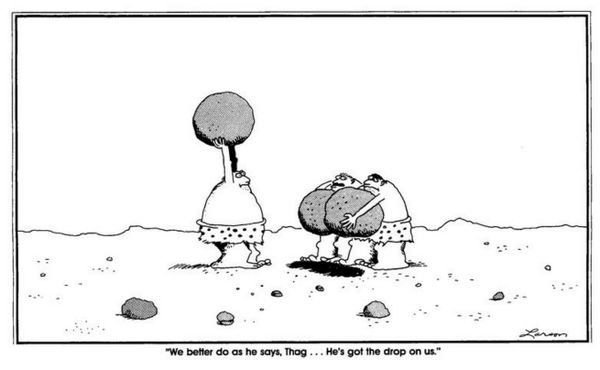
(3) Last question. If judges strike down a law that restricts judges’ authority to hold people in contempt, then they get to continue holding people in contempt. Right? Legally, they’ve “got the drop” on that law, right?

1996, the best year in movie history, pt. 86: The sweet hereafter


The spiderbitten little girl peers up at her father as he rides with her to the hospital. With one hand, he calms her; with the other, he grasps a knife to cut her throat that she might breathe, that he might not lose her. The girl survives. She grows up and addicts herself to drugs. Her father effectively loses her anyway. He’d once hoped for happiness with his daughter (and with her mother, from whom he also is estranged).

He thinks of the girl as he travels to a remote British Columbian town. A lawyer, he is recruiting plaintiffs for a class-action suit regarding a deadly schoolbus accident. Courting each household in turn, he trots out tired arguments for holding someone accountable, preferably a deep-pocketed entity, a municipality or a corporation rather than an individual. The more nebulous the scapegoat, the more eagerly the victims’ parents join the suit. They’re angry at a universe that has frustrated their expectations for their children, for themselves. (Just one parent resists this way of thinking. He already has had to grieve for a dead wife.)

Movies about grief are the hardest to watch. This is a hard movie. There are passages of startling beauty – flashbacks. They are not comforting. The camera hovers over wintry mountains and rivers, tracking the school bus as it wends toward disaster. Children play. They sleep. A teenager sings sweetly. The memory of these things is not sweet. All is embittered by the knowledge of how these lives will end.

The most piteous character is the lawyer (Ian Holm). The dark implication of his story, if I interpret it correctly, is that losing one’s children is the norm. They needn’t die; alienation suffices. But then, who’ll pay? Whoever is left to pay. Spouses. Neighbors. One’s town. Those with whom one does business. Anyone. The universe. Harboring vengeful thoughts, one becomes the prey of those who traffic in vengeance. The traffickers themselves are in vengeance’s thrall. This is this lawyer’s affliction.

The movie doesn’t object to vengeance as such. One character obtains it, and perhaps rightly: the teenager who sings so sweetly. The actress, Sarah Polley, performs a remarkable about-face. She is winsome, then ice-cold.


Maimed but not killed in the accident, this girl obtains new clarity about the false hope and love that her father (Tom McCamus) instilled in her. She avenges herself on him – and on the town. Arguably, her victims deserve their punishment. We have seen the town’s loyal spouses and its cheats, its wonderful parents and its abusers, equally bent out of shape by grief, equally desirous to inflict damage on third parties. One suspects that they grieve as much for their own frustrated ambitions as for the loss of their children. He would have been a good man, one townsperson, a sympathetic figure, says of a particular dead boy. Maybe so, but this child’s goodness, his special worth to others, is beside the point. The death of the unattractive “slow” boy is just as grievous.

Grief’s piteous distortions on the mind were previously studied in director Atom Egoyan’s great Exotica (1994). The Sweet Hereafter (1997) is interested in these, and in communal distortions. The movie quotes Robert Browning’s “Pied Piper,” in which a selfish town’s children are lured away, leaving the adults bereft. The poem’s significance for the movie is a complicated question. (Egoyan adds lines of his own.) But one clue is that it’s a poem about a community, not just one parent or family. One’s children, one’s hopes, even one’s grief – these things are not one’s exclusive property. Everyone participates.

Freddie Freeman, pt. 2

John-Paul: “Children, what should I blog about?”

Samuel: “Blog that we’re getting a new brother – ‘Pip’.”

A heartwarming answer.

♦ ♦ ♦ ♦ ♦

Let us again salute Freddie Freeman, who has homered in every game of this World Series. (As I type, it’s the third inning of Game 3.)

Freeman looks just like Mike, my next-door neighbor. Talks like him, too.

I mentioned it.

“It’s been pointed out before,” Mike said. “It’d be nice to be him.”

♦ ♦ ♦ ♦ ♦

Is it strange that I want to read a 900+ pp. textbook of British criminal law?

Is my anglophilia/​crime lit appetite out of control?

Today I learned of Lon Fuller’s “speluncean explorers” (1949), which I am a little ashamed not to have come across before. I had read about R v Dudley and Stephens (1884) and Philippa Foot’s “fat man stuck in the cave mouth” (1967), a sort of Lon-Fuller-Meets-Winnie-the-Pooh scenario (see p. 7; Foot says the case is “well known to philosophers,” although I confess I don’t know who previously discussed it).

Similar cases involve the shipwrecked guys who fight over a plank; and, in Candide, James the Anabaptist, whose plight, perhaps not interesting to the theorist, is (I hope) especially poignant to the person on the street.

A lawsuit

Now that we’ve recovered from our illnesses, Samuel has started throwing up. We hope it’s just a little food poisoning. He did get into some woefully expired milk. …

We are teaching him to throw up in a bucket and not on the furniture or the floor.

♦ ♦ ♦ ♦ ♦

Four big publishers – Hachette, HarperCollins, Wiley, and Penguin Random House – have sued the Internet Archive. Today, a court ruled in their favor.

I’m not competent to evaluate this case. For all I know, this ruling is legally correct.

But I’ll say this.

I’ve found the Internet Archive to be extremely useful. As I pursue my non-lucrative – but, I hope, not entirely worthless – personal projects, I tend to study several sources at the same time. The public library system can’t or won’t lend me the kinds of sources that I use – not all at once, and certainly not on less than four weeks’ notice. Nor do I have convenient access to university library materials.

As readers of this blog know, I buy as many books as I can – often, books issued by these same publishers. But that doesn’t quite meet my needs, either.

Indeed, I regularly buy books because I’ve been able to preview them via the Internet Archive. For me, this website is a reference tool – a pit-stop on the way to other reading, not an ultimate reading destination.

My point is that for an ordinary bloke like me, certain extremely meaningful projects would become much more difficult, and maybe even impossible, without some free service like the Internet Archive. If what this organization does is illegal … well, then, we oughta try really hard to figure out some way for the same thing to be done legally.

We are punished

Less than a fortnight before Ecuador is due to play in the World Cup, the Court of Arbitration for Sport (TAS) has ruled on the Byron Castillo case.

Castillo’s Ecuadorian citizenship has been reaffirmed, for the obvious reason – cited earlier by FIFA – that it’s up to the Ecuadorian government whether Castillo is a citizen. It was legitimate for Ecuador’s soccer team to field Castillo. No points earned in the 2022 World Cup qualification tournament are to be deducted. Ecuador will play in this World Cup, as scheduled.

But the TAS also has ruled that Castillo was born elsewhere and earlier than his passport says. So, although his citizenship and his eligibility to play are not objectionable, his documentation is. What is more, the TAS explains, the Federación Ecuatoriana de Fútbol (FEF) “is liable for an act of falsification … even if the FEF was not the author of the falsified document but only the user.”

The TAS grounds this on FIFA’s Disciplinary Code (the 2019 edition, presumably), article 21, paragraph 2:
An association or a club may be held liable for an act of forgery or falsification by one of its officials and/or players.
As punishment, Ecuador will be fined and must begin the next World Cup qualification campaign with a three-point deficit. That’s the equivalent of a three-draw or single-victory head start for each of Ecuador’s competitors. (Goal differential – and other tiebreakers – aren’t affected.)

♦ ♦ ♦ ♦ ♦

How sensible is this ruling? For argument’s sake, assume that Castillo – or his parents or other representatives – indeed gave false information so that he could obtain his citizenship papers.

The TAS’s ruling is consistent with the letter of FIFA’s Disciplinary Code. But a lesser punishment, or no punishment, also would have been consistent with the Code. An association may be held liable, the Code says. That is, punishment is optional; it should be determined on a case-by-case basis (and, eventually, by precedent).

Now, to take the word “may” so seriously is to interpret the Code rather literally; but then, a ruling against Ecuador depends on a severely literal reading of the Code. (Think of this as a “pound of flesh” sort of case.) As it is written, the Code says nothing about whether it matters if the party in question deliberately “used” a falsified document. But it seems that deliberate “use” was the Code’s target: it’s what the rule-makers evidently wished to discourage or punish (see paragraph 1 of the Code’s same article). And the TAS hasn’t determined whether Ecuador intentionally “used” a falsified document – at least, this isn’t stated in the ruling.

It behooves the authorities to be lenient on this occasion. The TAS is now imposing a harsh punishment for what hasn’t been proven to be anything worse than an unintended error. But this sets a fearsome precedent. How many other clubs or countries might be found similarly liable for failing to reject a false claim in this or that player’s papers? More than a few. And if this case becomes a precedent – as it must, if judgments are to be consistent – other cases would demand punishment than those involving “uses” of eligibility-determining falsifications. The present ruling makes it explicit that Castillo took the field eligibly. Ecuador’s punishment is for falsification, full stop – not for falsification-in-order-to-field-an-ineligible-player.

For insance, precedent would dictate that:

If a player lies about his birthday (height, weight, address, criminal record, etc.) but not his parentage, birth country, or any nationality-determining facts;

and if the falsehood is printed on his papers;

and if his country’s soccer association, acting in good faith, or in compliance with its national government, treats those papers as proof of the player’s citizenship;

then the soccer association must be harshly punished.

♦ ♦ ♦ ♦ ♦

There’s at least one other, perhaps more egregious, problem with this ruling. Again: FIFA’s Disciplinary Code only states that an association may be held liable for the offense of falsification. The Code doesn’t require FIFA to hold an offender liable; precedent, or some other consideration, would have to be adduced to generate such a requirement. Indeed, in its June ruling, FIFA refrained from holding Ecuador liable.

In so doing, FIFA acted in conformity with its Code. As far as I can see, then, without precedent, there is no basis for a higher court to overturn FIFA’s ruling; it was within FIFA’s discretion to rule as it did.

We are sued, pt. 2

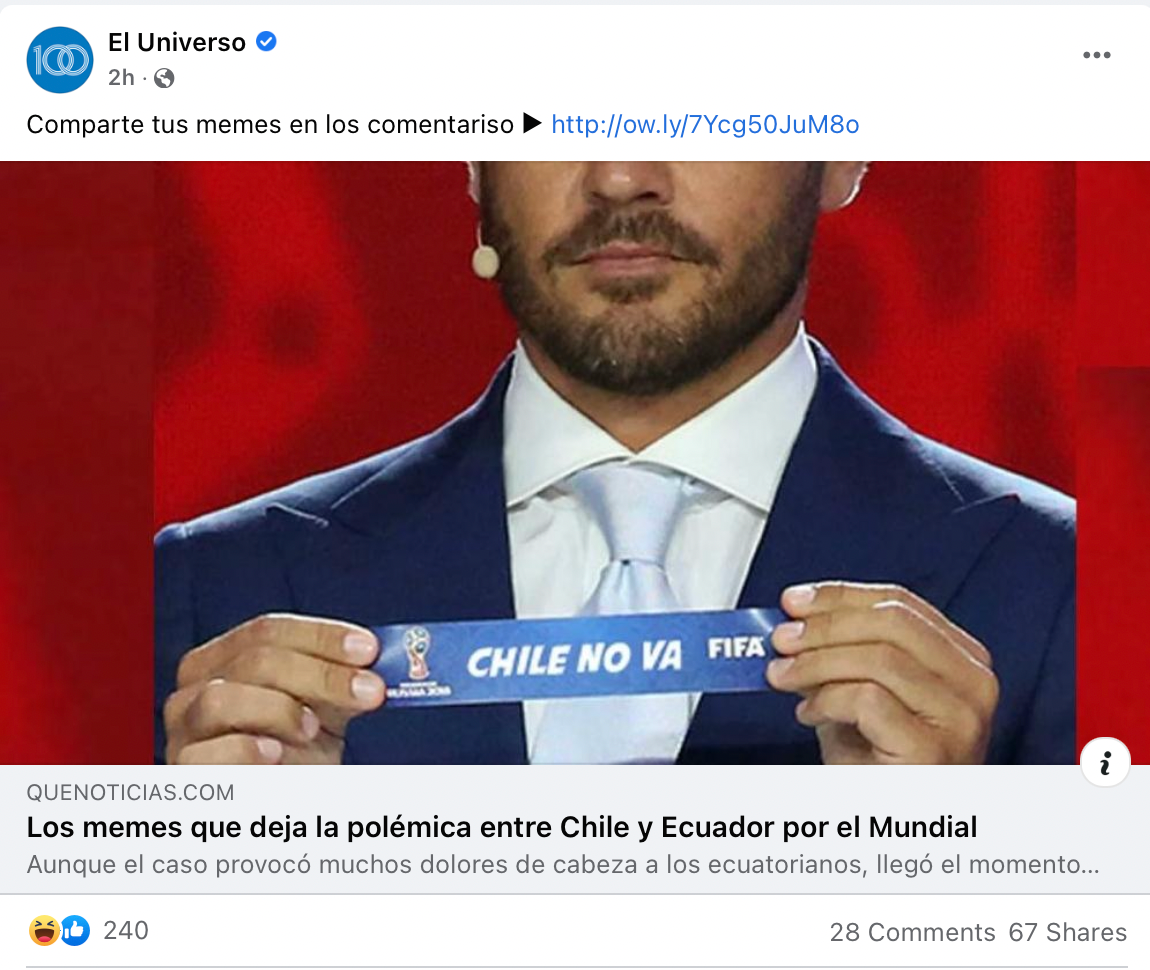
FIFA has judged in favor of Ecuador and Byron Castillo, and against Chile.


These are the reasons: (1) FIFA doesn’t oppose nations’ citizenship rulings, and Castillo had obtained the relevant documents from the Ecuadorian government; (2) Ecuador had previously consulted FIFA about including Castillo in its roster; and (3) Castillo had played for Ecuador’s youth teams, affiliating himself with Ecuador in FIFA tournaments.

I take it that each of these reasons establishes a strong presumption in Ecuador’s favor. (1) or (2) might even be regarded as conclusive.

Case closed.

Well, not quite. Chile could ask FIFA’s board of appeals to review the case. Or Chile could appeal to the Court of Arbitration for Sport, more commonly known by its French initialism, TAS. It was the TAS that ruled for Chile and against Bolivia during the 2018 World Cup qualification cycle.

But it seems likely that Ecuador, not Chile, will play in this year’s World Cup.

As will Iran.


(Stephen shared most of these links and memes with me.)

Castillo intends to counter-sue the Chilean soccer federation.

♦ ♦ ♦ ♦ ♦

R.I.P. Vangelis (d. May 17) and Julee Cruise (d. June 9). Two musicians of whom I’m fond, not least because they’ve so often lulled my sons to sleep.

We are sued

It’s time to discuss the lawsuit that Chile has brought against Ecuador and our starting right-back, Byron Castillo. This suit jeopardizes our participation in the World Cup.

Castillo is accused of having lied about his nationality. Ecuador is accused of having fielded him ineligibly in eight World Cup qualification games.

What if Castillo and Ecuador are judged to be at fault?

Ecuador would forfeit all the points earned in those eight games, or else would be disqualified outright. And perhaps banned in the future. Which would be the worst outcome of all.

♦ ♦ ♦ ♦ ♦

Who would benefit, then?

Here are two possibilities.

(1) The most obvious one is this. The Chileans, having been awarded the five points that they failed to earn in two games against Ecuador, would ascend to fourth place and qualify for the World Cup. Ecuador, points-poor, would have its qualification rescinded.

The precedent for this outcome was set during the qualification cycle of the 2018 World Cup. Chile and Peru were awarded points deducted from the Bolivians, who had fielded an ineligible player.

(Peru, not Chile, ultimately qualified.)

(2) Other nations with more clout than Chile also covet Ecuador’s place. One possible scenario involves Ecuador being disqualified outright and Italy qualifying for the World Cup.

But isn’t Italy in a different confederation?

Yes.

Wasn’t Italy eliminated by North Macedonia, even before the last European playoff round?

Yes.

Then why Italy?

Because the Italians are the world’s best-ranked eliminated team. By this criterion, they’re the most deserving eliminated team. More deserving than North Macedonia, the team that beat them.

If this reasoning sounds ad hoc to you, well, it is. But I’m not surprised that this option is being discussed.

It wouldn’t be the first time FIFA’s (highly dubious) rankings played such an important role.

♦ ♦ ♦ ♦ ♦

All right, so much for the possible consequences. What merit have the charges?

They have been described elsewhere. Their gist is this. Castillo is alleged to have been born in Colombia, not Ecuador. There is an Ecuadorian birth certificate for Byron Castillo Segura; but, also, there is a prior Colombian birth certificate for Byron Castillo Segura.

I have seen this accounted for. The explanation is not described in the linked article, though perhaps it is alluded to in the title (“Could Ecuador Really Be Thrown Out of the World Cup Over ‘Ghost’ Castillo’s Identity Scandal?”). Castillo’s brother was born in Colombia and died young. A few years later, Castillo was born in Ecuador and given the same first name, but not the same middle name, as his brother.

Ecuadorian officials have long been uncertain about Castillo’s earliest documents. They investigated the matter for several years. Finally, in 2021, they cleared him to play for Ecuador.

What’s beyond dispute is that Castillo has lived in Ecuador, as an Ecuadorian, since he was very young; that he has had up-to-date citizenship documents for some years; and that the government recognizes him as a citizen.

♦ ♦ ♦ ♦ ♦

This is the fourth time the Chileans have sought a judicial ruling that would usher them into a World Cup.

In the cycle of 1971–1974, this tactic worked, but in those of 1987–1990 and 2015–2018, it backfired spectacularly.

“Chile: Entering through the Window?” – a YouTube video that expains this history. (Spanish only, I’m afraid.)


From what I’ve seen, the world isn’t favorably impressed with Chile.

♦ ♦ ♦ ♦ ♦

What really bothers me is this. Suppose, for the sake of argument, that Castillo was born in Colombia, that his documents weren’t in order, and that Ecuador is complicit in covering this up. Not good. Procedure ought to be respected, and the truth ought not to be kept hidden. But … here are all these rich European countries, fielding players born in their former colonies, excelling in and even winning tournaments with these players, and no one brings a legal challenge; no one says, it’s grossly unjust that England, France, the Netherlands, Portugal, etc. continue to gain advantage from their history of colonialism. But when a family moves from one poor country to another, and the second country takes in that family as a matter of compassion, conscientiousness, or neighborliness, as it habitually has done and continues to do … then, to preserve their advantage, richer countries pounce, saying, Aha! your paperwork is not in order, as if what a government deemed acceptable for the day-to-day purposes of citizenship weren’t good enough for this citizen to represent his country in the World Cup.

Straight-up Communist

As always, to magnify an image, click on it.


What I’m sharing is a screenshot of one of my friends’ Facebook posts. According to my friend, not only are many of the recent quarantining measures “in direct opposition to our constitution,” they’re “straight up Communist.”

By embracing these measures, U.S. citizens “have changed their views on ‘freedom’.”

Instead, they should be holding leaders “accountable.”

Well, I want to know:

Which measures are the unconstitutional ones?

What about them is unconstitutional?

What about them is “straight-up Communist?”

What kind of holding accountable is being urged? Are leaders to be voted out? Are they to be impeached? Are their laws to be disobeyed?

My friend doesn’t say.

♦ ♦ ♦ ♦ ♦

This is hardly the most inflammatory post I’ve seen about the quarantining measures.

Yesterday, another friend, a sweet woman from my church, shared a photo of a Nazi putting a noose around a teenaged resistance fighter.

Socialism! was her accusation.

We need to pay attention to history!

But the history is that courts in the USA have given the federal government and, especially, the state governments extensive leeway to quarantine.

♦ ♦ ♦ ♦ ♦

Reading the two posts between their lines, I think that what’s being advocated is civil disobedience. (It’s a member of the resistance who’s being portrayed as a hero.)

This is a grave position for my friends to take, and not only because civil disobedience, by its nature, tends to weaken the rule of law. It’s especially grave in this context because disobeying the law is likely to result in many more deaths.

Interestingly, my first friend grants this point, saying, “Our opinions about whether or not the current measures are necessary are ultimately irrelevant.”

This position implies that certain freedoms (of commerce? of movement?) are more important than the preservation of many lives.

I wonder if my friend has thought this through.

He has six children. If he considered the measures necessary for preserving lives, would he grant his children the freedom to flout them?

I doubt it.

If his children were adults, would he want them to have the freedom to act so as to disregard the preservation of lives?

If he says he would, he’s more radical than the people who oppose seatbelt laws. The brunt of the harm that results from the choice not to wear a seatbelt is borne by the person who makes that choice. This is much less likely to be true of the person who chooses not to take precautions against COVID-19.

♦ ♦ ♦ ♦ ♦

As it happens, my friend doesn’t believe that the measures are necessary for preserving lives. He doesn’t believe that COVID-19 is especially dangerous. In other posts, he says that COVID-19 probably is much more widespread than the official story claims. He even believes that his whole family had COVID-19 in December, in South Carolina. (I think this is ludicrous.)

But if his disbelief in the measures’ necessity is what’s influencing him to reject the measures, then either (a) he’s confused – that is, he misspeaks when he says that whether the measures are necessary is irrelevant – or (b) he’s arguing in bad faith: he says that the question is irrelevant though he knows that it’s relevant to him.

♦ ♦ ♦ ♦ ♦

Relatedly, I wonder: when my friend says that the measures are “straight-up Communist,” is he confused, or is he arguing (or asserting) in bad faith, using an inflammatory label just for its rhetorical effect?

And if he’s confused, is his shoddy understanding of Communism indicative of willful neglect? Does it suggest that his general argumentative tendencies are characterized by bad faith?

La final del mundo, pt. 2

Today, CONMEBOL ruled that the game between Boca Juniors and River Plate should be played on December 8 or 9 – and not in Argentina.

And so, one year early, CONMEBOL is achieving its goal of staging the Copa Libertadores final in a neutral venue.

♦ ♦ ♦ ♦ ♦

It’s now publicly established that Boca’s president has been lobbying for River to be disqualified and for the title to be awarded to Boca by default.

In response, River’s president has expressed shock at this betrayal.

So much for collegiality.

♦ ♦ ♦ ♦ ♦

Of course, a few years ago, Boca was disqualified from the Copa Libertadores because its fans misbehaved against River. But on that occasion, the misbehavior occurred (1) during an earlier round rather than during the final, and (2) inside Boca’s stadium rather than on a public highway.

♦ ♦ ♦ ♦ ♦

I, personally, would welcome River’s disqualification.

Not as eye-for-an-eye retribution. The earlier incident and this year’s are too dissimilar.

And not as a deterrent against future fan violence, either. It’s doubtful whether previous deterrent measures in Argentina have been very effective.

No, in this case, I think the expressivist or reprobative justification of punishment holds the greatest promise. The punishment would be justifiable as an expression of society’s disapproval of the fans’ misdeeds.

♦ ♦ ♦ ♦ ♦

This theory of punishment also would be compatible with the imposition of some lesser (but still significant) penalty against River. For example, River’s home game might be played in an empty stadium.

I don’t think that staging the game in front of spectators in a neutral stadium would adequately express reprobation, however.

♦ ♦ ♦ ♦ ♦

Update, Thursday: CONMEBOL has decided that the game will be played on December 9 – in Madrid.

Madrid.

MADRID.

Madrid, Spain. The one in Europe.

First, CONMEBOL plotted to remove South America’s nations tournament (the Copa América) from South America, and now it’s doing the same thing with South America’s main club tournament.


Stephen says: “The Copa LIBERTADORES final will be in … Spain?”

(Shakes head.)

“Back to the colonizadores.”

♦ ♦ ♦ ♦ ♦

Update, Friday: River Plate and Boca Juniors have both rejected CONMEBOL’s ruling.

River will appeal its stadium ban. The current ruling moves this year’s final game away from River’s stadium. It also bans the stadium from hosting spectators during its next two CONMEBOL tournament games.

I’m not sure to whom River will direct its appeal – perhaps to the dreaded Tribunal arbitral du sport (TAS).

Boca has announced that it plans to appeal to the TAS after its initial appeal to CONMEBOL is rejected. Boca will argue that River should be expulsed from this year’s Copa Libertadores.

My previous discussion of this case was philosophic and casuistic. Boca, helpfully, has now communicated which of CONMEBOL’s disciplinary regulations it will cite in its appeal.

I think that much will hinge upon article 8.2:
Las Asociaciones Miembro y clubes son responsables de la seguridad y del orden tanto en el interior como en las inmediaciones del estadio, antes, durante y después del partido del cual sean anfitriones u organizadores. Esta responsabilidad se extiende a todos los incidentes que de cualquier naturaleza pudieran suceder, encontrándose por ello expuestos a la imposición de las sanciones disciplinarias y cumplimiento de las órdenes e instrucciones que pudieran adoptarse por los órganos judiciales.

[Translation, with key phrases italicized:] Member associations and clubs are responsible for security and order – inside and in the immediate vicinity of the stadium – before, during, and after the game which they host or organize. This responsibility extends itself to all incidents that might occur, of whatever nature. Member associations and clubs thereby find themselves exposed to the imposition of disciplinary sanctions and to compliance with the orders and instructions adopted by judicial organs.
Why does this rule refer to “member associations?” In this case, the pertinent association is the Argentine Football Association (AFA). Should the rule be interpreted as implying that the AFA and River are jointly responsible for what occurred? Probably not. The rule probably means that member associations are responsible for the security and order of the games that they host that don’t involve club teams.

More contentious will be what counts as the “immediate vicinity” of the stadium. The expression is vague. Over how many streets did River’s responsibility extend? Did the misbehavior occur inside or outside the club’s geographic area of responsibility? These questions reinvite casuistic interpretation, which isn’t especially likely to favor Boca, since, in the earlier case in which Boca was disqualified and River benefited, the misdeeds were performed inside the stadium.

The same interpretive problem arises with respect to article 13.2.f, which refers to “the stadium and its surroundings.”

Article 18.1 details the various penalties that may be imposed. However, it leaves the choice of penalty up to CONMEBOL. Here, too, Boca must make a casuistic argument for the imposition of a severe penalty. And in fact, in the last paragraph of its communiqué, Boca does insist that CONMEBOL’s rules should “be applied to all clubs equally.” Presumably, the club has in mind the ruling that was brought against it a few years ago which disqualified it from that edition of the Copa Libertadores.

♦ ♦ ♦ ♦ ♦

No matter how the dispute between the clubs should turn out, it’s sad that they aren’t uniting to protest the tourney’s removal to Spain, though they both oppose it.

August’s poem

This one, from Trial by Jury, is by the librettist W.S. Gilbert.

⎯⎯⎯⎯⎯⎯⎯⎯⎯⎯
Song – Judge
When I, good friends, was called to the bar,
I’d an appetite fresh and hearty,
But I was, as many young barristers are,
An impecunious party.
I’d a swallow-tail coat of a beautiful blue –
And a brief which I bought of a booby –
A couple of shirts, and a collar or two,
And a ring that looked like a ruby!

Chorus
A couple of shirts, and collar or two,
And a ring that looked like a ruby!


In Westminister Hall I danced a dance,
Like a semi-despondent fury;
For I thought I never should hit on a chance
Of addressing a British Jury –
But I soon got tired of third-class journeys,
And dinners of bread and water;
So I fell in love with a rich attorney’s
Elderly, ugly daughter.

So he fell in love [etc.].

The rich attorney, he jumped with joy,
And replied to my fond professions:
“You’ll reap the reward of your pluck, my boy
At the Bailey and Middlesex Sessions.
You’ll soon get used to her looks,” said he,
“And a very nice girl you will find her!
She may very well pass for forty-three
In the dusk, with a light behind her!”

She has often been taken for forty-three
In the dusk, with a light behind her.


The rich attorney was good as his word;
The briefs came trooping gaily,
And every day my voice was heard
At the Sessions or Ancient Bailey.
All thieves who could my fees afford
Relied on my orations,
And many a burglar I’ve restored
To his friends and his relations.

And many a burglar [etc.].

At length I became as rich as the Gurneys –
An incubus then I thought her,
So I threw over that rich attorney’s
Elderly, ugly daughter.
The rich attorney my character high
Tried vainly to disparage –
And now, if you please, I’m ready to try
This Breach of Promise of Marriage!

And now, if you please, he’s ready to try
This Breach of Promise of Marriage.


Judge
For now I am a Judge!

All
And a good Judge too!

Yes, now I am a Judge!

And a good Judge too!

Though all my law is fudge,
Yet I’ll never, never budge,
But I’ll live and die a Judge!

And a good Judge too!
⎯⎯⎯⎯⎯⎯⎯⎯⎯⎯

Thus, a century later, the Happy Mondays released their track “Judge Fudge.” Its lyrics also would merit inclusion in this series of poems.

A “civil” action

I finished reading A Civil Action, five hundred pages about why not to practice the law. A cover blurb says: “The legal thriller of the decade” (i.e., the 1990s). Indeed. No other task could be more herculean, more quixotic, than that to which these litigators set themselves.

These litigators obviously are the good guys. The two industries that they’re suing clearly are guilty of polluting some groundwater and causing the plaintiffs’ family members to die of cancer. But, righteous though the cause may be, the litigators are suing these two industries because the owners have deep, deep pockets. (You could say that the good guys are a little greedy.)

And so ensues a war of attrition. The defendants, with their unending resources, drag out the proceedings, expecting the plaintiffs’ lawyers to run out of money. The litigators plunge further and further into debt. The book opens with a flash-forward scene in which one litigator’s Porsche is repossessed. You could say that the main question of the book is: will this guy win enough money to recover his Porsche? Suspense is generated by such problems as: will he be able to pay the dry cleaners so that he can wear a suit to court?

All of which makes it seem terribly stressful to be a lawyer. And undignified. Everybody is always getting scolded by the judge – who, in some passages, himself seems barely competent. (You wonder: what is this crazy system?)

Worst of all, for the righteous litigators at least, there’s a constant crisis of the self. These smart people are pushed so hard that they end up trusting in some very dumb things, like lotto tickets and “shyster” credit cards. And horoscopes: “Whether your problems be of a personal or career nature, you must refuse point blank to settle for less than you know to be just and honorable” (emphasis on “settle”). And the judge. And even the defense lawyers. There’s a code of behavior in lawyering that encourages the litigators to trust their opponents. You can imagine how, in some circumstances, this would be a bad idea. The book’s title can be read as an ironic pun.