Posts

Showing posts with the label Italy

1996, the best year in movie history, pt. 93: Il postino (The postman)

Quintessential small “prestige” picture. Italian-French-Belgian adaptation of a Chilean novel, set on a small Mediterranean island. Scored by an Argentinian (Luis Bacalov); directed by an Englishman (Michael Radford); co-starring a Frenchman (Philippe Noiret) as history’s most revered Chilean: Pablo Neruda.

Released in 1994. Released in the United States in 1995.

Nominated for five 1996 Oscars: Picture, Director, Adapted Screenplay, Actor (Massimo Troisi, who’d died), and Score (Bacalov won).

(Not unusual for Miramax thirty years ago.)

But the movie’s success is due to Troisi’s tricky performance.

♦ ♦ ♦ ♦ ♦

Troisi is Mario, the (fictitious) part-time postman to Neruda, who is in political exile. Mario and Neruda become friends. This is very much at Mario’s instigation. He intrudes at all hours, with or without mail.

Victor Hugo remarked about his Channel Island years:
What a pity I was not exiled earlier! I could have achieved so many things which I fear I shall not have the time to complete.
Or as Simon Leys (ibid.) puts it:
The poet [Hugo] found himself left with only two interlocutors – but with these at least, he felt on the same footing: God and the ocean. … No wonder these years of solitude and contemplation were the most productive of his life.
Neruda seems determined to follow Hugo’s example. He devotes himself to beauty, politics, and his female companion. He is only pulled away from these things at the insistence of his tactless regular visitor.

♦ ♦ ♦ ♦ ♦

Roger Ebert:
The first time we see Mario … we think perhaps he is retarded. He is having a conversation with his father, who seems to be retarded, too, or perhaps just engrossed in his soup.

We realize in the next scene or two that Mario is of normal intelligence, but has been raised in a place that provided him with almost nothing to talk about.
I don’t think it’s the place that makes Mario inarticulate. It’s that what he seeks isn’t easily describable.

The island’s other postal worker (Renato Scarpa) has plenty to say. He has political opinions. He admires Neruda as a famous fellow Communist. Of Neruda’s poetry, he knows almost nothing; he’s utterly mundane. Similarly, Mario’s father thinks only of fishing; and there’s an old widow, an innkeeper, who’s downright suspicious of whatever is purported to transcend daily concreteness.

Mario couldn’t care less about fishing. He doesn’t really care about politics, either. The island must import water; its provision is irregular; the authorities really ought to intervene. Mario understands this problem but shrugs it off.

Practicalities – earning a decent wage, having water to drink – have no grip on his imagination.

♦ ♦ ♦ ♦ ♦

What does?

Not the wider world.

Not whatever must be read about. Mario is more literate than most islanders but deciphers sentences haltingly. He’ll never devour pages of prose.

What, then?

If he knew the term, he might say: Blessedness.

A kind of holiness or beauty. Saintly beauty, but not of deeds. Beauty of being.

And not just any beauty of being – not at first. There’s plenty of natural beauty all around Mario, but scenery leaves him unaffected.

No, it’s supernatural beauty that he’s groping after, although it doesn’t occur to him to say as much, or even to try to formulate the concept. (His priest is useless.)

♦ ♦ ♦ ♦ ♦

The closest thing to Blessedness that Mario knows about – the most exalted thing he can imagine – is Woman. Granted, he knows little of actual women. There are few on the island. His mother is long-dead.

Mario does go to the pictures. But this isn’t the story of a man’s love affair with the screen. There is another famous romance co-starring Philippe Noiret – Cinema Paradiso – in which an older man initiates a younger into the practice of using art to reach out to what is longed for. Mario doesn’t seem much affected by screen beauties, however. Just as he’s indifferent to mountains and seas, he doesn’t pine after actresses. He’s after something more transcendent.

What Mario notices, sorting Neruda’s mail, is that women adore the poet. Not just a woman. Women. He badgers Neruda: first, for autographs that he might show to women; then, for advice on wooing.

You have to talk to women, Neruda tells him. Neruda is deft with metaphor and rhythm. Mario takes note. Together they walk the hills and beaches, discussing the elements of figurative speech. Mario learns to attend to nature, and to use language to evoke feelings and happenings that have no names.

He listens to a recorded message from Neruda’s Chilean comrades. He acquires a sense of duty to his fellows.

He sees the world through his friend’s eyes.


Then Mario meets the prettiest girl on the island: the old innkeeper’s niece (Maria Grazia Cucinotta), fittingly named Beatrice. Here, at last, is Woman. Blessedness. He woos her with words. Some are Neruda’s; some are his own. This is the movie’s most conventional passage.

There is a wedding. Neruda signs the document as a witness. He wishes his friend well. Then, he returns to Chile.

♦ ♦ ♦ ♦ ♦

It’s at this point, in its last half-hour, that the movie reveals its ingenuity. Mario is drawn into politics, and into the daily running of the inn. He recites Neruda’s poetry while slicing onions and tomatoes. The mundane chores, more sensuous to him now that he has learned the language of poetry, recall Neruda to him.

He waits, in vain, to hear from his friend.

The story, hitherto so conventionally sweet, turns bitter.

This is an extraordinary development, and this is where Troisi’s anguished acting is extraordinary. Troisi, in fact, was near death. He put off a heart operation to make the movie and died one day after its completion.


There is a parallel with Mario’s story. The actor and the character both sacrifice themselves doing their respective labors of love.

This isn’t one of my favorite movies, but it has one of my favorite endings. It is very wise and very true. There is the friend who concerns himself with Great Causes, Great Sayings, and Great Deeds, who inadvertently or perhaps deliberately elevates those around him; and then there is the Great Friend, the one who loves his friend not for what he stands for or accomplishes but for who he is.

To each his own

The chicken-and-beer diet: lose 15 lbs. in 40 days.

I’m not surprised. A half-chicken + Pit-Tatoes® (from Nelson’s) < 400 kcals.

Do you know what else is good? Pollo Gus.

♦ ♦ ♦ ♦ ♦

I read another great little Sciascia novel: To Each His Own (1966), which is as Chronicle-of-a-Death-Foretold-ish as The Day of the Owl. On the evidence of these two shrimpy works I’d say this guy should have been given the Nobel Prize.

“To each his own” is unicuique suum in Latin and a ciascuno il suo in Italian. Reading the book, it helps to know these phrases.


♦ ♦ ♦ ♦ ♦

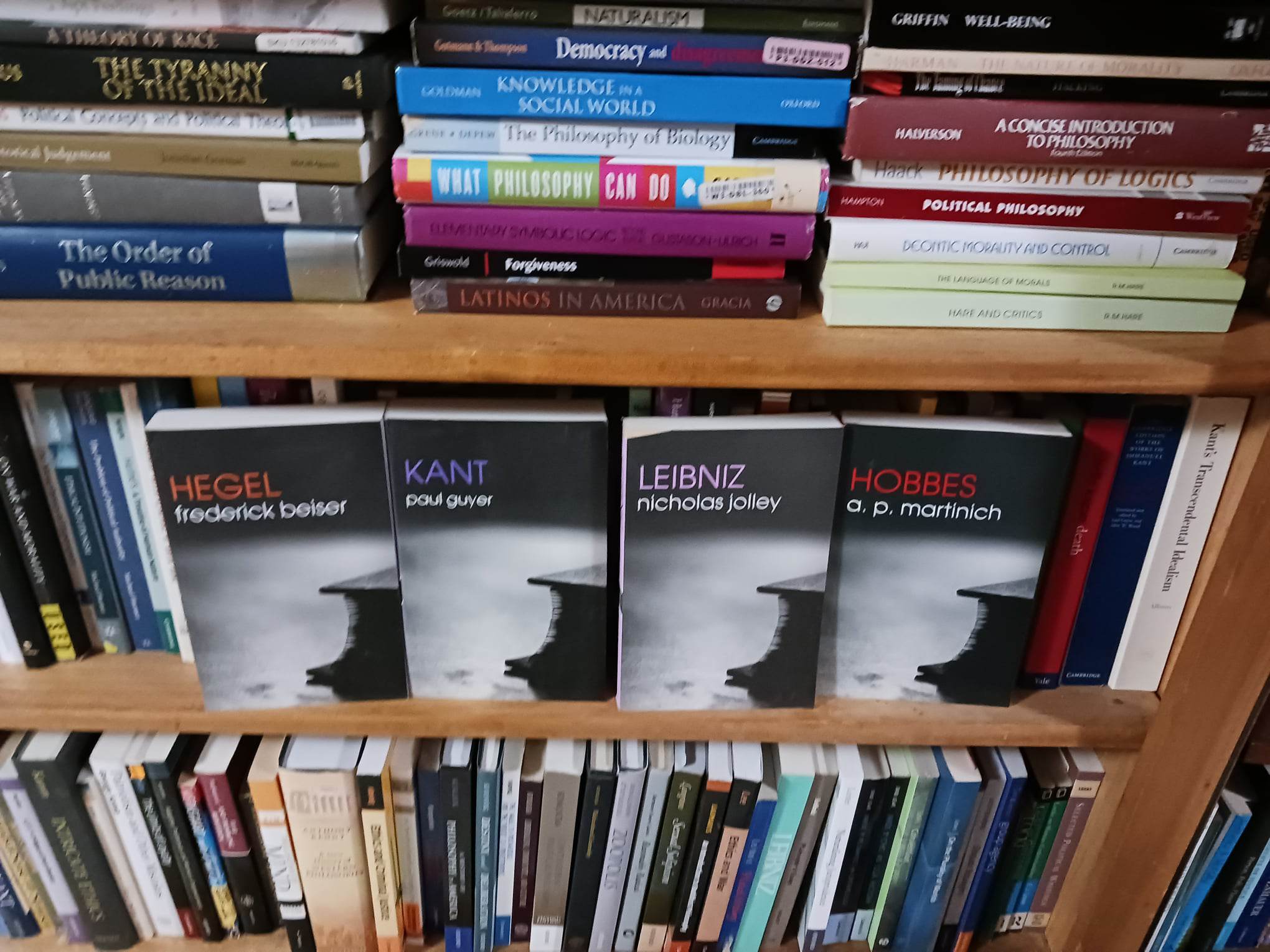
These volumes aren’t supposed to rest on the same shelf, but Samuel decided to line them up together. They do belong to the same series. (He must not have been able to reach the Locke book.)


I wish he’d organize his books.

Feliz cumple to Pervis Estupiñán who twice assisted Brighton & Hove Albion’s goalscorers today.

Body-text fonts, pt. 11: Vendôme

His departure is old news, but I’d like to record my gratitude to the Argentinian Gustavo Alfaro, Ecuador’s manager during this last World Cup cycle. An astute tactician and a careful mentor to young pros; by most accounts, a good person.

♦ ♦ ♦ ♦ ♦

This month I exhibit a bizarre typeface. It appears as body text in just one of my volumes, a Random House Value Publishing omnibus of E. M. Forster’s novels (obtained last weekend at Goodwill).


The italics are severely slanted.


That’s how they were designed to look.

[Update, 27 January: I now believe this isn’t a sample of true italics. Here’s a website where you can buy cheap font files of Vendôme. Images of body text are provided. Roman text looks like this; italics look like this.

You can see the italics aren’t just slanted versions of the romans. Compare the roman and italic uppercase “A,” as well as the roman and italic lowercase “b”: the romans have more serifs. And in the italic lowercase “g,” the lower and upper storeys are farther apart than in the roman “g.” On the other hand, all these differences are absent from the text sample taken from the Forster omnibus.

Of course, not every genuine Vendôme will look exactly like Fontsite’s Vendôme.]

Karin didn’t bother with the typesetting. She listened to a recording of the book. Cecil Vyse and Cousin Charlotte irked her equally.

♦ ♦ ♦ ♦ ♦

Daniel sleeps; I type.


He often goes to bed like this. I put on soothing Italian soundtrack music and lie with him. He rolls and jumps on me; then, declining suddenly, he “gives up the ghost.”

Two streaks; season’s reading; body-text fonts, pt. 10: Optima

A little trivia, and then I’ll be quiet about the World Cup until the South Americans’ qualification tournament begins in March.

Two venerable – for me, virtually life-long – streaks were left intact:

(1) The tournament was won by a first-round group winner. Not since 1982 has this not occurred; that year, Italy won the tournament having finished behind Poland in the first round. (Italy did win its three-team quarterfinal group.)

The lesson: A team ought to play well enough from the outset to win its group and not just qualify out of it.

(2) Even more remarkable: The final game of this World Cup featured players employed by Bayern Munich and Inter Milan, as has every World Cup final since, and including, that of 1982. Dayot Upamecano (Bayern) was a starter in this year’s final, and Kingsley Coman (Bayern) and Lautaro Martínez (Inter) came off the bench – Martínez in the 102nd minute.

♦ ♦ ♦ ♦ ♦

I’ve picked some Canadian or quasi-Canadian literature to read or finish reading this winter.
  • Margaret Atwood, Surfacing
  • Kate Beaton, Ducks: Two Years in the Oil Sands
  • Pierre Berton, The Comfortable Pew
  • Rachel Cusk, Outline
  • Robertson Davies, Tempest-Tost
  • Brian Moore, The Mangan Inheritance
  • Alice Munro, Dance of the Happy Shades
  • Howard Norman, The Northern Lights (or maybe The Bird Artist)
  • Carol Shields, The Stone Diaries
  • Bernard Suits, The Grasshopper
And I’d like to get around to watching Mon oncle Antoine.

Good luck to me.

(This is in honor of the solstice, the coming blizzard, and especially Canada’s rare and brief World Cup appearance – most of which I contrived to miss. My Internet died during one game; I was in church during another; and during the third game, I chose to watch Belgium vs. Croatia instead.)

One of the books from my list is the source of this month’s body-text sample, which is set in Hermann Zapf’s Optima. This is surely one of the most elegant typefaces, although it’s not often used for large blocks of literary text. Which is a shame. The Canadian Journal of Philosophy was set in Optima many years ago. My church’s history, Merging Streams, is set in Optima, as is Tom Wolfe’s The Painted Word. This blog currently is typeset with an Optima clone, URW Classico. Another clone is Zapf Humanist 601; a third, with old-style numerals, is Epigrafica; and a fourth, with old-style numerals and small capitals, is Ophian.

We are sued

It’s time to discuss the lawsuit that Chile has brought against Ecuador and our starting right-back, Byron Castillo. This suit jeopardizes our participation in the World Cup.

Castillo is accused of having lied about his nationality. Ecuador is accused of having fielded him ineligibly in eight World Cup qualification games.

What if Castillo and Ecuador are judged to be at fault?

Ecuador would forfeit all the points earned in those eight games, or else would be disqualified outright. And perhaps banned in the future. Which would be the worst outcome of all.

♦ ♦ ♦ ♦ ♦

Who would benefit, then?

Here are two possibilities.

(1) The most obvious one is this. The Chileans, having been awarded the five points that they failed to earn in two games against Ecuador, would ascend to fourth place and qualify for the World Cup. Ecuador, points-poor, would have its qualification rescinded.

The precedent for this outcome was set during the qualification cycle of the 2018 World Cup. Chile and Peru were awarded points deducted from the Bolivians, who had fielded an ineligible player.

(Peru, not Chile, ultimately qualified.)

(2) Other nations with more clout than Chile also covet Ecuador’s place. One possible scenario involves Ecuador being disqualified outright and Italy qualifying for the World Cup.

But isn’t Italy in a different confederation?

Yes.

Wasn’t Italy eliminated by North Macedonia, even before the last European playoff round?

Yes.

Then why Italy?

Because the Italians are the world’s best-ranked eliminated team. By this criterion, they’re the most deserving eliminated team. More deserving than North Macedonia, the team that beat them.

If this reasoning sounds ad hoc to you, well, it is. But I’m not surprised that this option is being discussed.

It wouldn’t be the first time FIFA’s (highly dubious) rankings played such an important role.

♦ ♦ ♦ ♦ ♦

All right, so much for the possible consequences. What merit have the charges?

They have been described elsewhere. Their gist is this. Castillo is alleged to have been born in Colombia, not Ecuador. There is an Ecuadorian birth certificate for Byron Castillo Segura; but, also, there is a prior Colombian birth certificate for Byron Castillo Segura.

I have seen this accounted for. The explanation is not described in the linked article, though perhaps it is alluded to in the title (“Could Ecuador Really Be Thrown Out of the World Cup Over ‘Ghost’ Castillo’s Identity Scandal?”). Castillo’s brother was born in Colombia and died young. A few years later, Castillo was born in Ecuador and given the same first name, but not the same middle name, as his brother.

Ecuadorian officials have long been uncertain about Castillo’s earliest documents. They investigated the matter for several years. Finally, in 2021, they cleared him to play for Ecuador.

What’s beyond dispute is that Castillo has lived in Ecuador, as an Ecuadorian, since he was very young; that he has had up-to-date citizenship documents for some years; and that the government recognizes him as a citizen.

♦ ♦ ♦ ♦ ♦

This is the fourth time the Chileans have sought a judicial ruling that would usher them into a World Cup.

In the cycle of 1971–1974, this tactic worked, but in those of 1987–1990 and 2015–2018, it backfired spectacularly.

“Chile: Entering through the Window?” – a YouTube video that expains this history. (Spanish only, I’m afraid.)


From what I’ve seen, the world isn’t favorably impressed with Chile.

♦ ♦ ♦ ♦ ♦

What really bothers me is this. Suppose, for the sake of argument, that Castillo was born in Colombia, that his documents weren’t in order, and that Ecuador is complicit in covering this up. Not good. Procedure ought to be respected, and the truth ought not to be kept hidden. But … here are all these rich European countries, fielding players born in their former colonies, excelling in and even winning tournaments with these players, and no one brings a legal challenge; no one says, it’s grossly unjust that England, France, the Netherlands, Portugal, etc. continue to gain advantage from their history of colonialism. But when a family moves from one poor country to another, and the second country takes in that family as a matter of compassion, conscientiousness, or neighborliness, as it habitually has done and continues to do … then, to preserve their advantage, richer countries pounce, saying, Aha! your paperwork is not in order, as if what a government deemed acceptable for the day-to-day purposes of citizenship weren’t good enough for this citizen to represent his country in the World Cup.

Ecuador 1, Argentina 1

In Guayaquil, Argentina had us under control; and then, at the 89th minute, the VAR awarded us a penalty kick. It was blocked, but the taker, Enner Valencia, put in the rebound. I think we are not very good, compared to Argentina.

I looked at Qatar on Google Maps. No two World Cup stadia are separated by more than an hour’s drive, or a thirteen-hour walk.

Example 1.

Example 2.

Here is a stadium built of shipping containers.

♦ ♦ ♦ ♦ ♦

I am so behind on my reading, I’ll have to finish nine books next month to meet my quota. (I begin counting titles each May and conclude the following April.)

I’ve again taken up the Commedia. The end of Purgatory is near. Some passages – e.g., the one with the Siren – are stunningly good; others are tedious; some are kinda weird; and some, like these lines from canto XXI, are shocking:

⎯⎯⎯⎯⎯⎯⎯⎯⎯⎯
In the days when good Titus, with the aid
of the Almighty King, avenged the wounds
that poured the blood Iscariot betrayed …
⎯⎯⎯⎯⎯⎯⎯⎯⎯⎯

(Translator: John Ciardi)

Um, which “good” Titus is this? Surely not …
Roman Emperor, A.D. 79–81. In A.D. 70 in the reign of his father Vespasian, Titus besieged and took Jerusalem. Thus, with God’s help, Rome avenged the death (the wounds) of Christ. So Dante, within his inevitable parochialism, chose to take that passage of history. The Jews, one may be sure, found less cause for rejoicing in the goodness of Titus.
[Translator’s note]
Within my own “inevitable parochialism,” I am a little horrified.

Dante is a master, and I’m just a guy. But … my goodness. On the one hand, he’s very careful about the position of the sun over Mt. Purgatory. On the other, he seems very casual with his name-dropping. Sometimes, he saddles a penitent soul with the sins of two historical people with the same name.

My favorite character is the first-century poet Statius, who has a celebrity-crush on Virgil. As Dante tells it, Statius clandestinely converted to Christianity. There is no evidence that he really did so; his role in the poem is to personify Christianity’s appropriation of the best aspects of pagan Rome. Dante is so proud of Rome, he reminds me of a “God and Founding Fathers” evangelical.

I’m woefully ignorant of the history of sola scriptura. I wonder, were the Reformers (non-Italians) driven to it because they were fed up with this sort of thing?

Paraguay 3, Ecuador 1

Not our best outing.

Fortunately, the Chileans failed to defeat Brazil (they came up five goals short), and Uruguay defeated Peru (somewhat controversially). These results guaranteed our qualification for this year’s World Cup, with a game to spare.

Uruguay qualified, too.

The really shocking result was in Europe: North Macedonia eliminated Italy, the continental champions.

As of this writing, we are the qualified nation with the second-least World Cup experience. This will be our fourth World Cup. For Qatar, the host nation, it will be the first.

Thirteen of thirty-two places remain unclaimed.

In praise of Venus shoes

Well, the goal drought has ended; but, in a way, it continues. I still haven’t scored with the new cleats that I bought this summer. But I did make a rather complicated golazo almost as soon as I took off the cleats and put on Venus shoes, some ten or fifteen minutes before the game’s conclusion. So, my record this summer is: four goals with Venus shoes, in less than one hour; zero goals with cleats worn for hours and hours. I could tell immediately that with Venus shoes I was three times better as a footballer.

Of course, it made all the difference that we were on artificial grass and not on the slippery mud-grass of previous weeks.

♦ ♦ ♦ ♦ ♦

I finished reading the shortest item on my book list: Leonardo Sciascia’s The Day of the Owl. Friends, this author oozes intelligence. This book is on a par with, if not better than, García Márquez’s Chronicle of a Death Foretold. A man is killed by the mafia; the subsequent investigation is narrated not only with logical exactitude – this is a police procedural, after all – but also, occasionally, by means of wry dialog between shadowy, unnamed men of power. Sicily is a morass of subservience and paranoia, with inhabitants (one hardly can call them citizens) who nonetheless make their meanings clear through innuendo. Hilariously, they adorn this innuendo with affirmations of Catholic piety. This book is what I wish I were clever enough to write.

Some lessons in geography

Today was warm and dry enough for strolling – Samuel was pleased.

♦ ♦ ♦ ♦ ♦

I’ve been watching Capitani (Netflix). It’s a typical cop show, but the episodes are just 24 minutes long. That’s about all I can view without having to pause to look after Samuel.

The show’s location isn’t obvious at first. The language is sometimes like French, sometimes like German.

Switzerland?

No, not mountainous enough.

(The land is hilly and lushly vegetated, like my beloved upstate New York.)

Then I figured it out. Luxembourg. Aha.

Apparently, there are stark regional differences in that nation. The show’s “northerners” and “southerners” constantly disparage one another. So do city and country folk.

This show is set in the country. Village life is comfortable and modern. Houses aren’t especially rustic.

The army is always conducting maneuvers in the forest.

Everyone knows everyone else. Even so, it’s possible for citizens to disappear from the police.

♦ ♦ ♦ ♦ ♦

Disoriented from this excursion into such a vast and untamed land, I put on some YouTube videos of San Marino, another country I’d never visited on TV or in the flesh. San Marino is easier to comprehend.

The government is seated in a castle at the top of a mountain – the country’s highest point. From there, one can easily gaze out, across ten Italian kilometers, all the way to the Adriatic.

Also, there are tourists everywhere.

I look forward to viewing the cop shows of San Marino.

♦ ♦ ♦ ♦ ♦

It would be remiss not to also mention Un mundo inmenso, my favorite geographical YouTube channel (Samuel is fond of it, too).

Finally, I recommend these photos of a yellow penguin. HT: National Geographic.

1996, the best year in movie history, pt. 22: The English patient

There was an unconventional Hungarian aristocrat named László Almásy who explored the Sahara in the 1930s. He had love affairs and died before he was old, but not in the spectacular fashion of Count Almásy of The English Patient.

The fictional Almásy (Ralph Fiennes) finds himself rolling across the desert in a (proto-) jeep with young Mrs. Katharine Clifton (Kristin Scott Thomas). She is talkative. He is quiet. She asks: How does a count make his way from the castle to the desert? Almásy replies:
I once traveled with a guide who was taking me to Faya. He didn’t speak for nine hours. At the end of it, he pointed at the horizon and said, “Faya.” That was a good day.
His answer is evasive. He already is in love with Katharine, whose husband is assisting him with his geographic expedition.

Almásy does what he can to keep himself at arm’s length from Katharine. Then they are caught in a sandstorm. It gathers quietly in the distance, obscuring the stars. Minutes later, Almásy and Katharine are forced to shelter together for the night while the sand beats against the jeep’s windows.

It is too much for Almásy. He strokes Katharine’s hair.
ALMÁSY: “Let me tell you about winds. There is a whirlwind from southern Morrocco, the aajej, against which the fellahin defend themselves with knives. And there is the ghibli, from Tunis …”

KATHARINE: “The ghibli !!!”

ALMÁSY: “The ghibli, which rolls and rolls and rolls and produces a rather strange nervous condition. And then there is the harmattan, a red wind, which mariners call the Sea of Darkness. And red sand from this wind has flown as far as the south coast of England, apparently producing showers so dense that they were mistaken for blood.”

KATHARINE: “Fiction! We have a house on that coast and it has never, never rained blood.”

ALMÁSY: “No, it’s all true. Herodotus, your friend. He writes about it. And he writes about a wind, the simoon, which a nation thought was so evil they declared war on it and marched out against it. In full battle dress. Their swords raised.”
There are scenes of such poetry all through The English Patient. Some of it is verbal; much is visual. The desert is a frequent backdrop. It is likened in different scenes to a human body, to a rumpled bedsheet, a slab of rock, a strip of parchment. As Shine is obsessed with the different appearances and meanings of drops of water, The English Patient showcases sand dunes and grains of sand.

Like Shine, again, The English Patient shifts backward and forward through time. Almásy’s moments with Katharine are deathbed recollections. He has been severely burned, and his lungs are failing. Mistaken for an Englishman, he is in Italy at the close of the Second World War, being cared for in an abandoned villa by Hana (Juliette Binoche), a French-Canadian nurse who has dropped out of her British military convoy to see this patient through his last days. Hana’s lover has just been killed; in Almásy, she recognizes a person similarly bereaved. She asks for his memories, which he divulges intermittently – as they return to him – or perhaps as he chooses to let others know them.

The villa gathers more occupants. Two are bomb disposal experts (the land is littered with mines). Another (Willem Dafoe) is a shadowy figure who calls himself Caravaggio. He, too, urges Almásy to recollect his past.

It is an international group, most of whose members are Britons in name only. Just one of the bomb disposers is fully English. The other (Naveen Andrews) is from India. He serves his colonizer with a certain wariness. Hana is more French than British. Caravaggio, ostensibly another Canadian, turns out to have spent most of his life in North Africa. Almásy, of course, is not an Englishman at all but has merely been taken for one. (In other circumstances, he has been taken for a German – no small matter during the Second World War.) Almásy himself hates the idea that countries claim ownership over land and people. It becomes clear why he might have chosen to leave his castle for an unmarked, largely ignored patch of desert.

This is an extraordinarily rich movie, splashing romance and history over startlingly scenic canvases. At one pole of the story is Hana, Almásy’s nurse, who freely gives of herself (in her first scene, she kisses a wounded soldier just because he asks her to). The other polar character is Almásy, who hates the idea of ownership, of being owned by others. It might more cynically be put that he believes in his absolute ownership of himself. What has been said of John Locke (by D.A. Lloyd Thomas) might also be said of Almásy: he is
perhaps one of those people who wish to protect a private place from everyone else. He [is] jealous of his independence and autonomy, and not only intellectually committed to the doctrine that persons own themselves.
The English Patient is one of the best artistic studies of this type of person. It is one of the very best movies in a good year.

Parental leave

These weeks of staying at home with Karin and Samuel have been among the happiest of my life. I’ve been able to watch plenty of TV – quality TV, like Midsomer Murders. And on my birthday, we viewed Whit Stillman’s Metropolitan, which delighted Karin.

We’ve also been eating handsomely. Our church created a “meal train” for us. The congregants have been taking turns bringing dinner.

Samuel has been eating better, too. His tongue tether was clipped by a doctor of the ear, nose, and throat. Now it’s easier for Samuel to latch on to the breast.

(On a wall in the doctor’s office was a satellite photo of San Francisco, California. “That’s how San Francisco looks?” asked Karin. That night, I showed her Dirty Harry.)

♦ ♦ ♦ ♦ ♦

We visited the public library in Mishawaka so that Karin’s former colleagues could admire our son. Browsing the stacks, I found a book that, many weeks ago, I’d asked South Bend’s librarians to procure via InterLibrary Loan (they never did). I was miffed to learn that the book hadn’t been far away – the two libraries are just minutes from one another. Perhaps the blood between them is poor.

♦ ♦ ♦ ♦ ♦

Having narrowly lost to Italy, Ecuador is out of the World Cup. It was interesting to watch the sixteen-year-olds: so talented, so boneheaded.

Earlier today, Karin & I viewed the first half of Mary Poppins. We turned Samuel toward the TV. It’d be nice if he would remember Mary Poppins as his first movie.

I hadn’t seen Mary Poppins for many years. It was startling how young, how fresh-faced, Julie Andrews looked. Karin did some research and learned that Julie Andrews was twenty-nine when the movie was released. I’m nine years older than Mary Poppins.

I’d always been impressed by her sternness. Now, she looks not long out of university.

(Give Bert a chance, Mary Poppins. Give Bert a chance.)

Another World Cup

Ecuador has been playing in its second World Cup of this year: the U-17 World Cup. We made it through the group stage with one defeat, against Nigeria, and two victories, against Australia and Hungary. On Thursday, we’ll play our first knockout game, against the Italians; should we progress, our next opponents will be either the Chileans or the Brazilians (the hosts).

This tournament is hardly the most prestigious or the most predictive of long-term success. Still, it matters. It generates some lovely “human interest” stories, such as this one about a man who walked many miles, over mountains, so his son could play.

♦ ♦ ♦ ♦ ♦

Karin will continue staying at home with Samuel all through November. I’ve been learning to care for the boy. Often, when I hold him, he doesn’t cry. He listens when I talk – and sometimes smiles.

Karin has been leaving him with me for short periods. Today she went shopping and then to the zoo to see South Bend’s new rhinoceros. The rhino stayed out of view. At home, I watched Lina Wertmüller’s World War II movie, Seven Beauties; Samuel slept.

Tomorrow, I’ll turn thirty-eight.

Los pibes

The last bits of my dissertation, not counting revisions, need to be turned in around the beginning of next week. Meanwhile, I continue to apply for academic jobs. It amazes me that so many are posted so near to the beginning of the next school year.

♦ ♦ ♦ ♦ ♦

After starting slowly, with a draw and a defeat in the first two group games, Ecuador has progressed to the quarterfinal round of the men’s U-20 World Cup in Poland.

Ecuador’s opponent in the quarterfinals: the USA.

(I’m not saying that one side is morally better than the other, but one is like Luke Skywalker and the other is like Darth Vader.)

Los pibes, as the youths are called, seem especially bad at kicking penalties. They missed one against the Japanese, whom they outplayed and should have beaten, and another against the Italians, whom they also outplayed and with whom they should have drawn.

They did convert two penalty kicks against the Uruguayans. They used two different shooters who followed the same strategy: shooting low and centrally into space vacated by the goalkeeper.

Not very inspiring. I hope the quarterfinal doesn’t have to be settled with a shootout.

An inconsequential game from the past

For no special reason, I watched a video of a league contest between Internazionale and Venezia that was played in 1999.


Inter’s roster drips with talent. The video’s highlighted players are Roberto Baggio and Ronaldo, but Iván Zamorano gives a strong supporting performance (three goals) and there are cameos by Pirlo, Simeone, Zanetti, and others.

Surely, a team of world beaters!

Well, no. That season, Inter would finish eighth in the Serie A.

Qualification, which has nearly ended

Africa completed its World Cup qualification cycle. These are the five successful teams: Egypt, Morocco, Nigeria, Senegal, and Tunisia.

In Europe, the Italians were knocked out by the Swedes. This was notable but not surprising. Since 2006, the Italians have underwhelmed.

The Northern Irish lost heartbreakingly against the Swiss. For analysis, I recommend an excellent video – “This Referee is Terrible. Never a Penalty. 12 Man Switzerland Beat Northern Ireland 1-0” – by YouTube user Themadmistake. (Karin told me not to link to this video. It has filthy language.)

The Greeks also failed to qualify, having lost to the Croatians.

Tomorrow, the Republic of Ireland will host Denmark in the culmination of yet another playoff series. And on Wednesday, Australia will host Honduras. In both these series, the initial matches were goalless.

The same was true of Peru’s first match against New Zealand. This series also will be decided on Wednesday, in Lima.

In the first game, in Wellington, the Peruvians were the vastly superior team. A timid team will bring the ball out of its own half by booting it through the air, and a good team will bring the ball upfield by performing a sequence of short passes. But the Peruvians brought the ball out simply by dribbling. The Kiwis were powerless to prevent this.

And yet the game was scoreless because the Kiwis packed all their players in front of their own goal.

Also, both teams were without their best strikers:

(1) The New Zealander Chris Wood, who was injured. He did make a rather terrifying appearance late in the second period.

(2) The Peruvian Paolo Guerrero, who’d tested positive for illicit drug use. As they say in Peru, Hoja de coca no es droga.

Semifinals

In their Quito leg, Independiente del Valle defeat Boca Juniors, 2–1. The Goodness Gracious moment comes at the end of the first half. IDV’s goalkeeper appears to step completely into his own goal, carrying the ball with him. But there is no goal-line technology to denounce him.

The Buenos Aires leg will be played on the 14th.

♦ ♦ ♦ ♦ ♦

Germany’s semifinals, these last ten years:

0–2 vs. Italy, 2006;
3–2 vs. Turkey, 2008;
0–1 vs. Spain, 2010;
1–2 vs. Italy, 2012;
7–1 vs. Brazil, 2014.

Not one drab contest among them.

This year’s semi against the French is, I think, hands-down the best game of these Euros. The Germans play artfully, airily, especially in the first period. But it is “Little Prince” Griezmann who puts in the goals.

♦ ♦ ♦ ♦ ♦

On a tip from Karin (by request of Karin, with Karin), I am watching Holes, a wonderful, strange movie about children forced to dig holes, for their own moral good.

On a tip from Coetzee, I am reading and re-reading “Death Fugue”:
Black milk of daybreak we drink it at evening / we drink it at midday and morning we drink it at night / we drink and we drink / we shovel a grave in the air there you won’t lie too cramped / A man lives in the house he plays with his vipers he writes / he writes when it grows dark to Deutschland your golden hair Marguerite / he writes it and steps out of doors and the stars are all sparkling / he whistles his hounds to come close / he whistles his Jews into rows has them shovel a grave in the ground / he orders us strike up and play for the dance

Black milk of daybreak we drink you at night / we drink you at morning and midday we drink you at evening / we drink and we drink / A man lives in the house he plays with his vipers he writes / he writes when it grows dark to Deutschland your golden hair Margeurite / your ashen hair Shulamith we shovel a grave in the air there you won’t lie too cramped / He shouts jab this earth deeper you lot there you others sing up and play / he grabs for the rod in his belt he swings it his eyes are blue / jab your spades deeper you lot there you others play on for the dancing

Black milk of daybreak we drink you at night / we drink you at midday and morning we drink you at evening / we drink and we drink / a man lives in the house your goldenes Haar Margeurite / your aschenes Haar Shulamith he plays with his vipers / He shouts play death more sweetly Death is a master from Deutschland / he shouts scrape your strings darker you’ll rise then in smoke to the sky / you’ll have a grave then in the clouds there you won’t lie too cramped

Black milk of daybreak we drink you at night / we drink you at midday Death is a master aus Deutschland / we drink you at evening and morning we drink and we drink / this Death is ein Meister aus Deutschland his eye it is blue / he shoots you with shot made of lead shoots you level and true / a man lives in the house your goldenes Haar Margarete / he looses his hounds on us grants us a grave in the air / he plays with his vipers and daydreams / der Tod is ein Meister aus Deutschland / dein goldenes Haar Margarete / dein aschenes Haar Shulamith

The British situation

Is the UK doing away with council housing?

Farewell, then, to the Britain of my imagination. The UK’d might as well get rid of its fish-and-chips shops and its London fog.

Not all Britons are very keen on council housing. I even happen to agree with those who, in 2008, opposed the inclusion of council flats in luxurious buildings.

Council flats shouldn’t have a hint of luxury about them. They ought to be squarely on the dingy side.

If council flats weren’t dingy, we wouldn’t have such brilliant movies as the Mike Leigh-directed All or Nothing or Andrea Arnold’s Fish Tank and Red Road

or such brilliant songs as the Orb’s “Little Fluffy Clouds”

(see these reminiscences of the Orb’s two members, Youth and Dr. Alex Paterson, about composing music, together with the KLF, inside a council flat).

♦ ♦ ♦ ♦ ♦

As I type this, Ireland Rep. are outplaying and defeating Sweden in the Euros. Yesterday, Ulster lost narrowly to Poland, and the day before that, Wales beat Slovakia. On the whole it’s been a good showing by the British Isles.

On the whole.

The English continue to disappoint their backers. During their game against the Russians, they were lions in possession but mouses in front of their opponents’ net. They squeaked in just one goal, a free kick, only for the Russians to equalize at the death. Then the Russian supporters chased the English supporters up and down the stadium and beat them up.

The Swedes have just equalized against the Irish.

♦ ♦ ♦ ♦ ♦

“I’m looking forward to Belgium’s game against the Italians,” I tell Karin. “The Belgians have been playing wonderfully these last few years.”

“Yes,” says Karin. “It must be because of Poirot.”

Costa Rica 0, England 0; Uruguay 1, Italy 0; Colombia 4, Japan 1; Greece 2, Ivory Coast 1

They fight
They bite
They bite and fight and bite
Bite, bite, bite
Fight, fight, fight
The Uruguayans scored late against the Italians, who spent most of the game running out the clock. What everyone is talking about, though, is how Luis Suárez bit yet another opponent. (It’s the third time in his career he’s done this.) And so the tournament probably is over for one of the world’s most exciting players.

Now Uruguay will likely lose against Colombia, the team with the most flair. Last night the Colombian bench players overwhelmed the Japanese. Their fourth goal was one of the tournament’s prettiest.

Touchingly, the Colombians gave some minutes to Faryd Mondragón — their 1998 goalie, now a substitute — making him, at 43, the oldest player in World Cup history.

The Greeks, who’d previously done nothing, knocked out the Ivorians with a stoppage-time penalty. Was it well-called? You decide. The referee was Ecuadorian. Today Ecuador will play its last group game; the referee is from the Ivory Coast.

Costa Rica 1, Italy 0; France 5, Switzerland 2; Ecuador 2, Honduras 1

The Costa Ricans are for real.

The Swiss’s collapse was sorrier than Spain’s. Some of the French goals were as soft as cotton.

Victory for Ecuador. … We looked awful. We looked like we were in the 2002 World Cup: tentative, nervy. Without Castillo, we couldn’t dominate the midfield. It wasn’t pleasing to behold.

A few other notes:

(1) The Hondurans have such dirty players. They tackle viciously; they handle deliberately. Playing beautifully against them is impossible. A cynical, cynical team.

(2) Our second goal against Honduras was a carbon copy of our goal against the Swiss — and of several earlier goals (here and here). A foul against Jefferson Montero on the left side of the box; a bullet cross by Walter Ayoví; a close-range header. This trick may be unstoppable.

Colombia 3, Greece 0; Costa Rica 3, Uruguay 1; Italy 2, England 1; Ivory Coast 2, Japan 1

Pray for Ecuador to beat Switzerland today. …

♦ ♦ ♦ ♦ ♦

The frontrunners for the Tiniest Passing award are the Colombians. Putt, putt, putt. At times they used a four-player phalanx (Stephen’s phrase) to advance the ball against the Greeks.

The Costa Ricans were surprisingly good.

Italy/England. … Meh. Who cares.

The Japanese were tidy and cunning, but in the end the Ivorians were too skilful. Didier Drogba, who started on the bench, wreaked havoc after entering the game.

Four games in one day … grueling.