1996, the best year in movie history, pt. 31: The truth about cats & dogs
From IMDb:
♦ ♦ ♦ ♦ ♦
Well, maybe not. IMDb lists the top four movies she’s known for:
Not, alas, The Truth about Cats & Dogs.
♦ ♦ ♦ ♦ ♦
I was just out of college when I saw this movie on TV. Since then, I’ve fondly remembered Garofalo’s performance. I didn’t remember that Uma Thurman was in the movie. Not that Thurman is bad; hers is a tricky role, and she acquits herself with aplomb. It’s just that Garofalo is superb.

Garofalo plays a type who appears now and then in romanctic comedies set in and around Los Angeles:
Garofalo’s character, Abby Barnes, is situated halfway between these two radio personalities. A veterinarian, she gives medical and relational advice to pet owners. She has a distinctive style: her wordplay is quick and slightly off-color; her advice is blunt but kind. One can believe that a casual listener would stop turning the dial and settle down to hear Doctor Abby Barnes talk to strangers about their pets.
One caller is Brian (Ben Chaplin), a young Britisher whose dog is having a crisis. Abby gives helpful advice. Brian calls again (not on the air) to ask Abby out on a date. Abby reluctantly agrees.
“What do you look like?” Brian asks.
This touches a nerve. Abby tells him that she is tall and blond (she is short and dark). She stands him up.
And then the movie puts its stock protagonist into a rather different stock scenario:
Abby’s friend is Noelle, a relatively new acquaintance who is getting out of a bad relationship. Noelle is played by Uma Thurman, who is blond and very tall. When Brian comes to the radio station to plead his case to Abby, he sees Noelle and infers that she must be Doctor Barnes.

Abby tells Noelle not to correct the misunderstanding. In the rest of the movie, Brian woos the awkward Noelle, whom he believes to be Abby, while Abby tags along as a “third wheel.” Of course, there are sparks between Abby and Brian.

And there you have it: the story plays out as you might expect it to do.
♦ ♦ ♦ ♦ ♦
The movie’s strength lies in its characterizations. Chaplin makes Brian into a very nice bloke. He is as kind to Abby as to Noelle when the three of them are together – and, indeed, when he and Abby happen to be together without Noelle. He also must convey both singlemindedness and vacillation: he is resolved to persist in wooing the person with whom he has spoken on the radio, but when he’s with “Abby,” she isn’t at all the sort of person he knows Abby to be.
The real Abby, loving him from afar, is the character who makes the movie fun to watch. It’s poignant to observe a cynical person gradually realize that she is desired for herself. In one long sequence, Brian calls Abby at her apartment. Since they’re physically apart, Brian believes he is talking to Uma Thurman’s “Abby.” Even so, the real Abby is drawn to him. She and Brian talk until early morning. One blush follows another as Abby hears Brian compliment her, tease her, and declare his love – love for her mind, her character, rather than for Uma Thurman’s looks.
Thurman’s is perhaps the most difficult role to pull off. Noelle, who is superficially dim, has reserves of insight and fellow-feeling. She receives lots of ill-intended focus from men. It’s as surpising to her as it is to Abby when someone as kind and attentive as Brian comes wooing.
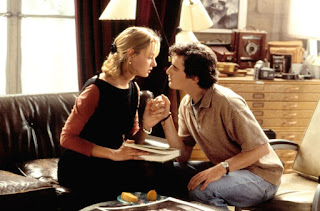
The movie is predictable, but there is a tiny amount of suspense. How will the disclosure of “Abby’s” real identity affect Noelle’s and Abby’s friendship?
There are signs that Noelle wants Brian for herself, despite his connection with Abby. But is Noelle really the kind of person who’d betray her friend?
Abby believes she might be. Partly, this is her knee-jerk assessment of women who are desired by lots and lots of men. But Abby also believes it because, in this case, it’s not altogether off the mark.
♦ ♦ ♦ ♦ ♦
I’ll give away the ending:
Noelle stands with her friend.

The movie has lots of animals in it. They’re included for comic effect. But the movie is about people, not animals. Why, then, is it called The Truth about Cats & Dogs? What truth does the movie reveal about cats and dogs?
Well, let’s allow ourselves to be a little crude and to put scare quotes around some of the words: THE TRUTH ABOUT “CATS” & “DOGS.” Some beautiful women are thought of as “cats” who undermine other women. And some women are thought of, or think of themselves, as ugly “dogs.” The title suggests that these hateful appraisals need not be true.
Also: “CATS” & “DOGS.” Ampersand. “Cats” and “dogs” in partnership – as friends.
The movie may be “soft and corny,” as Garofalo says, but that doesn’t make it anti-feminist. It’s anti-anti-feminist. It’s about how a smart woman who has trouble getting along with certain other women learns to see the truth about her friend and herself. Perhaps I’m “mansplaining,” but I wish Garofalo would look beyond the glamorous casting and the Banana Republic clothes and see the truth about what a lovely movie she’s helped to make.
Janeane Garofalo has been quite vocal about how unhappy she was with the film. Initially it was an independent film, but it was turned into a big-studio project when Uma Thurman signed on. Garofalo remarked, “I think it’s soft and corny. The soundtrack makes you want to puke. And everybody’s dressed in Banana Republic clothing. The original script and intent was very different. It was supposed to be a small-budget independent film, with a lot more complexity to the characters. …” Garofalo has since disowned the film, calling it anti-feminist.Ah, well, too bad. This is the movie she’ll be remembered for.
♦ ♦ ♦ ♦ ♦
Well, maybe not. IMDb lists the top four movies she’s known for:
- Ratatouille
- Mystery Men
- Wet Hot American Summer
- Romy and Michele’s High School Reunion
♦ ♦ ♦ ♦ ♦
I was just out of college when I saw this movie on TV. Since then, I’ve fondly remembered Garofalo’s performance. I didn’t remember that Uma Thurman was in the movie. Not that Thurman is bad; hers is a tricky role, and she acquits herself with aplomb. It’s just that Garofalo is superb.

Garofalo plays a type who appears now and then in romanctic comedies set in and around Los Angeles:
A variant of the “lonely hearts” columnist, this stock character dispenses advice, over the radio, about matters of the heart. Off the air, however, she is lonely. Against her better judgment, she permits one of her callers to get a little too close for comfort.The splendidly earnest Geneviève Bujold, in Choose Me (1984), occupies this role. A more recent example – who is much more crass – is a young woman who hosts a satellite radio show in the third season of Netflix’s Love.
Garofalo’s character, Abby Barnes, is situated halfway between these two radio personalities. A veterinarian, she gives medical and relational advice to pet owners. She has a distinctive style: her wordplay is quick and slightly off-color; her advice is blunt but kind. One can believe that a casual listener would stop turning the dial and settle down to hear Doctor Abby Barnes talk to strangers about their pets.
One caller is Brian (Ben Chaplin), a young Britisher whose dog is having a crisis. Abby gives helpful advice. Brian calls again (not on the air) to ask Abby out on a date. Abby reluctantly agrees.
“What do you look like?” Brian asks.
This touches a nerve. Abby tells him that she is tall and blond (she is short and dark). She stands him up.
And then the movie puts its stock protagonist into a rather different stock scenario:
The protagonist’s love object becomes attracted to one of the protagonist’s friends. To disavow any claim on the love object – and, perhaps, to remain in the love object’s orbit – the protagonist encourages the relationship by advising and lending considerable wit to the friend.This, of course, is the plot of Cyrano de Bergerac and its progeny (e.g., Roxanne). Usually, the witty, pining protagonist is a man, and the love object is a woman. This is inverted in The Truth about Cats & Dogs.
Abby’s friend is Noelle, a relatively new acquaintance who is getting out of a bad relationship. Noelle is played by Uma Thurman, who is blond and very tall. When Brian comes to the radio station to plead his case to Abby, he sees Noelle and infers that she must be Doctor Barnes.

Abby tells Noelle not to correct the misunderstanding. In the rest of the movie, Brian woos the awkward Noelle, whom he believes to be Abby, while Abby tags along as a “third wheel.” Of course, there are sparks between Abby and Brian.

And there you have it: the story plays out as you might expect it to do.
♦ ♦ ♦ ♦ ♦
The movie’s strength lies in its characterizations. Chaplin makes Brian into a very nice bloke. He is as kind to Abby as to Noelle when the three of them are together – and, indeed, when he and Abby happen to be together without Noelle. He also must convey both singlemindedness and vacillation: he is resolved to persist in wooing the person with whom he has spoken on the radio, but when he’s with “Abby,” she isn’t at all the sort of person he knows Abby to be.
The real Abby, loving him from afar, is the character who makes the movie fun to watch. It’s poignant to observe a cynical person gradually realize that she is desired for herself. In one long sequence, Brian calls Abby at her apartment. Since they’re physically apart, Brian believes he is talking to Uma Thurman’s “Abby.” Even so, the real Abby is drawn to him. She and Brian talk until early morning. One blush follows another as Abby hears Brian compliment her, tease her, and declare his love – love for her mind, her character, rather than for Uma Thurman’s looks.
Thurman’s is perhaps the most difficult role to pull off. Noelle, who is superficially dim, has reserves of insight and fellow-feeling. She receives lots of ill-intended focus from men. It’s as surpising to her as it is to Abby when someone as kind and attentive as Brian comes wooing.

The movie is predictable, but there is a tiny amount of suspense. How will the disclosure of “Abby’s” real identity affect Noelle’s and Abby’s friendship?
There are signs that Noelle wants Brian for herself, despite his connection with Abby. But is Noelle really the kind of person who’d betray her friend?
Abby believes she might be. Partly, this is her knee-jerk assessment of women who are desired by lots and lots of men. But Abby also believes it because, in this case, it’s not altogether off the mark.
♦ ♦ ♦ ♦ ♦
I’ll give away the ending:
Noelle stands with her friend.

The movie has lots of animals in it. They’re included for comic effect. But the movie is about people, not animals. Why, then, is it called The Truth about Cats & Dogs? What truth does the movie reveal about cats and dogs?
Well, let’s allow ourselves to be a little crude and to put scare quotes around some of the words: THE TRUTH ABOUT “CATS” & “DOGS.” Some beautiful women are thought of as “cats” who undermine other women. And some women are thought of, or think of themselves, as ugly “dogs.” The title suggests that these hateful appraisals need not be true.
Also: “CATS” & “DOGS.” Ampersand. “Cats” and “dogs” in partnership – as friends.
The movie may be “soft and corny,” as Garofalo says, but that doesn’t make it anti-feminist. It’s anti-anti-feminist. It’s about how a smart woman who has trouble getting along with certain other women learns to see the truth about her friend and herself. Perhaps I’m “mansplaining,” but I wish Garofalo would look beyond the glamorous casting and the Banana Republic clothes and see the truth about what a lovely movie she’s helped to make.
