Posts

Showing posts with the label Super Bowl

Seahawks 29, Patriots 13

A Super Bowl for connoisseurs of defensive football. I’m not one. I understand what’s happening when a DB breaks up a pass or a lineman beats his blocker and troubles the QB. But os and xs, zonal coverage, disguised coverage … I know these things exist, but I can’t perceive them – not in real time.

I like Kenneth Walker’s running. Dude calmly glides toward his blockers, awaits the defenders’ removal, scoots past them. Elegant. Not unlike slow-roll penalty taking (in soccer).

♦ ♦ ♦ ♦ ♦

My Facebook friends signal their politics by praising or condemning Bad Bunny’s halftime show.

What a stupid time to be alive.

I’ve not previously listened to Bad Bunny.

The sugarcane is good décor. The dancing is uncouth.

So are the lyrics. I learn them only by reading them online. (I can’t understand them sung; I have trouble with Puerto Rican Spanish.)

The apagón song stands out because I know what it’s like to endure frequent apagones (power outages). One extended passage in that song is reminiscent of, if not quite ideologically aligned with, The Vagina Monologues. Is it included in this Super Bowl performance? I’m not sure. I can’t make out enough words, and I’m distracted by utility-pole dancers.

USPS tracking

Alert: Winter storms in the Midwest through the Northeast U.S. and the professional football championship game in New Orleans may delay final delivery of your mail and packages.
No kidding. Behold the shipping history of the package I ordered three weeks ago:

Mishawaka
Mishawaka
Mishawaka
Indianapolis
Indianapolis
“In transit”
“In transit” (1.5 weeks later)
South Bend 😀
Indianapolis 😑
Indianapolis

(Indianapolis is 2–2.5 hrs. from Mishawaka and South Bend, which are across the street from each other.)

♦ ♦ ♦ ♦ ♦

Tonight’s Super Bowl’ll be shown on Fox – and, for the first time, on Tubi, which appears to be struggling to handle the increase in viewership. I can’t access my queue or viewing history on the app. I keep putting on Tom & Jerry, for Daniel, but when I go away it switches to Dances with Wolves. Daniel has given up and fallen asleep.

I, too, slept through most of that movie when I saw it twenty-five years ago. I can only suspend judgment as to its quality.

I’m impressed with Mary McDonnell’s hair.

Also, I’m reminded of this amusing error on Facebook (it’s surely due to A.I.).

February’s poem

It’s by Yeats:

⎯⎯⎯⎯⎯⎯⎯⎯⎯⎯
When you are old and grey and full of sleep,
And nodding by the fire, take down this book,
And slowly read, and dream of the soft look
Your eyes had once, and of their shadows deep;

How many loved your moments of glad grace,
And loved your beauty with love false or true,
But one man loved the pilgrim soul in you,
And loved the sorrows of your changing face;

And bending down beside the glowing bars,
Murmur, a little sadly, how Love fled
And paced upon the mountains overhead
And hid his face amid a crowd of stars.
⎯⎯⎯⎯⎯⎯⎯⎯⎯⎯


After the Super Bowl, Samuel wanted to listen to Taylor Swift.


Taylor: “She wears short skirts, I wear t-shirts …”

Samuel: “I wear t-shirts. And underwear.”

Yes, he does.

♦ ♦ ♦ ♦ ♦

Karin & I spent our Valentine’s outing (yesterday) getting haircuts and eating at Hacienda. Most years, we eat in the mall food court, so this was a step up.

Wheel, Jeopardy!, and How to Lose a Guy in 10 Days played on TV in the restaurant.

I really love Karin.

Murders on Orient Expresses

Hail to the Chiefs! Great team; great Super Bowl.

I tire of seeing the same teams succeed; but I wouldn’t mind if Reid, Mahomes & Co. kept on winning. This is saying something. I’ve despised the Chiefs most of my life.

I wish Travis Kelce & Taylor Swift all the best. ❤

♦ ♦ ♦ ♦ ♦

Speaking again of Kenneth Branagh: Here is a lovely video contrasting his (2017) and Sidney Lumet’s (1974) versions of Murder on the Orient Express.


I haven’t seen either movie. I don’t like the novel, although I love Christie and this is one of her most acclaimed works.

Cinema – Lumet’s kind, anyway – might be the best format for this story. What distinguishes each of these briskly treated characters is physicality: wrinkles, sex appeal, vigor, accent, clothes, etc. Stuff of cinema.

Christie was a dramatist, too. That’s what those suspects-gathered-in-one-room scenes at the end of her novels really are: theatre.

The sodfather; a warm day; a blood test; blurbs

Man ends 80-year career when bureaucrats tick him off (USA Today).

“They can’t tell me what to do anymore!”

… says the “Sodfather.”

♦ ♦ ♦ ♦ ♦

Wednesday: so warm, so dry, I let Samuel and Daniel have the run of the back yard. In shorts. We had a lovely time.


As of this afternoon, there’s snow-slush everywhere.

♦ ♦ ♦ ♦ ♦

Daniel went to his one-year checkup. They gave him five injections and poked him to test his blood. Seems a bit much, doesn’t it?

Anyway, he has too much lead in his blood.

♦ ♦ ♦ ♦ ♦

These are the best blurbs I’ve seen upon one dust jacket.

Re: the book:

“No summary or catalogue of details
will do it justice.” (Age)

Re: the author:

“Brilliant.” (Australian)

“Inspired.” (Sun-Herald)

“Irresistibly entertaining.” (Time Out New York)

“The genuine article.” (Australian Book Review)

“Gutsy.” (Australian’s Review of Books)

“Fast, funny, fabulous.” (The Adelaide Advertiser)

“World-class.” (Canberra Times)

“A cracker.” (Australian Bookseller & Publisher)

“Towering achievement.” (Guardian)

“Stone classic.” (Independent [UK])

“Top-class.” (Telegraph [UK])

“Startlingly good.” (Sydney Moring Herald)

“Powerfully economical.” (Bulletin)

I read the book. It truly was all of those things.

P.S. Australians are savage.

Another good anti-war essay

Karin: “Did you trim your mustache today, Sweetie?”

John-Paul: “No, Sweetie.”

Karin: “I thought you might have left it long, to show your support.”

John-Paul: “You mean for Andy Reid?”

Karin: “Yes, ha, ha.”

John-Paul: “Yes, that’s right, and that’s why I got fat again, too.”

♦ ♦ ♦ ♦ ♦

Tonight’s essay, by Richard Norman, is “The Case for Pacifism.” It takes the “skeptical” approach: it argues, first, that in the absence of a compelling justification, large-scale killing can be presumed to be wrong; and then that the best purported justifications of large-scale killing are not compelling enough. Finally (pp. 208 and 209), it addresses the lingering conviction that there are situations in which fighting nonetheless cannot be avoided:
If we can pin down the sense of the statement “We have no choice,” we may be in a position to understand why pacifism remains difficult to accept. …

When people say that one sometimes has no choice, what they mean, I think, is that by refusing to fight, say, against aggression, or indeed against internal oppression, one is acquiescing in a very great evil, and by acquiescing in it one is tacitly endorsing it. Morally speaking, faced with that evil, we have no choice but to resist it, and if the only way to resist it is to fight, then we have no choice but to fight.

Now this reading of the situation might be challenged. … One might say: “I have not acquiesced in Nazism. I refuse to engage in military resistance to it, … but that does not mean that I accept Nazism. I reject it wholeheartedly, I will give no support to it, and if the Nazis order me to cooperate with their crimes I shall disobey even though I may be shot.” …

Nevertheless, even if many people had thought and acted thus, it could remain true that, in an important sense, Nazism had not been resisted. This is because resistance to a social phenomenon such as aggression or oppression must, if it really is to count as resistance, take a socially identifiable form. … What forms of resistance are available will therefore depend upon the institutions and traditions of the community; and if the only recognised and organisable form of resistance is military resistance, then not fighting will mean not resisting. This, I think, is the significant sense in which people could say “We have no choice but to fight.”
This is another case of a pacifist explaining more clearly than do most “bellicists” (war apologists) how warring might continue to seem good, or necessary, to do, even after the usual justifications alluding to rights and harms have run out of steam.

Norman’s reconstruction of this bellicist argument has other applications. The same pattern of reasoning helps to make sense of a popular “anti-racist” claim: that failing to actively resist racism is itself a form of racism: that a person who merely refrains from engaging in racial discrimination, disrespecting, harming (etc.) and does not actively try to prevent or counteract others’ racism is himself guilty of racism. The underlying idea, as in the case of war, is that refraining from doing an evil without trying to prevent or counteract others’ doing it is a form of acquiescence, and that acquiescence in this evil is tacit endorsement of it. Each of these steps might be contested; here I just want to point out that insofar as “anti-racism” and advocacy of war both rely on this pattern of thought, they are structurally similar, and there is a prima facie tension in endorsing “anti-racism” together with pacifism; indeed, there would seem to be a tension between accepting pacifism and insisting on the viciousness of failing to promote a number of causes. Pacifists who, by temperament or habit, are militant activists need to examine themselves closely.

I said last time that I’d discuss “the encroachment of politics upon the sporting world.” It seems to me that the best argument for stripping a locale of its opportunity to host or participate in a sporting event is the same sort of argument that Norman advances on behalf of warring, and that whether the argument succeeds in a given situation depends on whether the above-delineated sequence of steps should be accepted in that situation. If Qatar, say, commits an injustice outside of sport, does allowing it to host the World Cup amount to acquiescing in that injustice? If so, does this amount to tacitly endorsing the injustice? How does allowing Qatar to host the World Cup compare, as a matter of tacit endorsement of injustice, with traveling to Qatar, trading with Qatar, maintaining diplomatic relations with Qatar, and so on? I suggest that this is a useful framework for assessing the widespread, knee-jerk disparagement of Qatar’s World Cup (and FIFA) that has taken place during the last dozen years.


Pre-gaming

On Sunday I’ll root for the Chiefs, but these Eagles seem terrific, so I’ll probably be entertained no matter who wins. I love it when the Super Bowl is contested by the two one-seeds.

In the 2010s, these Super Bowls were contested by both one-seeds:
  • Eagles and Patriots (good game)
  • Broncos and Panthers (bad game)
  • Patriots and Seahawks (awesome game)
  • Broncos and Seahawks (horror show, but very interesting – the Broncos set passing records while getting blown out)
(The games are in reverse chronological order.)

My inbox has been flooded with articles and videos whose subject is the NFL. Here are some of the best things I’ve looked at.

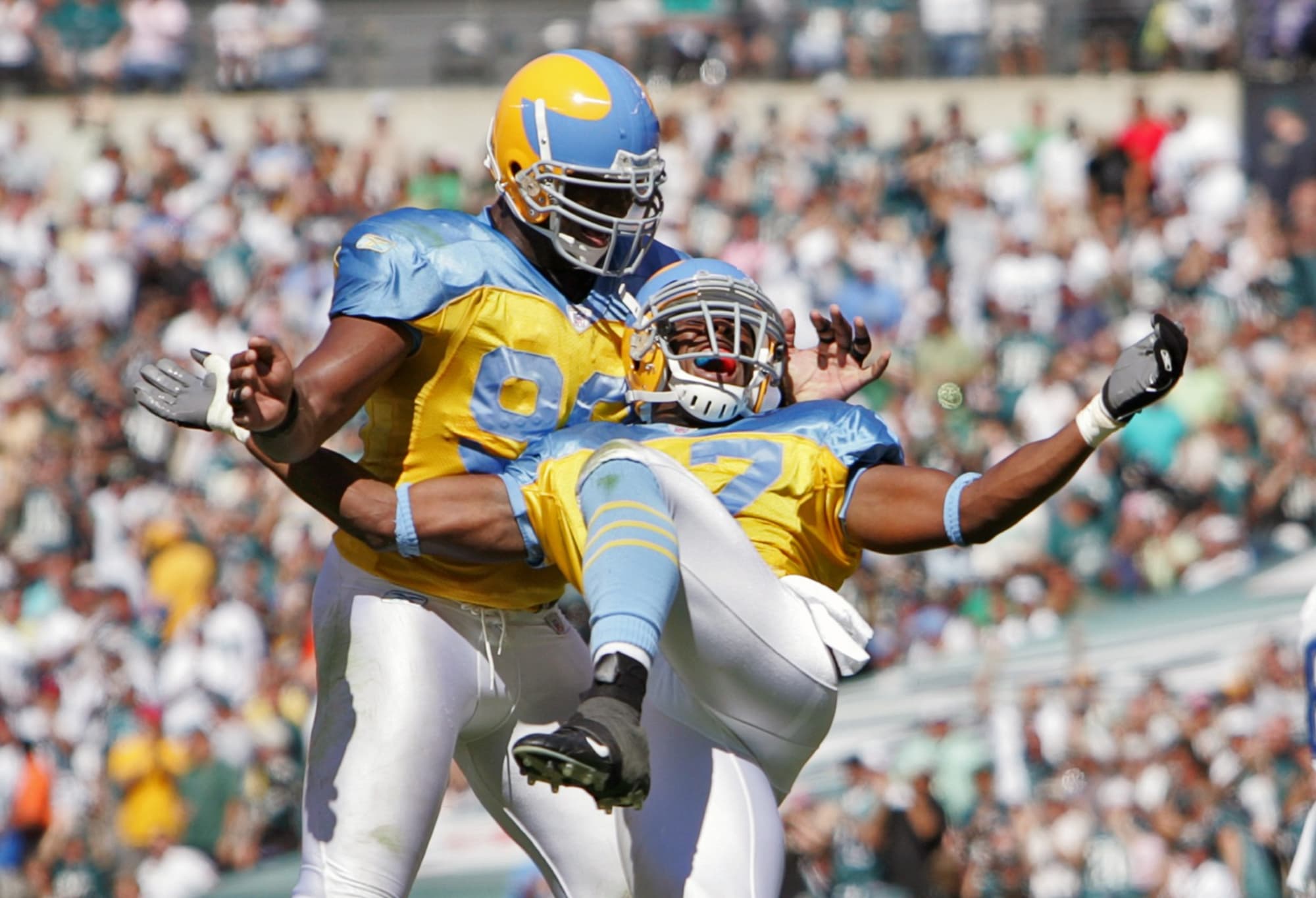
(1) A video of bizarre uniforms. The Eagles’ throwback uniforms of 2007 – which hearken back to the 1930s – might be the craziest NFL uniforms ever.

(2) Malcolm Butler recalls his great moment in the Patriots’ and Seahawks’ Super Bowl. That game was played in Arizona, in the same venue as this year’s Super Bowl.

(3) This article is about how Arizona was supposed to have hosted the Super Bowl in 1993 but didn’t do so. After that state refused to observe a holiday for MLK Jr., the NFL moved the game to California.

I have more to say about the encroachment of politics upon the sporting world, but I’ll wait until next time.

♦ ♦ ♦ ♦ ♦

What with its pageantry, the Super Bowl tends to get me thinking about war – this year, especially, because of a classic but currently unfashionable essay by William James, “The Moral Equivalent of War.” A pacifist, James concedes that war meets a real need felt by its advocates – a need that pacifists have had trouble acknowledging and which they certainly haven’t addressed in a compelling fashion.

The essay predates WW1. James doesn’t foresee that the martial values that he describes so well – hardiness, communal glory, individual subordination – would decline, or at least fall into some disrepute, as a result of the carnage of the twentieth century. But I think he is right that they are permanent, that they point toward things that are of essential significance for humans.

Toward the end of the essay, James tries to redirect the enduring militaristic impulses. He wants them to be productive, not destructive. He seems to have in mind ventures like the Boy Scouts or the (still-to-come) TVA. He says that he wants people to band together to fight against nature, not each other.

Again, he hasn’t had the benefit of witnessing the destruction of the Aral Sea – or, for that matter, that of the Great Salt Lake.

Nor does he foresee that martial itches would be scratched, at personal remove but with clinical efficiency, by such entities as the modern NFL.

Still, it’s a great essay.

Chiefs 31, 49ers 20

Last night’s was an exceptional Super Bowl, what with the Chiefs scoring 21 points in the last 6 minutes to defeat the 49ers. It took the Chiefs fifty minutes to unlock the Niners’ defense, and then it was like, BLAM, BLAM, BLAM. Mahomes, who’d thrown poorly in the third quarter, marshaled the late raid and was the MVP.

Over the years, I’ve tended to root against the Chiefs, but I do like this version of the club. I was especially happy for the Chiefs’ coach, Andy Reid, who won his first Super Bowl after having led NFL teams for 21 years. Reid is about as affable a big-time coach as there is.

You can tell it from this article in The Atlantic, written in 2008 when Reid was coaching the Eagles. It describes him analyzing the historic 1958 NFL championship game. It’s a good read (no pun intended).

A dud

If most Super Bowls were like tonight’s, I wouldn’t make it an annual priority to watch the game.

Patriots 13, Rams 3.

This was the Patriots’ sixth victory in a Super Bowl.

It also featured their largest winning margin in a Super Bowl. It was their “blowout” victory, so to speak.

Their defense played lights-out. Then again, the Rams’ once-great offense had been pretty well contained by several teams late in the season. (And let’s admit it: hardly anyone who watches football really knows how defending works; I certainly don’t.)

It was a good game to watch with Karin’s dad’s family (hardly football purists). They talked all the first half about the newest Pokémon and superhero movies, then complained because at halftime Maroon 5 didn’t play what they wished to hear.