Posts

Showing posts with the label war

June’s poem

Wilfred Owen’s:

⎯⎯⎯⎯⎯⎯⎯⎯⎯⎯
Bent double, like old beggars under sacks,
Knock-kneed, coughing like hags, we cursed through sludge,
Till on the haunting flares we turned our backs,
And towards our distant rest began to trudge.
Men marched asleep. Many had lost their boots,
But limped on, blood-shod. All went lame; all blind;
Drunk with fatigue; deaf even to the hoots
Of gas-shells dropping softly behind.

Gas! GAS! Quick, boys! – An ecstasy of fumbling
Fitting the clumsy helmets just in time,
But someone still was yelling out and stumbling
And flound’ring like a man in fire or lime. –
Dim through the misty panes and thick green light,
As under a green sea, I saw him drowning.
In all my dreams before my helpless sight,
He plunges at me, guttering, choking, drowning.

If in some smothering dreams, you too could pace
Behind the wagon that we flung him in,
And watch the white eyes writhing in his face,
His hanging face, like a devil’s sick of sin;
If you could hear, at every jolt, the blood
Come gargling from the froth-corrupted lungs,
Obscene as cancer, bitter as the cud
Of vile, incurable sores on innocent tongues, –
My friend, you would not tell with such high zest
To children ardent for some desperate glory,
The old Lie: Dulce et decorum est
Pro patria mori.
⎯⎯⎯⎯⎯⎯⎯⎯⎯⎯

♦ ♦ ♦ ♦ ♦

Better to chase glory in the World Cup than in war.

It’s Iran’s privilege to do both. The soccer team will be forced to fly into and out of the United States, each game day, to keep appointments.

Africa’s top-rated referee – a Somali – has been refused entry by the U.S. government.

Body-text fonts, pt. 49: ITC Garamond

The Iranians are trying to have their World Cup games moved from the U.S. to Mexico.

Good. Luck.

♦ ♦ ♦ ♦ ♦

Six-year-old Samuel, whom we don’t allow to use social media, has been talking about giving up social media for a week. 🙄

Not for Lent’s sake. For a Klondike bar. (“What would you do for a Klondike bar?”)

♦ ♦ ♦ ♦ ♦

Chubby ITC Garamond is this month’s typeface. (This link is to the darker version, and this link is to the lighter version.)


My children are less “Charlie Bucket,” more “Mike Teavee.”

Paul’s bedtime reading

Iran’s team has withdrawn from the World Cup. The newspapers are taking it in stride.

Surely, I’m not the only dismayed soccer follower in the West?

Update (March 13): The team has not withdrawn (or been ousted).

I’ll let you know when I know what I’m talking about.

♦ ♦ ♦ ♦ ♦

The war’s death toll has risen. And it’s beyond doubt that the U.S. killed those schoolchildren.

Update: I really hope the news about something so important is beyond doubt.

♦ ♦ ♦ ♦ ♦

I’ve also updated my unchangeable and definite reading list of the next two months. I’ll try to finish not five, not ten, but twenty-four more books before the late-April conclusion of my 2025–2026 cycle. And so it’s particularly cruel of the Web bots to pepper me with ads for the new John Galsworthy PBS show. I just can’t fit all nine of those novels into the schedule. If only Abel didn’t cling to me all day long.

♦ ♦ ♦ ♦ ♦
Little suspecting the incalculable consequences that the evening was to have for him, [Paul Pennyfeather] bicycled happily back from a meeting of the League of Nations Union. There had been a most interesting paper about plebiscites in Poland. He thought of smoking a pipe and reading another chapter of the Forsyte Saga before going to bed. He knocked at the gate, was admitted, put away his bicycle, and diffidently, as always, made his way across the quad towards his rooms. What a lot of people there seemed to be about! Paul had no particular objection to drunkenness – he had read a rather daring paper to the Thomas More Society on the subject – but he was consumedly shy of drunkards.
I think Paul Pennyfeather’s life sounds lovely (except for that ominous bit about “incalculable consequences”).

The good news is, the Forsyte show looks missable.

Springtime (pre-equinox)

Loud t-storm; air so warm, we have windows open. Earlier, when Samuel’s school bus arrived, he paced the aisle, unwilling to disembark in what was then a light rain. I had to climb aboard to coax him out. And earlier still, I’d gone with Karin, Abel, and Daniel to meet the boys’ new doctor (the previous one, a Seventh-day Adventist, has moved to Guam for a three-year religious sojourn). Upon our return to Toad Hall, the alarm was blaring. It took us an age to turn it off. Daniel ran down the block, did a round of hopscotch, and ran back.

I’m tempted to try reading Virginia Woolf’s Orlando, but the schedule is just too packed.


“He – for there could be no doubt about his sex, though the fashion of the time did something to disguise it – was in the act of slicing at the head of a Moor which swung from the rafters.”

(The opening lines.)

♦ ♦ ♦ ♦ ♦

I’m reading Adrian Mole and the Weapons of Mass Destruction, set just before Britain’s 2003 invasion of Iraq. Adrian is a die-hard Blair supporter. He believes there will be no war because that’s what Blair tells Britain. Adrian’s 17-year-old son Glenn has joined up and trains in Aldershot, running in full battle-dress on builder’s sand. Adrian has just used a Barclaycard blank check (29% interest) to obtain down payment funds (I forget how many thousands of pounds) for his trendy canalside loft, which he is furnishing on store credit (almost £10,000 at 20% interest). Moreover, his parents have sold their house to a developer and bought a pig-sty to convert, by “DIY” methods, into their new dwelling (“The Piggeries”). Meanwhile they live in a tent.

It’s a cheap trick, relaying what’s in other people’s books, but this stuff is too good to keep quiet about.

Iran at the World Cup?


Again, I wish FIFA would choose a host that did care.


Iran’s withdrawal is likely. Maybe we’ll know more after the U.S. completes the expected four-to-five weeks of bombardment. Because then the war’ll be done-and-dusted, won’t it? Because, as Trump himself professes, Iran already “is a very badly defeated country.”

If Iran does play in the World Cup, this eye-popping scenario will be possible:
Iran is currently scheduled to play New Zealand in Los Angeles on June 15, Belgium in Los Angeles on June 21 and Egypt in Seattle on June 26. If both the U.S. and Iran finish second in their respective groups, the two countries could face off in a July 3 elimination match in Dallas.
The two countries played what were, in effect, elimination matches (in the group stage) in 1998 and 2022. Iran won the first meeting; the U.S. won the second one.

1996, the best year in movie history, pt. 96: Wag the dog

What with the ongoing sex scandal and, now, a war, Wag the Dog (1997) is the obvious choice for this month. (Well, either it or Canadian Bacon [1995].)

Actors:
  • De Niro
  • Dunst
  • Harrelson
  • Heche
  • Hoffman
  • Macy
and
  • Willie Nelson (who, in scenes reminiscent of Nashville, directs a patriotic choir)
Wag the Dog is funny. It ticks a lot of boxes, satire-wise.

Trouble is, it’s not cynical enough.

Nowadays, this is a quaint, almost feel-good movie.

The country, nowadays, is that much worse.

The nineties were a gentler time.


R.I.P. Keith and Stu

… missionaries to Ecuador (and other countries) who died within days of each other. Fixtures of my early life. Good men. Heroes, arguably. Keith gave his wife, Ruth Ann, a kidney. He died of complications from the surgery. Stu’s death was brought on by lung trouble resulting from Vietnam War wounds. He climbed mountains and ran marathons, but, over time, his injuries took their toll.

Stu and his wife, Bev, managed my dorm during two of my boarding-school years. They were kind. Stu used to take me jogging, and he helped me to get the hang of algebra. We’d talk about his reading: Dante, Cervantes, Hugo, Tolstoy, Pasternak, Herman Wouk, Bodie and Brock Thoene. I got him to read Kenneth Grahame and Jerome K. Jerome.

I remarked to someone, the other day, that my favorite missionaries were from Canada and the Midwest – especially, Minnesota. Keith was from Ontario, and Stu was from the Gopher/​North Star State.

1996, the best year in movie history, pt. 92: Starship troopers

Well, that was a ludicrous display. Palmeiras 4, Liga 0. The Brazilians advance, 4–3 (on aggregate).

♦ ♦ ♦ ♦ ♦

Happy Halloween. This month, I review a 1997 movie with the IMDb description, “Humans, in a fascist militaristic future, wage war against giant alien bugs.”

“Fascist” – or something else? “Advanced neoliberal,” perhaps? That would make the movie a more pointed commentary on its time.

(“Neoliberalism” has several definitions, but the most common one is something like “the pursuit of economic integration on a global scale” – capitalist economic integration, to be precise. Warring doesn’t come into the definition, but it certainly has aided capitalist powers in establishing and maintaining their trade networks.)

Globalist capitalism appears to have triumphed so comprehensively in Starship Troopers that the planet’s cities have become indistinguishable. Our young protagonists hail from Buenos Aires but speak in English and look and act like stereotypical rich kids from Southern California. Most are concerned, not with the polis – the “Federation” – but with personal projects and desires. They aren’t nationalists, racists, or devotees of a “Great Leader”; but the common good isn’t foremost in their thinking, either.

The most ambitious high school graduates are willing to endure privation in order to rule. In the Federation, military service is what confers “citizenship” – roughly, the right to extend one’s influence by other means than capitalist free exchange. (This is my characterization. The movie doesn’t state this rather abstract notion in so many words.)

Hence: voting, governing, teaching, and childrearing are permissible only for the few. The violence-wielders. The warriors.

Domination is the basis of the global order. All pretense to the contrary has been dropped.

♦ ♦ ♦ ♦ ♦

This is made clear during a high school civics lesson:
TEACHER
All right, let’s sum up. This year we explored the failure of democracy: how our social scientists brought our world to the brink of chaos. We talked about the veterans, how they took control and established the stability that has lasted for generations since. You know these facts, but have I taught you anything of value this year?
(To a student)
You. Why are only citizens allowed to vote?

FIRST STUDENT
It’s a reward. Something the Federation gives you for doing federal service.

TEACHER
No. Something given has no value. When you vote, you are exercising political authority, you’re using force. And force, my friends, is violence. The supreme authority from which all other authorities are derived.

SECOND STUDENT
My mother always told me that violence doesn’t solve anything.

TEACHER
Really? I wonder what the city founders of Hiroshima would have to say about that.
(To a student)
You.

THIRD STUDENT
They wouldn’t say anything. Hiroshima was destroyed.

TEACHER
Correct. Naked force has resolved more conflicts throughout history than any other factor. The contrary opinion, that violence doesn’t solve anything, is wishful thinking at its worst. People who forget that always die.
The teacher (Michael Ironside), a grizzled old soldier, delivers his lesson sternly, compellingly. It sounds better than it looks on the page. I can think of a few objections to the argument. But then I imagine the teacher knocking me out cold with his arm-prosthesis: “I refute you thus.”

♦ ♦ ♦ ♦ ♦

Ideological stage-setting occupies the movie’s first half. The second half is given over to Humanity’s war against the Bugs, in scenes that manage to be cartoonish but also, dare I say, sublime.

The troopers land on a craggy desert planet. Most carry only machine guns – mere pea-shooters (the Bugs’ exoskeletons are bulletproof). The slaughter of Humans is terrible but not terribly affecting. Troopers are impaled and burned. Their brains are sucked out. Their limbs and heads are severed. Such things do happen in combat (well, maybe not the brain-sucking). I don’t know if they look ridiculous in real life. They do onscreen.

The sublimity of these scenes comes from seeing Bugs cover the landscape. The troopers’ situation is grave – tragic, even.

It ought to dawn on these soldiers – aspiring citizens, i.e. dominators – that they’ve been brought in as Bug fodder. Being dominated is their lot, as it is that of enemies and civilians. High-ranking warriors dominate their subordinates: they “play God”; they delegate suffering and death to the lower ranks while uttering platitudes about the good of the species. To the audience, these platitudes ring hollow since the species is evidently not very concerned about the common good.

But a curious thing happens. Maybe it happens in real life, too. The troopers – not the lofty generals, colonels, and starship captains, but those belonging to the lowliest infantry ranks – develop something akin to altruism. Faced with likely death, they become intensely loyal to their unit. They assume responsibility for the well-being of civilians – those whom they’d set out to dominate. I say this is akin to altruism because they still have no sympathy for the enemy. But it’s something.

There are viewers who interpret the whole movie cynically, who read the pervasively campy, mocking tone as applying to everything that happens. (It’s well known that the director, Paul Verhoeven, was deliberately subverting the jingoistic 1959 novel by Robert A. Heinlein.)

They have a strong case. Why are Humans and Bugs at war? Not just because the Bugs bombed Earth (but did they? see the last video below). Rather, because Humans first encroached. Encroaching is what Humans do. In particular, it’s what expansionist capitalists do. (Recall Hannah Arendt’s quotation of Cecil Rhodes: “I would annex the planets if I could.”) It’s briefly noted, early on, that a group of rogue Mormons has attempted to settle in Bug territory. Their foray may have been illegal and ill-considered, but the other Earthlings are happy to endorse it – post hoc – with force. Doing so allows them to flex military muscle abroad and at home. By implication, this isn’t the first expansionist war against residents of other planets, and it won’t be the last. The troopers themselves may develop noble, self-sacrificial ideals, but these just serve a regime of mostly selfish, violently competitive individuals doing land grab after land grab.

I don’t say the movie doesn’t intend to make these points, but I’m not sure that it doesn’t regard the troopers’ ideals as something valuable.

There’s a romantic subplot. Johnny (Casper Van Dien) loves Carmen (Denise Richards). Carmen, a selfish careerist, is on track to become a military starship pilot. Johnny doesn’t have the test scores for that, so he joins the infantry; he can at least become a citizen like Carmen. Dizzy (Dina Meyer, from Dragonheart) loves Johnny. She could become a professional athlete, but instead she joins the infantry so she can be near to Johnny. She knows that Johnny loves Carmen, but she pursues him anyway, even if it means dying. Here is self-sacrifice, born not out of servility to dominators or the trauma of war or hopeless nearness to death, but autonomous and unconcerned with death. Here is something good.

The classroom scene:


A relatively tame (still gruesome) battle scene:


One of 10,000 “fan theories” from the Internet:

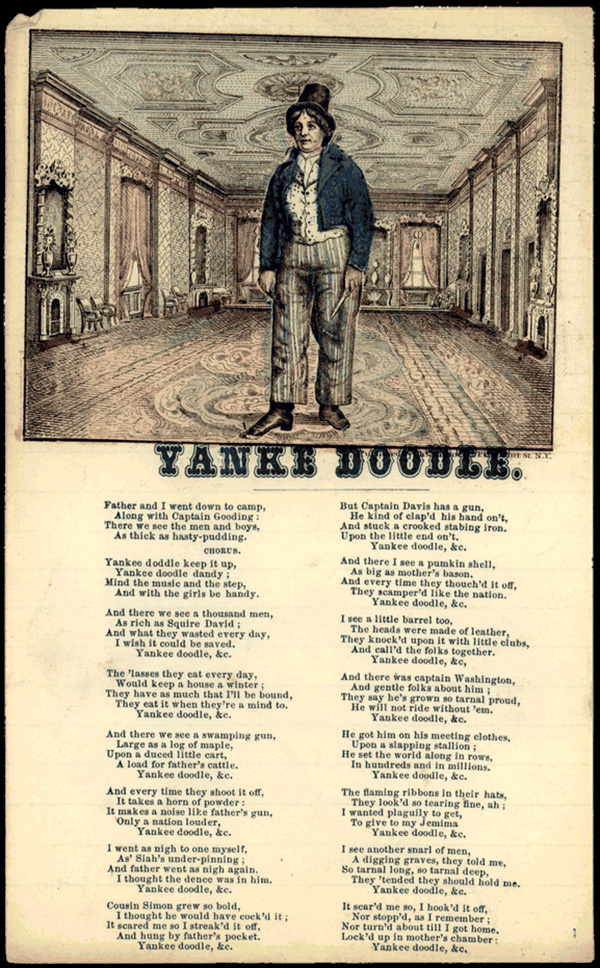
July’s poem

⎯⎯⎯⎯⎯⎯⎯⎯⎯⎯
Yankee Doodle went to town
A-riding on a pony
Stuck a feather in his cap
And called it macaroni

Yankee Doodle, keep it up
Yankee Doodle dandy
Mind the music and the step
And with the girls be handy

Father and I went down to camp
Along with Captain Gooding
And there we saw the men and boys
As thick as hasty pudding

Yankee Doodle, keep it up
Yankee Doodle dandy
Mind the music and the step
And with the girls be handy

And there we saw a thousand men
As rich as Squire David
And what they wasted every day
I wish it could be savèd

Yankee Doodle, keep it up
Yankee Doodle dandy
Mind the music and the step
And with the girls be handy

The ’lasses they eat every day
Would keep a house a winter
They have so much, that I’ll be bound
They eat when they’ve a mind to

Yankee Doodle, keep it up
Yankee Doodle dandy
Mind the music and the step
And with the girls be handy

And there I see a swamping gun
Large as a log of maple
Upon a deucèd little cart
A load for Father’s cattle

Yankee Doodle, keep it up
Yankee Doodle dandy
Mind the music and the step
And with the girls be handy

And every time they shoot it off
It takes a horn of powder
And makes a noise like Father’s gun
Only a ’nation louder

Yankee Doodle, keep it up
Yankee Doodle dandy
Mind the music and the step
And with the girls be handy

I went as nigh to one myself
As Siah’s under-pinning
And Father went as nigh again
I thought the deuce was in him

Yankee Doodle, keep it up
Yankee Doodle dandy
Mind the music and the step
And with the girls be handy

Cousin Simon grew so bold
I thought he would have cock’d it
It scar’d me so I shrink’d it off
And hung by Father’s pocket

Yankee Doodle, keep it up
Yankee Doodle dandy
Mind the music and the step
And with the girls be handy

And Cap’n Davis had a gun
He kind of clapt ’s hand on’t
And stuck a crooked stabbing iron
Upon the little end on’t

Yankee Doodle, keep it up
Yankee Doodle dandy
Mind the music and the step
And with the girls be handy

And there I see a pumpkin shell
As big as mother’s basin
And every time they touch’d it off
They scampered like the ’nation

Yankee Doodle, keep it up
Yankee Doodle dandy
Mind the music and the step
And with the girls be handy

I see a little barrel too
The heads were made of leather
They knock’d on it with little clubs
And call’d the folks together

Yankee Doodle, keep it up
Yankee Doodle dandy
Mind the music and the step
And with the girls be handy

And there was Cap’n Washington
And gentle folks about him
They say he’s grown so ’tarnal proud
He will not ride without ’em

Yankee Doodle, keep it up
Yankee Doodle dandy
Mind the music and the step
And with the girls be handy

He got him on his meeting clothes
Upon a slapping stallion
He sat the world along in rows
In hundreds and in millions

Yankee Doodle, keep it up
Yankee Doodle dandy
Mind the music and the step
And with the girls be handy

The flaming ribbons in his hat
They look’d so tearing fine, ah
I wanted dreadfully to get
To give to my Jemima

Yankee Doodle, keep it up
Yankee Doodle dandy
Mind the music and the step
And with the girls be handy

I see another snarl of men
A-digging graves, they told me
So ’tarnal long, so ’tarnal deep
They ’tended they should hold me

Yankee Doodle, keep it up
Yankee Doodle dandy
Mind the music and the step
And with the girls be handy

It scar’d me so, I hook’d it off
Nor stopp’d, as I remember
Nor turn’d about till I got home
Lock’d up in mother’s chamber

Yankee Doodle, keep it up
Yankee Doodle dandy
Mind the music and the step
And with the girls be handy
⎯⎯⎯⎯⎯⎯⎯⎯⎯⎯

Transcribed, accurately, more or less, from Wikipedia; resembles this version, more or less.

“NOW IS THE TIME FOR PEACE!”


Hot today, huh? I mowed this morning: it was only going to get hotter. I left ten percent unmowed. I felt like collapsing.

I lent the mower to our neighbor, and he mowed his lawn and felt like collapsing. When he returned the mower he told us about his recent excursions to Kroger. The security guard there embroiled himself in a dispute, and a half-dozen shoppers slipped away without paying. Another shopper loaded a hundred dollars’ worth of meat into his cart and fled without paying. Our favorite worker got fired for shoving someone in a dispute; he’ll get rehired, our neighbor expects. Our neighbor “almost got into it” with the butcher, then with the deli worker. Then he “almost got into it” with the worker who shelves the sleeves of bread (who’d nearly run him over in the parking lot). “Sounds like you need to chill out,” I told our neighbor. We like him, we get along great, but the better we know him, the more people he tells us he’s “almost gotten into it” with. He’s a chill guy, he assures us.

I worry that our Kroger will close down, because that’s something that happens to less-than-upscale supermarkets like ours. Please pray that it doesn’t close down. We love and need our Kroger.

Happy Father’s Day

… to all fathers; particularly:
  • mine own
  • mine by marriage (two living, one deceased)
My family almost always spends the day with Karin’s dad and his dad, in Goshen. We eat grilled meats, then go out strolling in the heat. Today it was painfully bright if not quite sweltering. We took the boys to a park.

Photos of my progeny: Samuel, Daniel, Abel.


Notice Samuel’s fighter jet: a gift from his grandpa, who, I believe, had just toured the Grissom Air Reserve base. (Daniel got one, too.)

The boys all loved the swings. Daniel fell off his, soon after the pic was taken.

I’m not used to being celebrated. It’s been only a few years since I became a father. Karin asked if I wanted anything. I said an opportunity to mow, a fastfood snack, and a thriftstore book hunt; and that’s what I got.

War plans; an inauspicious debut

From The Atlantic. If you can access it, read it. It describes shocking security breaches, callous disregard for human life, reckless emoji use, etc. Also shocking (but not surprising) is the current administration’s hatred of … Europe. Someone should force the Vice President and his cronies to turn off their phones, sit still, and watch some alluring travel videos by Rick Steves. …

This has been the wildest news story of the week.

♦ ♦ ♦ ♦ ♦

I take it back. Wilder, if less consequential, was Ecuador’s decision to start 17-year-old Darwin Guagua against Chile tonight. The boy hadn’t even debuted at the senior level for Independiente del Valle, his club.

The soccer federation appears to be trying to show off young Ecuadorian players so that European clubs will buy them. Federation officials probably are cutting backroom deals with local clubs and then pressuring the national team’s coach to field certain players.

Guagua had been about to enter Friday’s game as a late substitute. But when the Venezuelans scored, our coach, Sebastián Beccacece, left him on the bench. So, tonight, Guagua got to start. (I doubt it was what Beccacece wanted.)

The Chileans ate Guagua alive. We effectively ceded our left flank to them for half of the game.

Apart from that, our performance was … good. Kind of awesome. Unbalanced though we were, we contained the Chileans until halftime and dominated them afterward. The result was a goalless draw. Enner put the ball into the net but was narrowly offside.

We remain in second place. No other team gained ground on us this week, except Argentina.

Incidentally, guagua, in the indigenous languages of the Andes, means baby.

The “51st state,” pt. 2

A message from my high school French teacher and gentle fellow blogger, Madame Lorrie:
Good evening, JP – I just read your recent post regarding our sovereign nation. Most Canadians are spitting angry at the US President. I am one of them. We are refusing to purchase goods made in the USA, even groceries, which makes for some creative shopping. Stores are responding and are sourcing fruits and vegetables from countries other than the US with great success. We will not be traveling to the US for the foreseeable future.

I do thank you for the link to the list of Canadian literature. I have read 18 of them, mostly the fiction works, in my CanLit courses and my French courses. Alligator Pie is a fun book that my grandchildren enjoy listening to. Lots of rollicking rhythm and pure silliness that makes us all giggle.

We will not be conquered!

Hope you and your family are doing well.
I really ought to set up a decent commenting function for this blog.

Madame always was the best commenter.

Bless Canada. And Panama, and Greenland (and Denmark).

P.S. And Gaza. And Ukraine.

I shudder to think what other places will be added to the list.

Mitfords, pt. 8; body-text fonts, pt. 26: Dante; effects of nuclear attack

N. Mitford’s seventh novel, The Blessing (1951), is about an Englishwoman who moves to France with her promiscuous French husband and their son (and their son’s English, xenophobic nanny, who once was the Englishwoman’s nanny).

France-Britain comparison had been creeping into Mitford’s previous novels and here is “on at full blast.” Mitford lived her last years in France.

The dedication is to Evelyn Waugh.

My reading copy is The Penguin Complete Novels of Nancy Mitford: nearly 1,000 large pages set in teeny-tiny Dante (a font with pleasing apostrophes). What follows is a rather atypical passage for Mitford, since the main speaker is from the USA. The setting is a dinner party. The New Worlders want to talk global politics; the Old Worlders want to forget warring and get back to bedroom politics.


– let me finish –
what they ought to do in the case of atomic explosion, such explosion is robbed of half, or one-third, its terrors.’

‘Thank you, Charlie,’ said Mr Dexter. ‘I for one feel a lot easier in my mind. There is nothing so dangerous as a policy of lassair-aller, and I am very glad that the great American public, if I may say so, M. de Valhubert, without offending your feelings, is not hiding its head in the sand, but is looking the Bomb squarely in the eye.’
(“Heck” – para. 3 – is not an expletive but a British-conceived U.S. diminutive of “Hector.”)

This is hardly my favorite N. Mitford passage. But it goes nicely with this remarkable essay in the Daily Mail, also read by me today, which gives “macabre minute-by-minute detail” about what would happen during a nuclear attack. (Hat tip: Leiter.)

Sobering stuff, even if flanked by links to articles about celebrities, conjoined twins, sea monsters, and UFOs.

Bathtime; speech patterns; Orwell, pt. 2

Sick kids today. Right now they’re feeling OK; they’ve been medicated and bathed. Samuel has been granted six more minutes in the tub. I don’t want him to drown, but I don’t want to sit by the tub all that time, either. I’m a busy guy.

Sing to me, I tell him.

(I want him to make noises while I’m out of the room.)

No.

Sing “The Greatest Adventure.”

No.

(Alas, Samuel is no bathtime Pavarotti.)

I keep suggesting songs for him, he keeps saying no, and then it’s time for him to get out of the tub. That’s one way to do it.

Now the boys are chowing down on sandwiches. They wouldn’t eat the chicken noodle soup I cooked earlier tonight.

I usually drain the water out of it, says Karin.

Indeed.

Uh, says Daniel.

He means Ziva. He’s picked up the habit of saying only final syllables (or, in some cases, vowel sounds). If I put him to bed, he’ll say er, meaning pacifier. Suppose he’s talking about planets. He’ll say Nus. I’ll have to use contextual clues to figure out whether he means Venus or Uranus. He knows how to say full words; he’s just awfully casual.

Samuel, on the other hand, distinguishes every word, every syllable, every audible letter, with the utmost care. No “Mairzy Doats” for him.

♦ ♦ ♦ ♦ ♦

More Orwell. I’ve reached his Spanish Civil War essays. Not having read Homage to Catalonia – or any survey of that war – I find myself pretty badly out of my depth as to what all the different parties were trying to achieve. But then, Orwell’s point seems to be that the conflict was largely misunderstood outside of Spain, and that the few who did understand it used it for their own ends, as propaganda.

Interestingly, as the volume’s content becomes more complex and abstract, Orwell’s tone gets angrier. Traveling to Spain and fighting with a haphazardly chosen militia must have been a whole other kettle of fish than going, soused, into the clink for a few hours with burglars and embezzlers.

1996, the best year in movie history, pt. 71: War of the buttons

In the fifth and sixth grades, in Esmeraldas, I used to join my Room B classmates in the daily battle against the goons of Room A (and, occasionally, those of Room C, although those boys usually took our side). By “battle,” I mean we’d play soccer, fiercely, in the dirt – school uniforms be damned. I knew some of the boys were getting into trouble at home for this.

A rather rougher feud is the subject of War of the Buttons. The boys of Ballydowse and Carrickdowse, in County Cork, attend different schools; they can’t battle during recess, so they conduct after-hours warfare.

A Carrick boy calls a Bally boy a toss-pot. How bad is that word? To find out, the Bally boys bribe a younger child to say “toss-pot” to the priest. The priest chases the child out of the church.

The Bally boys sneak over to Carrickdowse at night and vandalize a billboard. The Carrick boys retaliate. Soon the two sides are taking prisoners and cutting off each other’s buttons, shoelaces, and neckties. This is hard on the Bally boys, who are poorer; the poorest among them are sure to get thrashed at home.

This only strengthens the resolve of one urchin: Fergus, the Bally boys’ brave leader. He instructs his troops to fight naked to avoid losing buttons; when they object, he imposes a fundraising scheme so they can buy more buttons. This tests their loyalty. Some grumble. Some commit treason. The feud, once two-sided, becomes more complex.

The movie begins with children aping grownups. Eventually, the grownups themselves, with their own resentments, which may have initially inspired the children’s conflict, get dragged into the war. Cutesy entertainment becomes dire parable.


The screenwriter, Colin Welland, won an Oscar for writing the great Chariots of Fire. He also won a BAFTA for acting in Ken Loach’s great Kes, playing a teacher who is kind to an oppressed but spirited little boy. There is a kind schoolmaster in Buttons, too, who looks after the downtrodden Fergus.

Welland himself was a teacher, as was Louis Pergaud, the author of the 1912 novel. A pacifist, Pergaud was conscripted in WW1, wounded, captured, and killed when his own side attacked the field hospital where he was convalescing. His novel was hugely popular in his native France. The French filmed it in 1962 and twice in 2011 – once setting it during WW2, with villagers, Jews, and Nazis.

I don’t know if any Irish strove to adapt the parable to their own society. This seems to have been an English endeavor. I don’t think it matters where it’s set. Like Truffaut’s Small Change, this is a tale of Urchins Everywhere, beginning, predictably, with their gusto and pluck and then slyly turning the spotlight upon their suffering – and on the differences between the boys.

Violence in Ecuador worsens

Ecuador is in an “internal state of war” after a spate of widespread, coordinated gang violence.

President Daniel Noboa has declared a sixty-day state of emergency.

The news is on Wikipedia’s main page. Whenever Ecuador is front-and-center there, I feel a twinge of pride, and then more often than not I weep (silently) because it’s because of something terrible. (Here is the Wikipedia article.)

There’s lots of official press coverage, of course.

Pray for Ecuador!

♦ ♦ ♦ ♦ ♦

In other news:

“BYU Offering New Taylor Swift-Inspired Philosophy Course.”

(“Philoswiftie” website.)

Move over, Immanuel Kant.

Closing credits

What happened in 2023? It’s a blur. I get through a day at a time. I barely look ahead or behind.

Mostly, I chase after children who live only in the moment. They are rather wicked. (As I compose this, one of them is removing his diaper and peeing on the floor.) My wife kindly looks after them a few hours every third evening so I can record my thoughts on this blog; a week later, I’ll’ve forgotten what I’ve written.

I steal moments to do a little reading. A book or two later, I’ll’ve forgotten what I’ve read.

Someone at a party asked which books I liked best this year. I said Shakespeare, Harry Potter, and Narnia; I had trouble remembering anything not in a series. I had to check my list of “completed” books after I got home.

My life is turning into a series of disconnected events. I’m becoming the hero of Borges’s “Funes, the Memorious,” only without the memories.

♦ ♦ ♦ ♦ ♦

Before I forget, I wish to complain that the previously serviceable app Grammarly has quietly gotten much too big for its britches. Yesterday, I was typing in a document, and Grammarly sneakily auto-corrected “resistible” to “irresistible,” which is THE OPPOSITE OF WHAT I MEANT. This illustrates a larger point, that 2023 was the year when a lot of ordinary people started noticing (or reading online) that AI had “jumped the shark.”

♦ ♦ ♦ ♦ ♦

“You need to go to therapy, Sweetie,” says Karin. “This is the bleakest entry ever. ‘I remember nothing, and the robots are coming.’”

She is too young to understand.

Now that I think about it, it would be amusing to pay a stranger to listen to me read my blog entries out loud.

♦ ♦ ♦ ♦ ♦

Allegedly I groan a lot, even when I’m sitting still.

Do I groan, or purr? Jasper snuggles next to me as I type this, and our noises sound alike.


Jasper is middle-aged now; Ziva is almost middle-aged. They’ve both mellowed out. They hardly fight each other anymore.

I look forward to my sons’ attainment of this happiness.

♦ ♦ ♦ ♦ ♦

Every year, I read the book of Zechariah; and afterward, I am sorry to say, I forget about it until the next year.

It ends like this.
[14:16 ff. (NIV):] Then the survivors from all the nations that have attacked Jerusalem will go up year after year to worship the King, the LORD Almighty, and to celebrate the Festival of Tabernacles. If any of the peoples of the earth do not go up to Jerusalem to worship the King, the LORD Almighty, they will have no rain. If the Egyptian people do not go up and take part, they will have no rain. The LORD will bring on them the plague he inflicts on the nations that do not go up to celebrate the Festival of Tabernacles. This will be the punishment of Egypt and the punishment of all the nations that do not go up to celebrate the Festival of Tabernacles.

On that day HOLY TO THE LORD will be inscribed on the bells of the horses, and the cooking pots in the LORD’s house will be like the sacred bowls in front of the altar. Every pot in Jerusalem and Judah will be holy to the LORD Almighty, and all who come to sacrifice will take some of the pots and cook in them. And on that day there will no longer be a Canaanite in the house of the LORD Almighty.
So when you worry about war in Israel, or anywhere, think about that.

Christmas with Boney M. et al.


We went to Karin’s mom’s house for our final Christmas party. The best part was hearing stories about Karin’s grandma, who died in 2016. (Don’t tell anyone, but she was my favorite person from that branch of the family.)

Karin’s mom used to consult a book called Mrs. Dunwoody’s Excellent Instructions for Homekeeping.

Mrs. Dimwitty, Karin’s grandma called it.

Karin noted that her grandma was the “queen of ‘work smarter, not harder’.”

She liked to dump ingredients into a vessel and let them bake. Hence her fondness for cookie bars – which are cut out from a grid, not sculpted individually – and for casseroles.

And she’d start washing the dishes while everyone else was eating dessert.

That’s pretty much how I like to clean and cook, except that my appliance of choice is the rice cooker, not the oven.

♦ ♦ ♦ ♦ ♦

It was a rough Christmas. Samuel and Daniel opened many gifts and fought over them all day long. I kept thinking of The Gods Must Be Crazy (1980), in which Bushmen fight over a Coke bottle that has fallen from heaven. Would my children fight so viciously no matter what, or would they get along better with less? Some of the famous “peace” churches severely restrict private ownership. Does it help them, peace-wise? The Thomas Friedmans of the world think that competition and accumulation help to make for a more peaceful planet. I really don’t know. This is the sort of thing that ought to interest “peace studies” academics, those who talk about war-curbing and peace-building. How many of them are telling people to get rid of their possessions? I can’t imagine there’d be much incentive for that sort of message, even if it were correct, but again, I don’t know what those writers actually say.

Wodehouse and Lewis

I’ve never read a novel or even a story by P.G. Wodehouse, but his Wikipedia biography impressed me greatly. The sad turning-point in his life was, of course, the Second World War. Stranded in German-occupied France, he was (uncomfortably) interned in various places and eventually transported to (comfortable) accommodation in Berlin. There, in 1941, he delivered a series of humorous, very ill-considered radio broadcasts (How to Be an Internee without Previous Training). These outraged the British; after the war, he emigrated to the United States, where he lived out his days, never returning to his native land.

But first he was briefly detained by the French. Malcolm Muggeridge, then with MI6, visited him in Paris and became fond of him. Muggeridge wrote:
The broadcasts, in point of fact, are neither anti- nor pro-German, but just Wodehousian. He is a man singularly ill-fitted to live in a time of ideological conflict, having no feelings of hatred about anyone, and no very strong views about anything. … I never heard him speak bitterly about anyone – not even about old friends who turned against him in distress. Such temperament does not make for good citizenship in the second half of the Twentieth Century.
Wodehouse had said in one of the broadcasts:
I never was interested in politics. I’m quite unable to work up any kind of belligerent feeling. Just as I’m about to feel belligerent about some country I meet a decent sort of chap. We go out together and lose any fighting thoughts or feelings.
Around the same time, C.S. Lewis was giving the broadcasts in England that would become Mere Christianity, in which this remarkable passage appears:
I have often thought to myself how it would have been if, when I served in the First World War, I and some young German had killed each other simultaneously and found ourselves together a moment after death. I cannot imagine that either of us would have felt any resentment or even any embarrassment. I think we might have laughed over it.
Lewis was rather more belligerent than Wodehouse, and not only because of his stated willingness to kill. But the same spirit of chuminess was in both men.

What also struck me about Wodehouse was his work ethic. He was prolific and meticulous:
Before starting a book Wodehouse would write up to four hundred pages of notes bringing together an outline of the plot; he acknowledged that “It’s the plots that I find so hard to work out.” … He always completed the plot before working on specific character actions. For a novel the note-writing process could take up to two years, and he would usually have two or more novels in preparation simultaneously. After he had completed his notes, he would draw up a fuller scenario of about thirty thousand words, which ensured plot holes were avoided, and allowed for the dialogue to begin to develop.
Wodehouse remarked:
When in due course Charon ferries me across the Styx and everyone is telling everyone else what a rotten writer I was, I hope at least one voice will be heard piping up, “But he did take trouble.”