Posts

Showing posts with the label Bolivia

An entertaining draw

– but a goalless one – between Peru and Ecuador. The Peruvians are a hairsbreadth from elimination. I’m sorry about that. They play hard but can’t score goals.

Peru: sixteen games played, six goals scored. 😢

Ecuador: sixteen games played, thirteen goals scored, five goals conceded. Three of the five were conceded during the first three games. These are amazing statistics. I wonder if any defense in CONMEBOL’s history has been so stingy (that is, since this qualification format was adopted in the mid-1990s). I’ll find out. Not tonight; after all the games have been played.

Average (i.e., mean) scoreline involving Ecuador: Ecuador, 0.8125 goals; opponent, 0.3125 goals.

Average (i.e., mode) scoreline: 0–0.

No wonder it has seemed so dreary. I should be grateful. This is historic.

Together with Venezuela’s defeat to Uruguay, this draw ensured Ecuador’s passage to the World Cup. Brazil also qualified. Uruguay and Paraguay each need one more point from two games (or else that Venezuela not obtain six). Colombia’s position also is strong. The Bolivians trail Venezuela by a point; either Bolivia or Venezuela will claim the play-in spot.

♦ ♦ ♦ ♦ ♦

Protests this weekend. Stay safe! Better yet, stay home! Some protests are effective. My hunch is, these won’t be. They’ll just embolden the government to crack down further. This is a powder keg, and all it needs is for some cop or protestor to kill or get killed.

Don’t like how things are going? Vote.

Ecuador 4, Bolivia 0

With an eye on their upcoming home match against Paraguay, the Bolivians rested almost all of their starters. They brought a team of youngsters to Ecuador.

One of them committed an atrocious handball in the penalty box.


Not a good strategy in the Era of VAR.

Red card.

Penalty kick converted – barely – by Enner Valencia … who, two minutes later, assisted Gonzalo Plata.

Game over.

This was a cakewalk for us. I’ve never seen a game handed over quite so blatantly.

“Not a real game,” said the Peruvians who narrated my broadcast. I agree.

I had prayed for an anxiety-free contest. Boy, wasn’t it ever. It was dull.

After the fourth goal, and with half an hour remaining, we brought on a handful of subs who ran around like headless chickens, trying to score. They didn’t.

It could have been five, six, seven goals.

We’ve played eleven games; scored only ten goals (four of them last night); stayed comfortably within the qualification zone. Failed to inspire. I’ve yet to enjoy any of our matches. Our defenders are superb. Our attackers are bottomless wells of disappointment. The coaches tried too hard to defend early in the cycle, and we never got into a goalscoring groove.

We’ll play in Colombia on Tuesday. That might be our hardest remaining contest.

“Pip” flips

“Pip” is upside-down, so that’s a relief.

Apparently, he has lots of hair. The latest ultrasound even showed his eyelashes.

Now, we wait. …

♦ ♦ ♦ ♦ ♦

R.I.P. our wonderful church sister, Donna – another driving force behind our adult Sunday School. She was ninety-two and quite spry, physically and mentally, until this year.

♦ ♦ ♦ ♦ ♦

Tomorrow, in Guayaquil, Ecuador will play a crucial World Cup qualifier against Bolivia. We’re shorthanded; the Bolivians, more so.

♦ ♦ ♦ ♦ ♦

Lest I neglect them – and before they lose to 2nd-ranked Ohio State – the 10–0 Indiana Hoosiers are ranked 5th in the land, in football. They lead the conference. They’ve brutalized every foe but one (the defending national champs).

Their stadium is packed every week. Their uniforms are simple and good.

I’m glad.

But it is a sign of the Apocalypse.

The scholar, pt. 2

Samuel seemed shell-shocked after his first day.

“What did you do in school?” I asked.

“Work,” he said, grimly.

He wouldn’t say much else. He made a beeline for his toy cars and organized them fastidiously. Then he slept all afternoon.

With Samuel away, Daniel has been extra clingy.

♦ ♦ ♦ ♦ ♦

World Cup-wise, we lost 1–0, in Brazil. We debuted a new coach (Sebastián Beccacece). We wore red (!). Alan Franco, a midfielder, played surprisingly well as a makeshift right-back. Otherwise, it was a forgettable game.

At the same time, in São Paulo, the Packers and Eagles played a regular-season game. Was the NFL wise to promote itself to Brazilians while a World Cup qualifier was in progress? Maybe: the qualifier was such a stinker.

The Bolivians have begun hosting games in El Alto – clearly a savvy choice. They defeated Venezuela 4–0 and leapt back into contention. A lot of bad teams are contenders this time.

Body-text fonts, pt. 28: Iowan Old Style

Halftime in Philadelphia: Ecuador 2, Bolivia 0. Ecuador using subs. Some ought to be starters.

Ecuador wearing white. Bolivia wearing very pale green shirts with dark green shorts and stockings. These outfits do not exactly fan the flames of patriotism.

For a while, I listened to a livestream with amateur Bolivian commentary. It sounded like this: We’re una porquería. … Come back, Marcelo Moreno Martins! … Hee, hee, Brazil is going to tie the USA.

♦ ♦ ♦ ♦ ♦

This month’s typeface is Iowan Old Style. Some computers arrive with it installed. Supposedly, it’s one of the “ten most popular text serif fonts, as selected by Identifont users over the past seven days.”

I’ve seen no evidence of this out in the wild. Who, exactly, is using Iowan? Maybe I look in the wrong places.

People should use Iowan. It’s lovely.

I own just one book set in Iowan. Fortunately, it has 600+ pp. – plenty from which to sample.

Here’s the italic:


And the roman:

Better than Arlington

Stephen shared these photos of the Estadio Municipal, in amazing El Alto, Bolivia (which has rapidly become the country’s second-largest city, with just under a million people).


The stadium’s elevation is 4095 meters or 13,435 feet. More or less. (I’ve seen slightly different figures on different websites.) La Paz’s feared Hernando Siles Stadium is more than a thousand feet lower. The Azteca in Mexico City – itself renowned for altitude – is only fifty-four percent as high.

The stadium’s chief tenant is Club Always Ready, which has enjoyed success in recent years.

The capacity is 20,000 to 25,000 spectators. The grass is fake.

Some people dream of viewing a match in the Bernabéu, the Bombonera, or Wembley. I dream of going places like El Alto.

Have I mentioned that I once rather seriously contemplated working in sports journalism, traveling to Ciudad del Este, Cusco, and Manaus to report on CONMEBOL tournaments for dedicated English-language readers? The demand for that service would have been approximately the same as the demand for what I do now.


On holiday; Bolivia 1, Ecuador 2; Brazil 1, Venezuela 1

A satisfactory little vacation in Austin. I’ve done what I said I’d do, except I haven’t ridden the bus.

I’m about to finish reading my second book.

David took me to a good Colombian restaurant in East Austin, the seedy-but-gentrifying part of town. He lives in a much-nicer-but-also-gentrifying part of town. I gather there are other neighborhoods that leave his in the dust.

My legs are sore because yesterday I hiked through a stony, scrubby forest. I’m no birdwatcher, but I was delighted when a roadrunner crossed my path. It was an idyllic morning – except that the freeway traffic near the forest was very loud.

Back where Ana & David live, we did a little tour of the Halloween decorations.


Ada, my neice, is a chatterbox. She is keen to describe all the neighborhood calaveras (skulls). She tells us about Ellison, her imaginary older sister.

George, my nephew, likes to be read to and to dribble the soccer ball around the house.

We watched Ecuador play awfully against Bolivia. To our intense relief, Ecuador scored the winning goal in the last minute. Afterward, David and I listed four or five players whom we never want to see again. The commentator was a nice man from South Africa or maybe New Zealand who clearly knew little about South American soccer or soccer in general. By the end of the game, even he was remarking on how poor these players were, and David and I were warming up to him.

The other notable result was that Venezuela rescued a point in Brazil thanks to a late bicycle-kick goal. The Brazilians were very angry.

October’s poem

A dead racoon lay in the middle of our street, in front of our house. Someone put a traffic cone next to it to alert passing cars. The racoon remained there for many hours.

No city official collected the racoon.

Our next-door neighbors – jovial young men – held a memorial service for the racoon and buried it in their back yard. I applaud the sentiment but worry. Scent of racoon attracts more racoon.

♦ ♦ ♦ ♦ ♦

It’s chilly in the house. Our brand-new furnace provided heat for two days. Then it quit.

Not that I’ll be affected much. Repairs have been comissioned, and meanwhile I’ll fly to Texas to visit David, Ana, Ada, George, and Russell (the dog). The forecast there is for temperatures in the 70s and 80s, F.

Ana & David have jobs, and Ada and George go to day-care, so I’ll have time to myself. I intend to walk, ride the bus, eat, and read – things I used to do when I was a bachelor. I’ve pared down my cargo to these texts:
  • The Bible
  • Daphne Du Maurier, Don’t Look Now: Stories (I’ll probably just read one or two longish ones)
  • R. M. Dworkin, ed., The Philosophy of Law (probably just one or two articles)
  • Dolores Hitchens, Sleep with Strangers (unless I finish it tonight)
  • Alasdair MacIntyre, The Unconscious
  • Ronald Hugh Morrieson, The Scarecrow
I’ll use the Internet to continue reading Macbeth.

So, in addition to Scripture: texts of criminality, deviance, and buried desire. My usual seasonal fare.

Ecuador and Bolivia will play in La Paz on Thursday. David and I will watch that game together.

♦ ♦ ♦ ♦ ♦

October’s poem is “October”:

⎯⎯⎯⎯⎯⎯⎯⎯⎯⎯
O hushed October morning mild,
Thy leaves have ripened to the fall;
Tomorrow’s wind, if it be wild,
Should waste them all.
The crows above the forest call;
Tomorrow they may form and go.
O hushed October morning mild,
Begin the hours of this day slow.
Make the day seem to us less brief.
Hearts not averse to being beguiled,
Beguile us in the way you know.
Release one leaf at break of day;
At noon release another leaf;
One from our trees, one far away.
Retard the sun with gentle mist;
Enchant the land with amethyst.
Slow, slow!
For the grapes’ sake, if they were all,
Whose leaves already are burnt with frost,
Whose clustered fruit must else be lost –
For the grapes’ sake along the wall.
⎯⎯⎯⎯⎯⎯⎯⎯⎯⎯

(Robert Frost)

We are sued, pt. 2

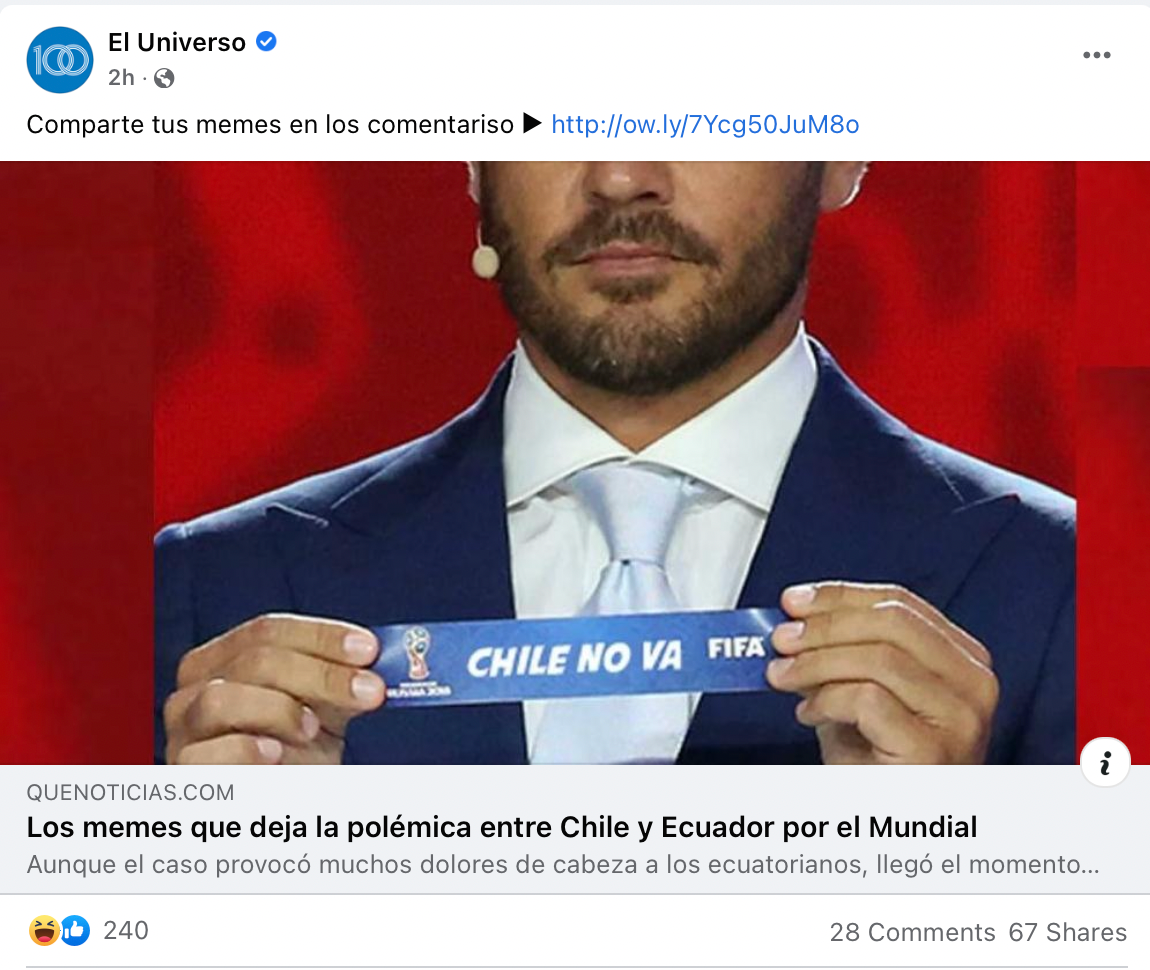
FIFA has judged in favor of Ecuador and Byron Castillo, and against Chile.


These are the reasons: (1) FIFA doesn’t oppose nations’ citizenship rulings, and Castillo had obtained the relevant documents from the Ecuadorian government; (2) Ecuador had previously consulted FIFA about including Castillo in its roster; and (3) Castillo had played for Ecuador’s youth teams, affiliating himself with Ecuador in FIFA tournaments.

I take it that each of these reasons establishes a strong presumption in Ecuador’s favor. (1) or (2) might even be regarded as conclusive.

Case closed.

Well, not quite. Chile could ask FIFA’s board of appeals to review the case. Or Chile could appeal to the Court of Arbitration for Sport, more commonly known by its French initialism, TAS. It was the TAS that ruled for Chile and against Bolivia during the 2018 World Cup qualification cycle.

But it seems likely that Ecuador, not Chile, will play in this year’s World Cup.

As will Iran.


(Stephen shared most of these links and memes with me.)

Castillo intends to counter-sue the Chilean soccer federation.

♦ ♦ ♦ ♦ ♦

R.I.P. Vangelis (d. May 17) and Julee Cruise (d. June 9). Two musicians of whom I’m fond, not least because they’ve so often lulled my sons to sleep.

We are sued

It’s time to discuss the lawsuit that Chile has brought against Ecuador and our starting right-back, Byron Castillo. This suit jeopardizes our participation in the World Cup.

Castillo is accused of having lied about his nationality. Ecuador is accused of having fielded him ineligibly in eight World Cup qualification games.

What if Castillo and Ecuador are judged to be at fault?

Ecuador would forfeit all the points earned in those eight games, or else would be disqualified outright. And perhaps banned in the future. Which would be the worst outcome of all.

♦ ♦ ♦ ♦ ♦

Who would benefit, then?

Here are two possibilities.

(1) The most obvious one is this. The Chileans, having been awarded the five points that they failed to earn in two games against Ecuador, would ascend to fourth place and qualify for the World Cup. Ecuador, points-poor, would have its qualification rescinded.

The precedent for this outcome was set during the qualification cycle of the 2018 World Cup. Chile and Peru were awarded points deducted from the Bolivians, who had fielded an ineligible player.

(Peru, not Chile, ultimately qualified.)

(2) Other nations with more clout than Chile also covet Ecuador’s place. One possible scenario involves Ecuador being disqualified outright and Italy qualifying for the World Cup.

But isn’t Italy in a different confederation?

Yes.

Wasn’t Italy eliminated by North Macedonia, even before the last European playoff round?

Yes.

Then why Italy?

Because the Italians are the world’s best-ranked eliminated team. By this criterion, they’re the most deserving eliminated team. More deserving than North Macedonia, the team that beat them.

If this reasoning sounds ad hoc to you, well, it is. But I’m not surprised that this option is being discussed.

It wouldn’t be the first time FIFA’s (highly dubious) rankings played such an important role.

♦ ♦ ♦ ♦ ♦

All right, so much for the possible consequences. What merit have the charges?

They have been described elsewhere. Their gist is this. Castillo is alleged to have been born in Colombia, not Ecuador. There is an Ecuadorian birth certificate for Byron Castillo Segura; but, also, there is a prior Colombian birth certificate for Byron Castillo Segura.

I have seen this accounted for. The explanation is not described in the linked article, though perhaps it is alluded to in the title (“Could Ecuador Really Be Thrown Out of the World Cup Over ‘Ghost’ Castillo’s Identity Scandal?”). Castillo’s brother was born in Colombia and died young. A few years later, Castillo was born in Ecuador and given the same first name, but not the same middle name, as his brother.

Ecuadorian officials have long been uncertain about Castillo’s earliest documents. They investigated the matter for several years. Finally, in 2021, they cleared him to play for Ecuador.

What’s beyond dispute is that Castillo has lived in Ecuador, as an Ecuadorian, since he was very young; that he has had up-to-date citizenship documents for some years; and that the government recognizes him as a citizen.

♦ ♦ ♦ ♦ ♦

This is the fourth time the Chileans have sought a judicial ruling that would usher them into a World Cup.

In the cycle of 1971–1974, this tactic worked, but in those of 1987–1990 and 2015–2018, it backfired spectacularly.

“Chile: Entering through the Window?” – a YouTube video that expains this history. (Spanish only, I’m afraid.)


From what I’ve seen, the world isn’t favorably impressed with Chile.

♦ ♦ ♦ ♦ ♦

What really bothers me is this. Suppose, for the sake of argument, that Castillo was born in Colombia, that his documents weren’t in order, and that Ecuador is complicit in covering this up. Not good. Procedure ought to be respected, and the truth ought not to be kept hidden. But … here are all these rich European countries, fielding players born in their former colonies, excelling in and even winning tournaments with these players, and no one brings a legal challenge; no one says, it’s grossly unjust that England, France, the Netherlands, Portugal, etc. continue to gain advantage from their history of colonialism. But when a family moves from one poor country to another, and the second country takes in that family as a matter of compassion, conscientiousness, or neighborliness, as it habitually has done and continues to do … then, to preserve their advantage, richer countries pounce, saying, Aha! your paperwork is not in order, as if what a government deemed acceptable for the day-to-day purposes of citizenship weren’t good enough for this citizen to represent his country in the World Cup.

Margie; Somaliland; Western Togoland; Uyuni

R.I.P. Margie, a kindly old woman who went to church with us. She was famous for sending greeting cards. Word has it, before she died she prepared several dozen Thanksgiving cards, and so we may hear from her one last time. We attended her funeral; Samuel was asleep when we arrived, but he soon woke up and had to be taken outside; he and I sat on the front steps and identified passing cars. “Sports car. Truck. S.U.V. Sedan. Truck. S.U.V. Police car.” This kept us busy until the last hymn.

♦ ♦ ♦ ♦ ♦

Here’s another fine video from the YouTube channel Un mundo inmenso. This one is about Somaliland, the self-governing northwestern region of Somalia.


I hadn’t known that Somaliland is so stable, or that other countries and the UN refuse to recognize it as an independent state because they’re wary of lending credibility to other secessionist movements.

(The situation may well be more complicated than this. Even so, the video is a good starting-point; also, it got me reading about another “unrepresented nation”: Western Togoland, which has eleven million people and the world’s friendliest flag.)

But Somaliland isn’t as beautiful as “Uyuni, the Most Incredible Landscape in the World”:


One time, with David, I was looking at pictures of Bolivia, and he was like, “I don’t understand why this isn’t everyone’s main interest in life.”

Ecuador 3, Bolivia 0

The goals were scored in the first twenty minutes, and the rest of the game was a cool-down session for our starters and then a tryout for various bench players. Énner Valencia broke Ecuador’s career scoring record.

Afterward, Bolivia’s captain, the goalkeeper Carlos Lampe, was interviewed.

He said: We were our own worst enemy – or something to that effect.

Let the scoreline not cause us to forget the solid defending that we did in the second half.

I’m afraid he was deluding himself.

♦ ♦ ♦ ♦ ♦

We’ve moved to South Bend. Kind church friends helped us; so did Sam the architect; so did my parents; so did Karin’s dad & Carol, his girlfriend. Samuel was parked in front of the TV for many hours in a mostly happy state, but he would cry whenever I’d leave to move things into the new house. When I’d come back, he’d hug me and whimper, “Don’t go.”

The new house is crammed with disordered furniture and boxes. The rooms are impassable. Karin’s dad & Carol helped us to tidy up our bedroom, so at least we’ll have a place to sleep tonight.

Jasper and Ziva are distressed, of course, but they have been venturing out from their hiding places in the basement.

More qualifiers

This long day began for me before five o’clock. Then I didn’t get a full meal until after two; a couple of hours later, I was sleeping from sheer exhaustion. Did Samuel sleep today? He did not.

Thankfully, Karin was here to watch him: she stayed at home to prepare for the move.

My parents and I spent much of the day cleaning the new house, and we waited there for a plumber who didn’t come. A different plumber will come next Wednesday … after Karin, Samuel, and I have moved in.

Until this plumber arrives, the bathtub will serve as our all-purpose sink.

♦ ♦ ♦ ♦ ♦

Ecuador’s next World Cup qualifier will be played tomorrow night (8:30 ET).

Opponent: Bolivia.

Location: Guayaquil.

This will be our first home qualifier outside of Quito since 1997 (the last one also was played against Bolivia, and in Guayaquil).

Afterward, we’ll travel to Venezuela and Colombia. It makes sense to prepare for those games on the Caribbean coast by playing our home game in a hot, coastal city.

Guayaquil was in the news a few days ago because a particularly brutal prison riot happened there.

November’s poem

It’s been several days since the temperature descended from glorious heights. Almost all the leaves have died. We’ve had several frosts. The wind howled all of today; it is still howling.

Now that the porch is uninhabitable, Karin & I are making plans to clear out the spare bedroom and turn it into a play room for Samuel.

♦ ♦ ♦ ♦ ♦

Stephen David showed me this video of Brazilian referees discussing whether to award the penalty kick that led to Ecuador’s third goal against Bolivia.


The Bolivian almost surely didn’t handle the ball deliberately, but in this era of the VAR, that hardly matters. You can hear these referees talking about the defender’s having abierto la masa corporal – i.e., he had extended his bodily mass (of course, the operative concept is surface area, not mass). It’s notable that the defender “enlarged his body” before the shot was taken. The video shows the ball striking the arm after a ricochet, but the arm had occupied its “enlarged” position for some time.

If such refereeing were applied consistently, defenders would have to train themselves to keep their arms next to their sides inside the penalty box or else risk conceding a penalty kick for involuntarily handling. This would make it harder for defenders to balance themselves inside the penalty box. This, in turn, would allow attackers to easily dribble or pass around them very near to the goal.

I wonder if it would gradually improve the sport. Teams would have a strong incentive to defend well outside of the box.

Defensive bunkers might be abandoned or at least moved farther away from the goal, toward the middle of the field. There would be less clustering at either end.

Soccer would again become a full-field game – less like basketball, more like itself.

♦ ♦ ♦ ♦ ♦

This month’s poem – from the movie We Are the Best! – is called “Hate the Sport!”

⎯⎯⎯⎯⎯⎯⎯⎯⎯⎯
Nature is fully polluted
But you only care about the recruited
Children cry and scream
You only care about your soccer team
The world is a morgue
But you’re watching Björn Borg
Hate the sport
Hate the sport
Your team is winning
Oil companies are sinning
Hate the sport
Time to abort
Hate the sport
Hate the sport
Hate the sport
Hate the sport
People die and scream
But all you care about is your high-jump team
Children in Africa are dying
But you’re all about balls flying: hate the sport, yeah!
⎯⎯⎯⎯⎯⎯⎯⎯⎯⎯

(English subtitles – translated from the Swedish)

Another good result

… in World Cup qualification, against Bolivia. The match transpired as I expected it would, with defensive errors, wasted shots, and Ecuador’s eventual victory. The final score was 3 to 2. We briefly leaped into second place among South Americans. It was mathematically impossible for us to remain there, however, and Argentina overtook us by drawing against Paraguay, in lackluster fashion.

Tomorrow, Colombia or Uruguay can knock us down into fourth place, but not if they also draw. The Colombians will play against us on Tuesday.

♦ ♦ ♦ ♦ ♦

November’s novel by C.P. Snow is The New Men, in which scientists jockey for the privilege of building the atomic bomb. They all consider that it’d be better for the world if the bomb weren’t built – but as long as Nazi and U.S. scientists are trying to build it, British scientists may as well try, too. And thus is lit the fuse of personal ambition.

The old Penguin covers are interesting.

More results

Well, Paraguay lost to Venezuela, 1 to 0. So much for Paraguay.

Argentina defeated Ecuador, leaped over several teams, and qualified for the World Cup. Ecuador didn’t field any of the players who defeated Argentina in the first game of the tourney. That, perhaps, is the most surprising fact of Ecuador’s World Cup cycle.

In Lima, Peru and Colombia each scored one goal. Peru’s was a golazo by its talisman, the excellent Paolo Guerrero. He scored with an indirect free kick that was touched by the Colombian goalkeeper. Now, to reach the World Cup, Peru must defeat New Zealand in a two-game playoff. Colombia finished above Peru and reached the World Cup directly.

The Uruguayans scored twice against themselves but still defeated Bolivia, 4 to 2. They also qualified for the World Cup.

These results helped to eliminate the Chileans, whom the group-winning Brazilians defeated, 3 to 0.

♦ ♦ ♦ ♦ ♦

Ironically, the Chileans would’ve qualified for the playoff at Peru’s expense had they not won an earlier judgment in court. Due to Bolivian impropriety, Chile and Peru had sued against that nation. Chile’s 0–0 draw against Bolivia was converted into a 3–0 Chilean victory, and a 2–0 victory for Bolivia became a 3–0 victory for the Peruvians. On the whole, then, the judgment benefited Peru more than Chile. The difference was enough to switch these nations’ respective, final positions (click to enlarge):


(The chart on the left gives the official, post-judgment standings. The chart on the right shows what would’ve resulted without the court judgment.)

♦ ♦ ♦ ♦ ♦

All of this was dramatic enough. But it paled in comparison to what happened in North America.

The Hondurans, obliged to defeat Mexico, narrowly managed to do so. One of their goals came from a shot that hit the crossbar and bounced off the Mexican goalkeeper’s head.

The Panamanians were similarly obliged to defeat Costa Rica. Their winning goal came at the end of the game. I celebrated it with great passion. Their earlier goal was even more dramatic. It was un gol fantasma: the ball never crossed the goal line. But the shooter, Blas Pérez – my old Panamanian favorite – was fouled and should’ve been awarded a penalty kick.

Here’s a video that shows all of this in clear detail. It also shows the Hondurans’ lucky goal.

Why do I care about these North American games? Because they made possible the elimination of the United States, that hollow team, which lost against Trinidad and Tobago. And so one of my dreams, that the U.S. should fail to qualify for a World Cup, has finally come true.

Results

Though the Ecuadorians played hard, they lost, two goals to one, relinquishing their last chance of qualifying for next year’s World Cup.

They almost didn’t lose. The Chileans scored their winning goal because an Ecuadorian substitute, having just ventured onto the infirm playing surface, slipped. But the night’s other results would have sunk the Ecuadorians even if they’d drawn.

A draw also would have pretty well sunk the Chileans. Instead, momentarily, they’re vaulted into third place. I say “momentarily” because they must play their concluding game in Brazil. Whether they qualify may well depend on how few goals the Brazilians decide to score against them. The Brazilians may end up KO’ing Chile for the third consecutive World Cup cycle.

♦ ♦ ♦ ♦ ♦

Argentina and Peru stalemated in Buenos Aires. Their fates depend upon their respective final matches.

Sitting pretty are the Brazilians (already qualified); the Uruguayans (assured of a playoff, at least; virtually assured of direct qualification); and, amazingly, the Paraguayans. GET THIS. Right now, the Paraguayans are in seventh place, i.e., three places from direct qualification, with a goal differential of minus-five. But if they defeat Venezuela at home, they’ll at least reach the playoff (they’d overtake either Colombia or Peru) and they might even qualify directly, overtaking Chile or Argentina (or both). This good placement is due to their superb comeback victory in Barranquilla. They scored in minutes 89 and 92, defeating the Colombians, 2–1. The Paraguayans are South America’s “cardiac” team.

Then again, I wouldn’t put it past them to fail to defeat the last-placed Venezuelans.

To recapitulate, this is the table (click to enlarge):


And these are the concluding fixtures:

Argentina at Ecuador
Bolivia at Uruguay
Chile at Brazil
Colombia at Peru
Venezuela at Paraguay

♦ ♦ ♦ ♦ ♦

The best result of the day was Kazuo Ishiguro’s selection as the Nobel literary laureate. When it was announced, it made me so pleased, I almost wasn’t bothered about the World Cup. Ishiguro is a fine writer, and The Remains of the Day, his most famous novel, displays the sublimest English and Japanese virtues.

Thank you Uruguay, thanks Bolivia

… for defeating Paraguay and Chile, respectively, which is all that’s keeping Ecuador in the hunt. The Venezuelans helped us, too, drawing with Argentina in Buenos Aires.

(I feel like Alanis Morissette in her “Thank U India” video: chastened and nude.)

No thanks to ourselves. Last night, the Peruvians defeated us in Quito. We were bad.

It’s hard to know what, or whom, to blame. Our players? They’d do better if things weren’t so dire. Our coach? Certainly, his tactics are bankrupt, or else they aren’t suited to our personnel; but I’m not sure what tactics to suggest instead. The groundskeeping? That was a problem last night. The grass was cut short to make the ball roll quickly. But our players kept failing to control the ball.

The altitude? Last night, it didn’t help us. I think Peru may have used more “highland” players than we used.

I’d be in utter despair – I was all through the night – except that Argentina and Chile are playing badly, too, and they’re our closest qualifying rivals, and they’re whom we will play against in our last two games. I thought the Peruvians would be easier to beat, but now I’m not so sure. The Argentinians have looked tepid under all three of their world-class coaches. And the Chileans, well, they’re a disaster. And so are we. The three teams are punch-drunk and knocked down. Whoever can stand up just a little will be admitted to the World Cup.

Matchday 13, pt. 2

Well, we lost. All credit to the Paraguayans. They ran hard, troubled our best passers, blocked our lanes, and converted two scrappy goals. Moreover, they were expert time-wasters. When the “Topo” Cáceres became injured, the medics took a good while to cart him off, making several changes of direction. The ref had to toss one of the medics out of the game. Also, crucially, the Paraguayans were much taller than the Ecuadorians. Toward the end, our coach brought on skillful little Matías Oyola. It was a mistake. Whenever Oyola had to jump for a high ball, he was dwarfed and ended up committing a foul, allowing the Paraguayans to waste more time. (I am not complaining. Time-wasting is a fact of life.)

Meanwhile, the Brazilians demolished the (very good) Uruguayans in Montevideo. After several woeful years, the Brazilians again look to be world beaters. They are trouncing the other South Americans, and no one in Europe seems as good.

The Colombians squeaked past the Bolivians. Argentina defeated Chile. Draws in these games would have served Ecuador better. In the sole unimportant game, Venezuela squandered a two-goal lead, drawing against Peru.

More soccer results

As expected, we beat the Venezuelans – no great feat, especially since the margin of victory, three, could easily have been seven or eight. ‘SUFRIDA’ GOLEADA, headlined the newspapers. The visitors “closed up shop” in front of their goal and stalled whenever play was interrupted. They did this until our central defender, Arturo Mina, burst forward and headed in a cross (our whole team was playing very high up the field).

This occurred early in the second half. Our next goal was from a counterattack, and the third came from an even simpler counterattack after the Venezuelans had no choice but to send their players forward.

Again our most dangerous attacker was Renato Ibarra. He and the “Hormiga” were devastating along the right wing. But neither of them could shoot. (My grandpa likes to tell how, decades ago, he arrived in Ecuador unable to speak Spanish. The evangelicals prayed: O Señor, suelta la lengua del hermano Pablo. In the same spirit, I’d like us to pray: O Señor, suelta las patas de la “Hormiga” y de Renato.)

As I’d predicted, we climbed up into third place, because the Colombians lost against the Argentinians in this week’s duel of desperate teams. Which proud team will miss the World Cup is the question that grips the continent. It’ll be either the Argentinians, the Colombians, or the Chileans. We might miss the World Cup, but we are not especially proud. The Paraguayans, also humble, were hopeful until these last two matches, when they lost against two of the cellar-dwellers: at home, 4 to 1, to Peru, and away, 1 to 0, to Bolivia. This last result has “cooked their goose.”

♦ ♦ ♦ ♦ ♦

In the CONCACAF, the gringos also are in crisis mode. They followed their home defeat to Mexico with a 4 to 0 defeat in Costa Rica. I was very happy about this, and I gloated about it to my Spanish students – most of whom didn’t care – until Mary told me that Martin has been very sad about it. That tempered my glee a little bit.