Posts

Showing posts with the label Internet Archive

Throw a kiss, Harry

Samuel’s first spring break. We didn’t go out of town, but we did take the boys to the local Bricks & Minifigs store. I’d never seen them more excited to be anywhere. It’s a pleasant store: clean; well-lighted; not overwhelmingly full of merchandise; inexpensive, as long as one can keep from going hog-wild.

The cashiers were a couple of sad-sacks. Not just bored: despondent.

♦ ♦ ♦ ♦ ♦

The more time I spend with children, the more I marvel at the lifelikeness of Mary Chalmers’s Throw a Kiss, Harry.

Read it here. This is the bowdlerized version from the ’nineties. It’s the version familiar to our household.

The original version, from the ’fifties, is even truer to life: Harry’s mother casually threatens to spank him.

Whether they actually spank or not, parents’ll recognize how tempting (and gratifying) it is to threaten retribution.

Children are simultaneously so naughty and so adorable, so ornery and so affectionate. These are the truths that Throw a Kiss, Harry understands.

Body-text fonts, pt. 35: Monotype Baskerville

After three phone calls to city officials, a heavy snowfall, a thaw, and another freeze, the unhappy (or happy?) cat remains in a cardboard box outside our house. We removed it from our curb. The house across the street is for sale, and we don’t want to deter prospective buyers.

Reader, come, buy this house and be my friend.

♦ ♦ ♦ ♦ ♦

I’ve reached the eighth of nine scheduled books by E. M. Forster:
  • Where Angels Fear to Tread
  • The Longest Journey
  • A Room with a View
  • Howards End
  • The Celestial Omnibus
  • Maurice
  • A Passage to India
  • Aspects of the Novel
  • The Eternal Moment
These will be enough for now. Someday, I may read Arbinger Harvest and Two Cheers for Democracy.

It hasn’t been an unpleasant project. And yet Forster has slipped into the perhaps unenviable category inhabited by Stephen King and David Lodge, of novelists whose discourses on the novel are more pleasurable than their novels. There’s some delightful stuff in Aspects, not least the quotations. This one, from Moll Flanders, has me itching to read that book.


Aspects’s above edition (Pelican/​Penguin) can be read here; a PDF with Aspects’s original pagination is here.

Zuleika; LOTR; Farmer boy

One of my favorite chapter openings, almost as good as “The grandmother didn’t want to go to Florida”:
Her actual offspring does not suffice a very motherly woman. Such a woman was Mrs. Batch. Had she been blest with a dozen children, she must yet have regarded herself as also a mother to whatever two young gentlemen were lodging under her roof. …
The same is true of Karin: not with lodgers but with pets and strays.

This time, ’twas a spider. It spun its web on the prongs of our “Medusa” lamp.

Karin once feared spiders – maybe she still does – but she treated this one oh so tenderly. She brought it ants and flies.

Last night, she brought it a live Junebug. That cracked something inside of her. She was anguished for the Junebug: “It just fought so hard to live.”

She carefully removed the spider from our house.

♦ ♦ ♦ ♦ ♦

Her actual offspring are with their grandfather tonight. A respite for us.

This morning I hazarded a library outing with them. They were loud, and I had to drag them home when Daniel wouldn’t stop running through the stacks. But it was gratifying that at first they shunned the e-⁠tablets. Samuel built with blocks from a Jenga-like game. Daniel filled, emptied, and refilled the Connect Four grid.

I kept an eye on them and read Tolkien. Pippin tries to sneak off with the palantír. Gandalf scolds him; then they ride away in the night, on Shadowfax.
As he fell slowly into sleep, Pippin had a strange feeling: he and Gandalf were still as stone, seated upon the statue of a running horse, while the world rolled away beneath his feet with a great noise of wind.
Thus ends LOTR bk. III. Tolkien is at his best in the concluding paragraphs of the “books.” So far, he has always concluded with a scene of hobbits. There are grand things in this story, but they are best viewed through hobbits’ eyes; they are too grand for anyone less humble. Tolkien himself may have been a bit of a hobbit, recording momentous and homely detail, for homely folk.

♦ ♦ ♦ ♦ ♦

I also am reading the Little House books. Nine-year-old Almanzo, in Farmer Boy, isn’t quite a hobbit, but he is driven to and fro by industrious larger creatures. The temperatures are frigid; the work is hard; but all is worthwhile because it is fueld by mountains of rich food, described unstintingly.

Mitfords, pt. 8; body-text fonts, pt. 26: Dante; effects of nuclear attack

N. Mitford’s seventh novel, The Blessing (1951), is about an Englishwoman who moves to France with her promiscuous French husband and their son (and their son’s English, xenophobic nanny, who once was the Englishwoman’s nanny).

France-Britain comparison had been creeping into Mitford’s previous novels and here is “on at full blast.” Mitford lived her last years in France.

The dedication is to Evelyn Waugh.

My reading copy is The Penguin Complete Novels of Nancy Mitford: nearly 1,000 large pages set in teeny-tiny Dante (a font with pleasing apostrophes). What follows is a rather atypical passage for Mitford, since the main speaker is from the USA. The setting is a dinner party. The New Worlders want to talk global politics; the Old Worlders want to forget warring and get back to bedroom politics.


– let me finish –
what they ought to do in the case of atomic explosion, such explosion is robbed of half, or one-third, its terrors.’

‘Thank you, Charlie,’ said Mr Dexter. ‘I for one feel a lot easier in my mind. There is nothing so dangerous as a policy of lassair-aller, and I am very glad that the great American public, if I may say so, M. de Valhubert, without offending your feelings, is not hiding its head in the sand, but is looking the Bomb squarely in the eye.’
(“Heck” – para. 3 – is not an expletive but a British-conceived U.S. diminutive of “Hector.”)

This is hardly my favorite N. Mitford passage. But it goes nicely with this remarkable essay in the Daily Mail, also read by me today, which gives “macabre minute-by-minute detail” about what would happen during a nuclear attack. (Hat tip: Leiter.)

Sobering stuff, even if flanked by links to articles about celebrities, conjoined twins, sea monsters, and UFOs.

Some ex-residences

Forgive me for raking up old history, some of which I’ve surely blogged about before, but I have little else to discuss tonight. I must be getting on in years because I’m keen to list buildings I’ve lived in that have been torn down.

(1, 2) Mission houses, Las Palmas, Esmeraldas, Ecuador.

My boyhood home was the eastern house. As a baby, I briefly lived in the western house.

(3) Cottage on the property of Lakeview Church, Zion, Illinois.

My family lived in Zion from 1990 to 1991 (my third-grade year).

(4) Missionary Church Dorm, Quito, Ecuador.

My home during boarding-school years.

If I were asked to choose one former residence to live in forever, this would be it. My own Hogwarts.

It was torn down a few weeks ago.

(5) The Music Machine, River Park, South Bend, Indiana.

I lived in the tiny apartment above the office of the Music Machine, a DJ-ing business. I moved in when I married Karin. Less than a year later, the city forced us out and built a fire station on the land.

♦ ♦ ♦ ♦ ♦

I used Google Maps to try to find the house in Seattle’s U-District in which I rented a room for four months, in 2004 and 2005.

Ultimately, I can’t be sure of the address. It was a grungy building surrounded by gaudy fraternity houses. I leeched wireless Internet from one of those fraternities; the network was called “Sex Gods.” So, if I’m ever back in that neighborhood, I’ll know how to pinpoint my old location.

I did find this lovely 2013 article in the University of Washington’s student newspaper about my landlady, who rented to ex-cons, sex offenders, and others who needed a break. I was in neither of the first two categories, but she rented to me after she called my friends and they confirmed that I didn’t drink alcohol. (And it was good that she rented to me, because it was about the only room in Seattle I could have afforded.)

I lent her my mom’s parents’ missionary memoirs, and she read them.

That year and the next, when I moved back and forth across the continent, alone, to pursue fruitless but necessary studies, the Lord put me in touch with some remarkable people.

R.I.P. Harry Frankfurt; July’s poem

The outstanding philosopher Harry G. Frankfurt has died. He’s one of just a few philosophers of my lifetime whom I would unreservedly recommend to the general reader.

Here are his two most important books – collections of short- and medium-length essays. “Jewel-like,” these pieces often are said to be. I spent a lot of time reading and discussing these books during my fifth semester of grad school.

See also this book about Frankfurt. But read the two other books first!

♦ ♦ ♦ ♦ ♦

This month’s poem is “The Windhover” by Gerard Manley Hopkins.

To Christ our Lord

⎯⎯⎯⎯⎯⎯⎯⎯⎯⎯
I caught this morning morning’s minion, king-
dom of daylight’s dauphin, dapple-dawn-drawn Falcon, in his riding
Of the rolling level underneath him steady air, and striding
High there, how he rung upon the rein of a wimpling wing
In his ecstasy! then off, off forth on swing,
As a skate’s heel sweeps smooth on a bow-bend: the hurl and gliding
Rebuffed the big wind. My heart in hiding
Stirred for a bird, – the achieve of; the mastery of the thing!

Brute beauty and valour and act, oh, air, pride, plume, here
Buckle! AND the fire that breaks from thee then, a billion
Times told lovelier, more dangerous, O my chevalier!

No wonder of it: shéer plód makes plough down sillion
Shine, and blue-bleak embers, ah my dear,
Fall, gall themselves, and gash gold-vermillion.
⎯⎯⎯⎯⎯⎯⎯⎯⎯⎯

June’s poem

“Lochinvar,” by Sir Walter Scott.

Thurber’s drawings can be viewed here (The New Yorker) or here (Fables for Our Time and Famous Poems Illustrated).

⎯⎯⎯⎯⎯⎯⎯⎯⎯⎯
O young Lochinvar is come out of the west,
Through all the wide Border his steed was the best;
And save his good broadsword he weapons had none,
He rode all unarm’d, and he rode all alone.
So faithful in love, and so dauntless in war,
There never was knight like the young Lochinvar.

He staid not for brake, and he stopp’d not for stone,
He swam the Eske river where ford there was none;
But ere he alighted at Netherby gate,
The bride had consented, the gallant came late:
For a laggard in love, and a dastard in war,
Was to wed the fair Ellen of brave Lochinvar.

So boldly he enter’d the Netherby Hall,
Among bride’s-men, and kinsmen, and brothers and all:
Then spoke the bride’s father, his hand on his sword,
(For the poor craven bridegroom said never a word,)
“O come ye in peace here, or come ye in war,
Or to dance at our bridal, young Lord Lochinvar?”

“I long woo’d your daughter, my suit you denied; –
Love swells like the Solway, but ebbs like its tide –
And now I am come, with this lost love of mine,
To lead but one measure, drink one cup of wine.
There are maidens in Scotland more lovely by far,
That would gladly be bride to the young Lochinvar.”

The bride kiss’d the goblet: the knight took it up,
He quaff’d off the wine, and he threw down the cup.
She look’d down to blush, and she look’d up to sigh,
With a smile on her lips and a tear in her eye.
He took her soft hand, ere her mother could bar, –
“Now tread we a measure!” said young Lochinvar.

So stately his form, and so lovely her face,
That never a hall such a galliard did grace;
While her mother did fret, and her father did fume,
And the bridegroom stood dangling his bonnet and plume;
And the bride-maidens whisper’d, “’twere better by far
To have match’d our fair cousin with young Lochinvar.”

One touch to her hand, and one word in her ear,
When they reach’d the hall-door, and the charger stood near;
So light to the croupe the fair lady he swung,
So light to the saddle before her he sprung!
“She is won! we are gone, over bank, bush, and scaur;
They’ll have fleet steeds that follow,” quoth young Lochinvar.

There was mounting ’mong Graemes of the Netherby clan;
Forsters, Fenwicks, and Musgraves, they rode and they ran:
There was racing and chasing on Cannobie Lee,
But the lost bride of Netherby ne’er did they see.
So daring in love, and so dauntless in war,
Have ye e’er heard of gallant like young Lochinvar?
⎯⎯⎯⎯⎯⎯⎯⎯⎯⎯


Eat your heart out, Benjamin Braddock …

Fantasy reading

I’m reading a kind of fantasy novel, or at least a fantastical novel: How Steeple Sinderby Wanderers Won the FA Cup, an underdog tale by J.L. Carr (who also wrote A Month in the Country). Today, in real life, the FA Cup final was disputed between two quintessential non-underdogs: Manchester City and Manchester United. The Citizens won. They scored the first goal after just fifteen seconds.

I’m also reading “fantasy proper”: Harry Potter, no. 4. I kept my promise to Karin, which was to read the first two novels, and then I decided to finish the series. If I’d known that they’re mystery novels, I would have read them sooner.

We’re also viewing the movies. Tonight we finished Chamber of Secrets (or, as I like to call it, Chamber of Toilets). It took three days to watch because we kept having to pause it, what with all the noise of Samuel’s crying out how he loves Harry, Hagrid, etc., and his loudly murmuring magical gibberish.

He’s going through a curious phase. He wants the living room curtains to stay closed. If I bring the street into view, he goes to his room and lies on his bed, in the dark. He might be onto something. Today we got junk mail with a photo of our house printed on the envelope.

He’s particularly afraid of the ice-cream truck. He might be onto something there, too.

P.S. As a family, we’re reading The Princess and the Goblin.

This is not a genre in which I especially like to read, but somehow I’ve already created a fantasy reading schedule for the next two years.

A lawsuit

Now that we’ve recovered from our illnesses, Samuel has started throwing up. We hope it’s just a little food poisoning. He did get into some woefully expired milk. …

We are teaching him to throw up in a bucket and not on the furniture or the floor.

♦ ♦ ♦ ♦ ♦

Four big publishers – Hachette, HarperCollins, Wiley, and Penguin Random House – have sued the Internet Archive. Today, a court ruled in their favor.

I’m not competent to evaluate this case. For all I know, this ruling is legally correct.

But I’ll say this.

I’ve found the Internet Archive to be extremely useful. As I pursue my non-lucrative – but, I hope, not entirely worthless – personal projects, I tend to study several sources at the same time. The public library system can’t or won’t lend me the kinds of sources that I use – not all at once, and certainly not on less than four weeks’ notice. Nor do I have convenient access to university library materials.

As readers of this blog know, I buy as many books as I can – often, books issued by these same publishers. But that doesn’t quite meet my needs, either.

Indeed, I regularly buy books because I’ve been able to preview them via the Internet Archive. For me, this website is a reference tool – a pit-stop on the way to other reading, not an ultimate reading destination.

My point is that for an ordinary bloke like me, certain extremely meaningful projects would become much more difficult, and maybe even impossible, without some free service like the Internet Archive. If what this organization does is illegal … well, then, we oughta try really hard to figure out some way for the same thing to be done legally.

Marchette Chute

I’m reading Marchette Chute’s Stories from Shakespeare, which I’ve discovered late in life. These retellings compare favorably with those of Charles & Mary Lamb and Leon Garfield. Chute outdoes those authors by discussing nearly all of the plays, even those that the Lambs and Garfield won’t touch. For example, Chute writes separate chapters for each of the three dreadful parts of King Henry VI. She mentions, but avoids dwelling upon, the chief plot points and characters of that trilogy. Its ambitious nobles – and, for that matter, commoners like Joan of Arc (who, according to Shakespeare, definitely was a witch) – rise up and are mowed down at a nice clip, as in Judges or 2 Kings. But Chute is uninterested in gore: Titus Andronicus is dispatched in a little more than a page. And the misanthropic Timon of Athens gets just three and a half pages. I was eager to read a quick dismissal of Pericles, which, apparently, Shakespeare nonchalantly co-authored with a brothel keeper; and then I realized that Chute avoids that play altogether by restricting herself to those of the First Folio. Well played, Madam, well played.

When I was a child, I loved Shakespeare and Shakespearean retellings, and then I put away childish things; and now I wonder if I ought to have stayed with with my first love.

Illness; reading to Samuel; reading to Daniel; the canceling of books

Nasty colds this week for Samuel and Daniel. It’s the first cold of Daniel’s life. Samuel, poor lad, is old enough to ruminate upon how unpleasant illness is – and to feel not just ill but, also, demoralized.

To cheer him up, I read him four chapters of Fantastic Mr. Fox. He enjoys it well enough, and then he abruptly goes off to play.

When he is demoralized again, I read him half of The Enormous Crocodile.

“Do you like this book, Sammy?” I ask.

“No,” he says.

But we soldier on. When we finish, I again ask, “Did you like that book?”

“Yes,” he says in a low, raspy voice.

It won’t be very many days until we finish Fantastic Mr. Fox, and then Samuel will have had his first full excursion through an (almost-)novel. We’ve read a good amount of Stuart Little, too, but I had to put that devastating book down for a bit because I was demoralized. Samuel liked it pretty well until he was confronted with E.B. White’s rather technical descriptions of the schooner Wasp.

He may not yet be ready for Herman Melville or Patrick O’Brien. I may never be ready for Patrick O’Brien.

Like his brother before him, Daniel has been signed up for Dolly Parton’s Imagination Library, and this week he received the usual first installment, The Little Engine that Could, which I neither enjoy nor admire, and of which we already own maybe a half-dozen copies. This version has new drawings. Have the old ones been deemed to be morally beyond the pale? Or just too ugly? I know that a couple of years ago Samuel was given a copy with the old drawings. Since Samuel was born, some of Dr. Seuss also has been canceled, and Roald Dahl has had his bitter prose sweetened up by his publishers. I need to make sure to buy the editions that I like before they disappear.

(It’s hardly a new thing, of course – the canceling of children’s books because of a decline in tolerance for this or that wrongful or different attitude.)

The sodfather; a warm day; a blood test; blurbs

Man ends 80-year career when bureaucrats tick him off (USA Today).

“They can’t tell me what to do anymore!”

… says the “Sodfather.”

♦ ♦ ♦ ♦ ♦

Wednesday: so warm, so dry, I let Samuel and Daniel have the run of the back yard. In shorts. We had a lovely time.


As of this afternoon, there’s snow-slush everywhere.

♦ ♦ ♦ ♦ ♦

Daniel went to his one-year checkup. They gave him five injections and poked him to test his blood. Seems a bit much, doesn’t it?

Anyway, he has too much lead in his blood.

♦ ♦ ♦ ♦ ♦

These are the best blurbs I’ve seen upon one dust jacket.

Re: the book:

“No summary or catalogue of details
will do it justice.” (Age)

Re: the author:

“Brilliant.” (Australian)

“Inspired.” (Sun-Herald)

“Irresistibly entertaining.” (Time Out New York)

“The genuine article.” (Australian Book Review)

“Gutsy.” (Australian’s Review of Books)

“Fast, funny, fabulous.” (The Adelaide Advertiser)

“World-class.” (Canberra Times)

“A cracker.” (Australian Bookseller & Publisher)

“Towering achievement.” (Guardian)

“Stone classic.” (Independent [UK])

“Top-class.” (Telegraph [UK])

“Startlingly good.” (Sydney Moring Herald)

“Powerfully economical.” (Bulletin)

I read the book. It truly was all of those things.

P.S. Australians are savage.

Some old, old, old favorites

For the boys, we put on Chitty Chitty Bang Bang – overlong but not devoid of charm. I wouldn’t be surprised if it were responsible for twenty-five to fifty percent of my anglophilia. Daniel is transfixed, and Samuel jumps up and down: he loves the old automobiles. One of the best gifts I ever bought him was a huge volume called The Complete Encyclopedia of Motorcars ($1 at a library sale). It is too heavy for him to gently carry around, and so, over the years, he has wrecked its spine. (Lately, Daniel has been tearing out its pages; he also ripped the front cover off a paperback that I received in the mail today.)

I once read Ian Fleming’s Chitty-Chitty-Bang-Bang during a long car ride. The novel was disappointing. At least it is slim. The movie is 2½ hours long. Some of its musical numbers seem that long, all by themselves.

Tonight we don’t watch the whole movie. Instead, I put on Bugs Bunny: Superstar and we watch the first two cartoons. Samuel doesn’t know what to make of it. He’s a shrewder child than I was. Bugs Bunny may have unduly influenced my personality.

Edoarda & Stephen have acquired a puppy: Rembrandt (Remi). Last night we all went over to Mishawaka to meet him. He is still an excitable young beast.

Le spam; body-text fonts, pt. 12: URW Garamond

For 1½–2 years, my phone wouldn’t ring. A short time ago, however, it “fixed” itself – probably by downloading an automatic update – and the spammers began making up for lost time. A spammer roused Daniel from his nap, and, when I picked up, inquired after my “senior benefits.” Within an hour, another spammer had tried, twice, to convince me that an impostor had used my Amazon.com account to buy a MacBook Pro.

The police, paramedics, firefighters, war veterans, university chancellors, air traffic controllers, dentists, etc. resumed their panhandling-by-phone. I still am waiting to hear from the U.S. Space Force – or whichever underfunded military branch it is whose job involves shooting down Chinese weather balloons.

(I mean, either the phone repaired itself or Samuel fixed it by punching who knows what buttons. The other day, he called 911.)

♦ ♦ ♦ ♦ ♦

This “true crime memoir” is quite good.


The typeface is URW Garamond, the upper-case “Q” of which makes it an apt choice for setting The Fifth Queen by Ford Madox Ford.

An ambitious plan

Robert Paul Wolff made a list of twenty-five philosophical books for grad students to read. Since I’m something of an eternal first-year grad student, I intend to get through all of these books – including those I’ve already read – and twenty-five more because, as Wolff acknowledges, the list includes too little from the Middle Ages and the nineteenth and twentieth centuries; besides, I want to tackle a few “non-essentials” like Butler’s Analogy of Religion (recently reissued).

Having begun with Plato’s shorter dialogs, I’m now breezing through Robin Waterfield’s Oxford World’s Classics translation of the Republic. Why isn’t this version assigned more often? It’s cheap, it’s helpfully annotated, and it’s got the smoothest and most propulsive prose of any English Republic I’ve looked at. Yet I don’t remember my grad school teachers or classmates reading it. (I do see that one teacher has endorsed Waterfield’s new translation of Marcus Aurelius.)

Two quirks of this Republic. (1) As a reviewer points out, Waterfield writes “morality” instead of “justice” for dikaiosyne, as well as “type” instead of “form” or “idea” for idea/eidos. I am not put off. I can juggle a few conspicuous word changes. These don’t feel as strange as when my beloved Good News Translation of the Bible says “Covenant Box” instead of “Ark” or “Sudanese” instead of “Ethiopian.” (2) Traditionally, the Republic is divided rather arbitrarily into ten “books”; Waterfield divides it thematically into fourteen “chapters.” For an amateur reader, this change is welcome. For a long time now, my aim has been to read at least one philosophical article or chapter each day. It’s harder than you’d think. So, the shorter the chapters are, the better.

I wonder if the general neglect of Waterfield is due to ignoble prejudices. He is self-employed. He has written shameless potboilers – for children. At this stage of my life, these things only endear an author to me.

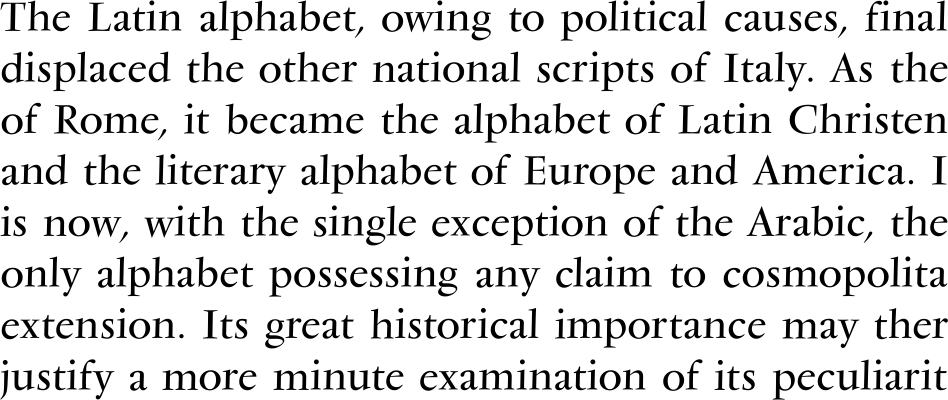
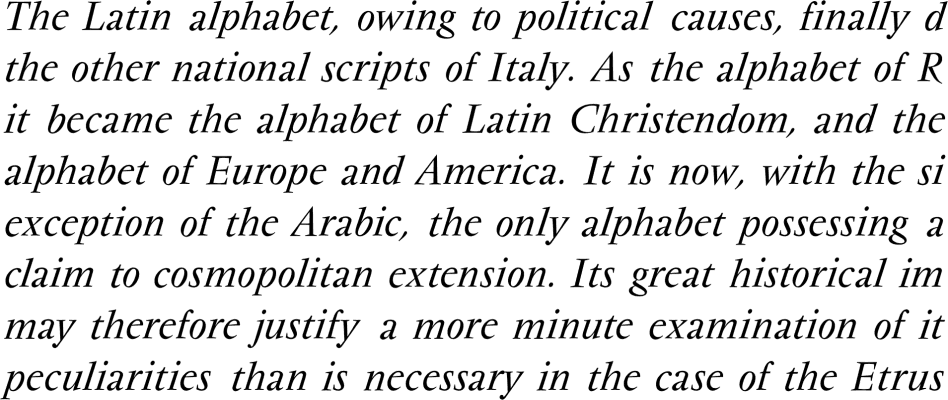
Body-text fonts, pt. 11: Vendôme

His departure is old news, but I’d like to record my gratitude to the Argentinian Gustavo Alfaro, Ecuador’s manager during this last World Cup cycle. An astute tactician and a careful mentor to young pros; by most accounts, a good person.

♦ ♦ ♦ ♦ ♦

This month I exhibit a bizarre typeface. It appears as body text in just one of my volumes, a Random House Value Publishing omnibus of E. M. Forster’s novels (obtained last weekend at Goodwill).


The italics are severely slanted.


That’s how they were designed to look.

[Update, 27 January: I now believe this isn’t a sample of true italics. Here’s a website where you can buy cheap font files of Vendôme. Images of body text are provided. Roman text looks like this; italics look like this.

You can see the italics aren’t just slanted versions of the romans. Compare the roman and italic uppercase “A,” as well as the roman and italic lowercase “b”: the romans have more serifs. And in the italic lowercase “g,” the lower and upper storeys are farther apart than in the roman “g.” On the other hand, all these differences are absent from the text sample taken from the Forster omnibus.

Of course, not every genuine Vendôme will look exactly like Fontsite’s Vendôme.]

Karin didn’t bother with the typesetting. She listened to a recording of the book. Cecil Vyse and Cousin Charlotte irked her equally.

♦ ♦ ♦ ♦ ♦

Daniel sleeps; I type.


He often goes to bed like this. I put on soothing Italian soundtrack music and lie with him. He rolls and jumps on me; then, declining suddenly, he “gives up the ghost.”

I meet a politician; the Golden Rule; one thing leads to another

Political ads have been landing in our mailbox, and today a candidate came to our house. I stepped outside to talk to him.

(Samuel wanted to go outside, but I wouldn’t allow him to. He stared out the window, howled, and made a piteous face. Daniel chugged his milk.)

The candidate wore a U.S. Marine Corps baseball hat. The flyer he gave me didn’t say which party he belonged to, but it named and criticized a certain Republican candidate, so I figured he was a Democrat. He unenthusiastically confirmed this. “I’m running as a Democrat because I was raised as one,” he said, “but I’m against the extremists in both parties who are tearing our country apart.”

♦ ♦ ♦ ♦ ♦

R.I.P. Harry J. Gensler, the Jesuit philosopher who wrote a helpful (if expensive) “Golden Rule book for everyone.” You ought to treat others as you’d like to be treated, the Rule says. In most societies, this is regarded as common sense. But is it philosophically defensible? How, exactly, should the Rule be interpreted, formulated, and applied? And what is its place in an overall picture of morality and value? One could do worse than to begin with Gensler’s book.

Incidentally, if you use Amazon to search for books on the Golden Rule, you’ll be led to authors affiliated with the Templeton Foundation. I don’t object to Templeton; but if you click on too many Templeton Golden Rule products, you’ll soon be shown items from Douglas Wilson’s Canon Press, with titles like The Case for Christian Nationalism. Gensler cites examples of Golden Rule reasoning due to Barack Obama and George W. Bush, and concludes that the Rule’s appeal is “bipartisan.” Alas, the Web bots suggest otherwise.

Sally Rooney; body-text fonts, pt. 6: Garth Graphic

This is another August when I’ll fail to read Light in August. Instead, I’ll finish my second Sally Rooney novel. (No, I haven’t seen the TV episodes, which are reputed to be steamy.) I’m pretty sure Rooney is the youngest novelist I’ve read – the youngest, as in, the most recently born; not as in, the youngest to write a novel. That person is Daisy Ashford.


Rooney is less jaundiced than Ashford was at age nine. But you can sense Rooney inching toward disillusionment. These are her novels’ titles: Conversations with Friends; Normal People; Beautiful World, Where Are You.

Rooney’s pacing is propulsive. Her scenes are tautly constructed. Her protagonists make me feel like an old fogy: I spend most of the time feeling sorry for them. I suppose that for a lot of her fans, her blank young men and, especially, her aloof young women are personal reference points, imaginary peers for modeling oneself after or for suffering with or for projecting one’s self-conception onto. Some books lend themselves to that sort of thing. Jane Eyre is a fine example, carefully and richly realized though Jane and Rochester are as characters.

As much as I like Jane Eyre, I don’t read that way anymore: I stopped around age thirty-two or thirty-three. Sally Rooney is thirty-one.

♦ ♦ ♦ ♦ ♦

Now, this month’s mini-essay on the typefaces in my books.

One doesn’t often see this font used for setting body text. Which is too bad!


Look at those inconspicuous commas and apostrophes. Look at those very conspicuous, asymmetically serifed, lower-case ys. Look at those interrogation marks, and the big, spiky serifs on the Gs: were I a fly fisherman, this is the font I’d choose.

August’s poem (more Mother Goose)

A colleague of Karin’s asked if I fought in the Vietnam War.

I didn’t. I was born in 1981.

POTUS 45’s house was raided by the FBI. Makes you wonder where they got the warrant, Karin’s colleague said.

From the judge, Karin told him. (We don’t watch all those crime shows for nothing.)

On Facebook, one of my friends has been comparing Trump’s “martyrdom” to that of William Wallace, in Braveheart.

♦ ♦ ♦ ♦ ♦

R.I.P. Raymond Briggs, author-illustrator of The Snowman and other books, whose work I didn’t encounter until I had children. He illustrated a rather large volume of Mother Goose. Like Rosemary Wells, he got his texts from the Opies (Iona & Peter).


⎯⎯⎯⎯⎯⎯⎯⎯⎯⎯
There was a little man, and he had a little gun,
And his bullets were made of lead, lead, lead;
He went to the brook, and shot a little duck,
Right through the middle of the head, head, head.
He carried it home to his old wife Joan,
And bade her a fire for to make, make, make,
To roast the little duck he had shot in the brook,
And he’d go and fetch her the drake, drake, drake.
⎯⎯⎯⎯⎯⎯⎯⎯⎯⎯


I am now going to discuss some formal qualities of this fine poem, which I hardly ever do; my remarks will be obvious ones. Each odd-numbered line slant-rhymes its own middle. But the even-numbered lines don’t just rhyme each other: they beat their ending-sounds to death. The effect is tidy and off-kilter – and almost sickeningly jaunty for something that treats the cold-blooded murder of little animals.

Briggs’s (Quino-like) drawing of the bullets replicates this monstrous jollity.

The Opies transcribed lots of chants used for schoolyard games like “Miss Suzie,” jumping rope, etc. This poem has a similar feel, though I’d lay ten to one it was written by an adult.

Obama’s elf

Another week, another successful mowing of the lawn. Karin went to the dentist’s today. She brought home a complimentary goody bag with a toothbrush, toothpaste, etc. I didn’t notice these goodies until I saw Samuel carrying them around the house. He also emptied a bottle of “Flavor Chews” (off-brand TUMS) onto the floor.

At bedtime, I told Samuel to quit the living room, and I turned out the lights. I waited. He didn’t come out. I went into the dark living room and found him lying on the couch under a textbook and a blanket, his hands behind his head, his expression serene and prepared. I carried him to his crib. I went to Karin and read to her from Saki’s Beasts and Super-Beasts. This night’s story, “Laura,” was one of those to do with a super-beast.

Daniel has started to laugh.

It is better to be in a family than to be Obama’s Elf.