Posts

Showing posts with the label Castillo (Byron)

Pre-tourney gripes

As if we needed more scandal, the rumor spread on Twitter that supporters of Qatar bribed several Ecuadorian players to lose the opening match. The rumorer, a British-based Bahraini journalist, has been identified and discredited.

Still, it irks.

Meanwhile, The Guardian takes pot shots, as it has been doing since Russia and Qatar rather than England and Australia were awarded the hosting rights for the 2018 and 2022 tournaments. The paper now claims that this World Cup is a ruse for the host nation to be glorified through the Argentinian, Brazilian, and French players employed and rested by Paris Saint-Germain. (The club is owned by Qatari investors.) True or not, the criticism is silly. Is it really unfair that PSG should give Messi some days off before the tournament, when other clubs – and entire leagues – could protect their stars if they so chose?

Other criticisms of the host country, and of the social and political evils of global soccer, are more serious. Of these, some are better supported than others. The Guardian’s tally of deaths of foreign workers is especially contentious, yet it is cited without qualification by other mainstream publications, such as The Atlantic.

There is a lot of noise.

♦ ♦ ♦ ♦ ♦

I listened to an analysis by the Anglo-centric YouTube channel Tifo Football that got Ecuador’s tactics and personnel pretty wrong. I’m not saying we’re world-beaters or that we play the prettiest soccer, or even that we’re better than Qatar or Senegal or the Netherlands. But it’d be nice not to be slandered. When we lose possession, we don’t immediately stack our players behind the ball; on the contrary, we fight to quickly regain possession high up the field. And it’s Moisés Caicedo who attacks and Carlos Gruezo who drops back, not vice versa. Anyone who watches knows this. (This mistake would be less irritating if the analyst hadn’t just name-dropped Caicedo – a Premier Leaguer – as if he knew whom he was talking about.)

As regular readers know, this is the time when my thoughts and blogging are pretty well filled up by the World Cup.

We are punished

Less than a fortnight before Ecuador is due to play in the World Cup, the Court of Arbitration for Sport (TAS) has ruled on the Byron Castillo case.

Castillo’s Ecuadorian citizenship has been reaffirmed, for the obvious reason – cited earlier by FIFA – that it’s up to the Ecuadorian government whether Castillo is a citizen. It was legitimate for Ecuador’s soccer team to field Castillo. No points earned in the 2022 World Cup qualification tournament are to be deducted. Ecuador will play in this World Cup, as scheduled.

But the TAS also has ruled that Castillo was born elsewhere and earlier than his passport says. So, although his citizenship and his eligibility to play are not objectionable, his documentation is. What is more, the TAS explains, the Federación Ecuatoriana de Fútbol (FEF) “is liable for an act of falsification … even if the FEF was not the author of the falsified document but only the user.”

The TAS grounds this on FIFA’s Disciplinary Code (the 2019 edition, presumably), article 21, paragraph 2:
An association or a club may be held liable for an act of forgery or falsification by one of its officials and/or players.
As punishment, Ecuador will be fined and must begin the next World Cup qualification campaign with a three-point deficit. That’s the equivalent of a three-draw or single-victory head start for each of Ecuador’s competitors. (Goal differential – and other tiebreakers – aren’t affected.)

♦ ♦ ♦ ♦ ♦

How sensible is this ruling? For argument’s sake, assume that Castillo – or his parents or other representatives – indeed gave false information so that he could obtain his citizenship papers.

The TAS’s ruling is consistent with the letter of FIFA’s Disciplinary Code. But a lesser punishment, or no punishment, also would have been consistent with the Code. An association may be held liable, the Code says. That is, punishment is optional; it should be determined on a case-by-case basis (and, eventually, by precedent).

Now, to take the word “may” so seriously is to interpret the Code rather literally; but then, a ruling against Ecuador depends on a severely literal reading of the Code. (Think of this as a “pound of flesh” sort of case.) As it is written, the Code says nothing about whether it matters if the party in question deliberately “used” a falsified document. But it seems that deliberate “use” was the Code’s target: it’s what the rule-makers evidently wished to discourage or punish (see paragraph 1 of the Code’s same article). And the TAS hasn’t determined whether Ecuador intentionally “used” a falsified document – at least, this isn’t stated in the ruling.

It behooves the authorities to be lenient on this occasion. The TAS is now imposing a harsh punishment for what hasn’t been proven to be anything worse than an unintended error. But this sets a fearsome precedent. How many other clubs or countries might be found similarly liable for failing to reject a false claim in this or that player’s papers? More than a few. And if this case becomes a precedent – as it must, if judgments are to be consistent – other cases would demand punishment than those involving “uses” of eligibility-determining falsifications. The present ruling makes it explicit that Castillo took the field eligibly. Ecuador’s punishment is for falsification, full stop – not for falsification-in-order-to-field-an-ineligible-player.

For insance, precedent would dictate that:

If a player lies about his birthday (height, weight, address, criminal record, etc.) but not his parentage, birth country, or any nationality-determining facts;

and if the falsehood is printed on his papers;

and if his country’s soccer association, acting in good faith, or in compliance with its national government, treats those papers as proof of the player’s citizenship;

then the soccer association must be harshly punished.

♦ ♦ ♦ ♦ ♦

There’s at least one other, perhaps more egregious, problem with this ruling. Again: FIFA’s Disciplinary Code only states that an association may be held liable for the offense of falsification. The Code doesn’t require FIFA to hold an offender liable; precedent, or some other consideration, would have to be adduced to generate such a requirement. Indeed, in its June ruling, FIFA refrained from holding Ecuador liable.

In so doing, FIFA acted in conformity with its Code. As far as I can see, then, without precedent, there is no basis for a higher court to overturn FIFA’s ruling; it was within FIFA’s discretion to rule as it did.

We are sued, pt. 2

FIFA has judged in favor of Ecuador and Byron Castillo, and against Chile.


These are the reasons: (1) FIFA doesn’t oppose nations’ citizenship rulings, and Castillo had obtained the relevant documents from the Ecuadorian government; (2) Ecuador had previously consulted FIFA about including Castillo in its roster; and (3) Castillo had played for Ecuador’s youth teams, affiliating himself with Ecuador in FIFA tournaments.

I take it that each of these reasons establishes a strong presumption in Ecuador’s favor. (1) or (2) might even be regarded as conclusive.

Case closed.

Well, not quite. Chile could ask FIFA’s board of appeals to review the case. Or Chile could appeal to the Court of Arbitration for Sport, more commonly known by its French initialism, TAS. It was the TAS that ruled for Chile and against Bolivia during the 2018 World Cup qualification cycle.

But it seems likely that Ecuador, not Chile, will play in this year’s World Cup.

As will Iran.


(Stephen shared most of these links and memes with me.)

Castillo intends to counter-sue the Chilean soccer federation.

♦ ♦ ♦ ♦ ♦

R.I.P. Vangelis (d. May 17) and Julee Cruise (d. June 9). Two musicians of whom I’m fond, not least because they’ve so often lulled my sons to sleep.

We are sued

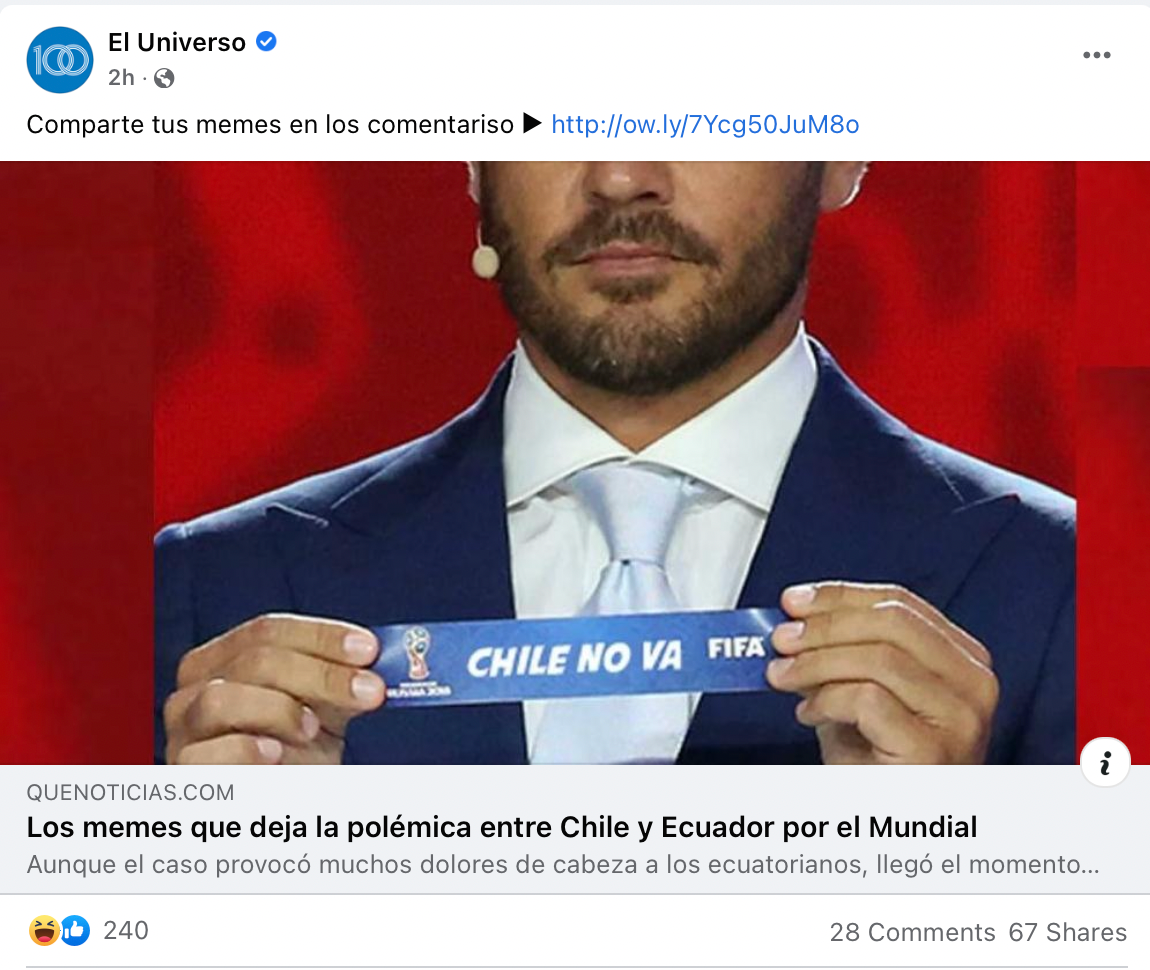
It’s time to discuss the lawsuit that Chile has brought against Ecuador and our starting right-back, Byron Castillo. This suit jeopardizes our participation in the World Cup.

Castillo is accused of having lied about his nationality. Ecuador is accused of having fielded him ineligibly in eight World Cup qualification games.

What if Castillo and Ecuador are judged to be at fault?

Ecuador would forfeit all the points earned in those eight games, or else would be disqualified outright. And perhaps banned in the future. Which would be the worst outcome of all.

♦ ♦ ♦ ♦ ♦

Who would benefit, then?

Here are two possibilities.

(1) The most obvious one is this. The Chileans, having been awarded the five points that they failed to earn in two games against Ecuador, would ascend to fourth place and qualify for the World Cup. Ecuador, points-poor, would have its qualification rescinded.

The precedent for this outcome was set during the qualification cycle of the 2018 World Cup. Chile and Peru were awarded points deducted from the Bolivians, who had fielded an ineligible player.

(Peru, not Chile, ultimately qualified.)

(2) Other nations with more clout than Chile also covet Ecuador’s place. One possible scenario involves Ecuador being disqualified outright and Italy qualifying for the World Cup.

But isn’t Italy in a different confederation?

Yes.

Wasn’t Italy eliminated by North Macedonia, even before the last European playoff round?

Yes.

Then why Italy?

Because the Italians are the world’s best-ranked eliminated team. By this criterion, they’re the most deserving eliminated team. More deserving than North Macedonia, the team that beat them.

If this reasoning sounds ad hoc to you, well, it is. But I’m not surprised that this option is being discussed.

It wouldn’t be the first time FIFA’s (highly dubious) rankings played such an important role.

♦ ♦ ♦ ♦ ♦

All right, so much for the possible consequences. What merit have the charges?

They have been described elsewhere. Their gist is this. Castillo is alleged to have been born in Colombia, not Ecuador. There is an Ecuadorian birth certificate for Byron Castillo Segura; but, also, there is a prior Colombian birth certificate for Byron Castillo Segura.

I have seen this accounted for. The explanation is not described in the linked article, though perhaps it is alluded to in the title (“Could Ecuador Really Be Thrown Out of the World Cup Over ‘Ghost’ Castillo’s Identity Scandal?”). Castillo’s brother was born in Colombia and died young. A few years later, Castillo was born in Ecuador and given the same first name, but not the same middle name, as his brother.

Ecuadorian officials have long been uncertain about Castillo’s earliest documents. They investigated the matter for several years. Finally, in 2021, they cleared him to play for Ecuador.

What’s beyond dispute is that Castillo has lived in Ecuador, as an Ecuadorian, since he was very young; that he has had up-to-date citizenship documents for some years; and that the government recognizes him as a citizen.

♦ ♦ ♦ ♦ ♦

This is the fourth time the Chileans have sought a judicial ruling that would usher them into a World Cup.

In the cycle of 1971–1974, this tactic worked, but in those of 1987–1990 and 2015–2018, it backfired spectacularly.

“Chile: Entering through the Window?” – a YouTube video that expains this history. (Spanish only, I’m afraid.)


From what I’ve seen, the world isn’t favorably impressed with Chile.

♦ ♦ ♦ ♦ ♦

What really bothers me is this. Suppose, for the sake of argument, that Castillo was born in Colombia, that his documents weren’t in order, and that Ecuador is complicit in covering this up. Not good. Procedure ought to be respected, and the truth ought not to be kept hidden. But … here are all these rich European countries, fielding players born in their former colonies, excelling in and even winning tournaments with these players, and no one brings a legal challenge; no one says, it’s grossly unjust that England, France, the Netherlands, Portugal, etc. continue to gain advantage from their history of colonialism. But when a family moves from one poor country to another, and the second country takes in that family as a matter of compassion, conscientiousness, or neighborliness, as it habitually has done and continues to do … then, to preserve their advantage, richer countries pounce, saying, Aha! your paperwork is not in order, as if what a government deemed acceptable for the day-to-day purposes of citizenship weren’t good enough for this citizen to represent his country in the World Cup.