Abel has cabin fever now. He points at the stroller, squawks, climbs onto my chest, and beats it. Soon, Abel, soon.
Like his brothers before him, he attacks my face and snatches at my glasses when I put them on at night. His little nails must have cut inside my eyelid. When I fold it back I find the scab. It has been chafing my eyeball.
Happy Valentine’s (this time, on the day itself). No celebration for Karin & me tonight. We’ll go out later this week.
I did put on Sleepless in Seattle for the family. There aren’t a lot of Valentine’s Day movies. I’ve seen these others:
My Bloody Valentine and the excellent Picnic at Hanging Rock – two for the horror aisle;
Eternal Sunshine of the Spotless Mind;
and:
Some Like It Hot.
Irrespective of overall merit or demerit, only Sleepless preserves the spirit of, and does justice to, the holiday. (I’ve not seen An Affair to Remember.)
Happy birthday to my long-dead Great Grandad Valentine, my father’s mother’s father.
Forgive this lazy entry, but it’s late and this has been a rough day. Here’s an entry by somebody else: Alan Jacobs, who is writing a biography of Dorothy Sayers that I very much look forward to reading.
Happy St. Valentine’s Day. Samuel and Daniel are with grandparents. Karin & I – accompanied by sleeping Abel – romantically gorged at the local diner (I ordered Mexican food and pancakes). We knew it’d be a quiet venue; there were just a handful of couples. But all races and persuasions were represented, including people with MAGA hats.
Afterward, I remarked to Karin how nicely everyone got along. “They all ignored each other,” she said.
Then I realized, not everyone shares my idea of “getting along.”
Back at home, we read love poems to each other.
♦ ♦ ♦ ♦ ♦
“Forget-Me-Not,” by William McGonagall:
⎯⎯⎯⎯⎯⎯⎯⎯⎯⎯
A gallant knight and his betroth’d bride,
Were walking one day by a river side,
They talk’d of love, and they talk’d of war,
And how very foolish lovers are.
At length the bride to the knight did say,
“There have been many young ladies led astray
By believing in all their lovers said,
And you are false to me I am afraid.”
“No, Ellen, I was never false to thee,
I never gave thee cause to doubt me;
I have always lov’d thee and do still,
And no other woman your place shall fill.”
“Dear Edwin, it may be true, but I am in doubt,
But there’s some beautiful flowers here about,
Growing on the other side of the river,
But how to get one, I cannot discover.”
“Dear Ellen, they seem beautiful indeed,
But of them, dear, take no heed;
Because they are on the other side,
Besides, the river is deep and wide.”
“Dear Edwin, as I doubt your love to be untrue,
I ask one favour now from you:
Go! fetch me a flower from across the river,
Which will prove you love me more than ever.”
“Dear Ellen! I will try and fetch you a flower
If it lies within my power
To prove that I am true to you,
And what more can your Edwin do?”
So he leap’d into the river wide,
And swam across to the other side,
To fetch a flower for his young bride,
Who watched him eagerly on the other side.
So he pluck’d a flower right merrily
Which seemed to fill his heart with glee,
That it would please his lovely bride;
But, alas! he never got to the other side.
For when he tried to swim across,
All power of his body he did loss,
But before he sank in the river wide,
He flung the flowers to his lovely bride.
And he cried, “Oh, heaven! hard is my lot,
My dearest Ellen! Forget me not:
For I was ever true to you,
My dearest Ellen! I bid thee adieu!”
Then she wrung her hands in wild despair,
Until her cries did rend the air;
And she cried, “Edwin, dear, hard is out lot,
But I’ll name this flower Forget-me-not.
“And I’ll remember thee while I live,
And to no other man my hand I’ll give,
And I will place my affection on this little flower,
And it will solace me in a lonely hour.”
⎯⎯⎯⎯⎯⎯⎯⎯⎯⎯
♦ ♦ ♦ ♦ ♦
“May Colvin,” from The Oxford Book of Ballads (ed. Sir Arthur Quiller-Couch):
⎯⎯⎯⎯⎯⎯⎯⎯⎯⎯
False Sir John a-wooing came
To a maid of beauty fair;
May Colvin was this lady’s name,
Her father’s only heir.
He woo’d her but, he woo’d her ben [Editor’s note: both in the outer and inner rooms],
He woo’d her in the ha’;
Until he got the lady’s consent
To mount and ride awa’.
“Go fetch me some of your father’s gold,
And some of your mother’s fee,
And I’ll carry you into the north land,
And there I’ll marry thee.”
She’s gane to her father’s coffers
Where all his money lay,
And she’s taken the red, and she’s left the white,
And so lightly she’s tripp’d away.
She’s gane to her father’s stable
Where all the steeds did stand,
And she’s taken the best, and she’s left the warst
After the Super Bowl, Samuel wanted to listen to Taylor Swift.
Taylor: “She wears short skirts, I wear t-shirts …”
Samuel: “I wear t-shirts. And underwear.”
Yes, he does.
♦ ♦ ♦ ♦ ♦
Karin & I spent our Valentine’s outing (yesterday) getting haircuts and eating at Hacienda. Most years, we eat in the mall food court, so this was a step up.
Wheel, Jeopardy!, and How to Lose a Guy in 10 Days played on TV in the restaurant.
This gentle movie is the closest I’ve seen to a live-action My Neighbor Totoro or Ponyo. Set and filmed in Ireland with Irish actors, it’s not just Irish. It’s based on a book set in the Outer Hebrides of Scotland; the book’s Canadian-born author, Rosalie K. Fry, lived in Wales. The movie’s director, John Sayles, is from the United States. His movies explore social issues. This one is more primal. Its protagonists are citizens of the sea.
They dwell on a sparsely-peopled coast. They aren’t outcasts or recluses or separatists; they’re pulled spiritually – or naturally (the distinction is blurred) – toward the water. Their numbers have dwindled, and they’ve moved to the mainland, deserting their native Roan Inish (“seal island”). They pine for their old home. They occasionally paddle their fishing boats over to Roan Inish, where the abandoned huts still stand, disheveled but sturdy.
Seals have long frequented this island and communed with the people. Legends say that some of the islanders were born of Selkies (seal-women). Selkie traits have been passed down. Some of the people are fair, some, dark; the dark ones are especially seal-like.
A golden-haired little girl, Fiona, whose family has moved away from the community, returns to live with her grandparents. (Her mother has died and her father is drowning his sorrows in the taverns.) The movie is especially Totoro-like when it observes the child exploring beaches and meadows, gathering mussels, and stirring liquid boat-tar for her grandfather. She listens to the locals’ wondrous tales: Seals save a youth from drowning. A man captures a Selkie and makes her his wife. A baby – Jamie, Fiona’s brother – is pulled out to the sea, by the tide, in a wooden ark-cradle; from time to time, the islanders glimpse a cherubic little boy bobbing on the waves in his cradle or running along the beaches.
These stories are told as if they might be true. Fiona accepts them as true.
The tellings are haunting, as achingly beautiful as any scenes in any movie. The movie is visually beautiful: It was filmed by the great cinematographer Haskell Wexler. The land and sky and sea are beautiful. So is Fiona, the serene little girl.
There is a tradition of literary criticism that says that stories fall into patterns of universal archetypes, and that these patterns can be arranged by season: romance (summer), tragedy (autumn), satire and irony (winter), and comedy (spring). (Never mind that not every culture recognizes the same seasons.) One season leads to the next. Children begin with romance. Romance fixes its gaze on a world apart from ours, idealized and inaccessible (at least right now). Edenic literature is romantic literature.
People outgrow Eden; or, rather, their injuries and sins bar them from it. They move on to sadness, then to cynicism. If they’re fortunate, they’ll achieve comic rebirth. To this end, it may help them to retain some picture of Eden, to acknowledge rather than disavow the imaginative role that romance plays in the cycle.
This is the kind of picture that The Secret of Roan Inish gives us: a picture of innocence, of the most absorbing and hopeful moments of childhood, of natural beauty, of a lost home worth seeking. A romance for adults.
This movie was released in Japan in 1995 and in the USA in 1996. The version I know is the one dubbed into English.
I first saw it in 2007. I was twenty-five, still tossed by youth’s tempests. The movie affected me considerably.
Revisiting it, what impresses me is its patience. It isn’t obvious, at first, that the movie is a love story. For a long while, it mostly just follows fourteen-year-old Shizuko in and out of buildings and trains, and up and down the sidewalks and outdoor stairways of hilly Tokyo – all of which are drawn with the naturalistic clarity that is typical of Studio Ghibli.
Shizuko is a solitary person, but she is not a loner. Her parents, sister, and friends occupy stable positions in her life. But she is driven by her own interests, so that these other people occasionally complain that she neglects them. She also neglects her studies.
She is obsessed with motifs and feelings. She does some writing. Mostly, though, she just absorbs as many stories as she can, reading dozens of library books.
She notices that one book after another has been checked out by the same borrower. She dreams of meeting this person. She even makes a few inquiries about him. But she is a little too wrapped up in her own idea of what he is like. She imagines that he is unfailingly polite (it turns out that he is not). What she does sense, correctly, is his offbeat drivenness; in this respect, she and the other book borrower are as alike as two peas.
Then, one day, she follows a strange cat around a neighborhood and ends up wandering into a shop with some marvelous antiques. …
I had better stop describing the plot. This isn’t a suspenseful movie, but it has secrets. What is revealed isn’t the solution to any great mystery, but, rather, depth of feeling.
“You complete me,” Tom Cruise says to Renée Zellweger in Jerry Maguire. This movie, Whisper of the Heart, has similar utterances, delivered with an earnestness several orders of magnitude more powerful than in most love stories.
The movie is about unrecognized love …
unrequited love …
lovers tragically separated …
and lovers who manage to come together – who, in the fullness of time, might indeed complete one another as well as lovers could do …
who, after some struggle, are able to express this out loud.
(I think, also, of another exquisite Japanese movie, The Garden of Words, and its shattering declaration: “You saved me!”)
It’s possible to interpret the lovers’ condition, their being-in-love, as age-specific. They feel and speak so strongly because they are so young. Of course, there is something to this, but to lay all the emphasis on this point would be a mistake. Another important character, an old man, is shown to feel his own love just as intensely.
The division isn’t between the young and the old, but between those who are romantic and those who are not – or, perhaps, between those who speak frankly about their passion and those who do not (or, between those who are ready to do so, and those who are not). There is a delightful scene in which the two main lovers talk intimately upon a rooftop, in full view of a crowd of gawkers. The lovers simply ignore them. They have important things to tell one another.
As in Jerry Maguire, it’s the frankness about idealism that makes the movie so good. It’s a pleasure to watch people who are passionate about living excellently – and who recognize and love each other for it.
(The music in this video isn’t from the movie. YouTube has lots of videos made by fans of Whisper of the Heart who have mixed different scenes together and set them to other music.)
Both of these movies, released a week apart from one another in the USA, are about men and women who talk about love while keeping it at arm’s length. In Les rendez-vous de Paris, they do much of their talking out of doors, in and around parks, markets, graveyards, and cafés; in Nelly & Monsieur Arnaud, they talk in restaurants and apartments. All the locations are stereotypically Parisian. Together, the movies suggest: If you want romance, go to Paris; if you want true love, stay away.
The great and prolific director of Rendez-vous is Éric Rohmer. (I’ve already reviewed another of his movies, A Summer’s Tale.) Gene Hackman, playing a hard-boiled detective in Arthur Penn’s thriller, Night Moves (1975), says, “I saw a Rohmer film once. It was kind of like watching paint dry.” This is correct. In Rendez-vous, the characters literally watch the paint dry in order to talk about it.
I think [Rohmer] believes that love is love and that flirtatious conversation is an entirely separate pleasure, not to be confused with anything else. … What the people in Rendezvous in Paris are really saying, underneath all of their words, is: “I am not available. You are not available. But let us play at being available because it is such a joy to use these words and tease with these possibilities, and so much fun to be actors playing lovers, since Paris provides the perfect set for our performance.” Rohmer splendidly illustrates the theory that Parisians possess two means of sexual intercourse, of which the primary one is the power of speech.
Ebert’s review is spot-on, and I have little to add to it. The same is true of his review of Nelly & Monsieur Arnaud:
What a delicate dance they perform. … It is a matter of great erotic fascination when two people are intrigued by the notion of becoming lovers, but are held back by the fear of rejection and the fear of involvement. Signals are transmitted that would require a cryptographer to decode. The difficulty is to send a message that can be read one way if the answer is yes, and the other way if the answer is no.
I’ll say nothing about the movies’ respective plots. (Rendez-vous alone contains three separate stories, and each is fairly complex.) I’ll just note this difference between the two movies. In Rendez-vous, the characters are still young, and their flirting is fraught with insecurity. Not so in Nelly & Monsieur Arnaud. Nelly may only be in her twenties, but, as played by Emmanuelle Béart, she’s an expert at wielding her beauty against men. And M. Arnaud (Michel Serrault) is a wily ex-judge and businessman who knows precisely what sort of allure he holds for one such as Nelly. Theirs is a dance, yes, but also a sparring match between two assured veterans. Compared to them, the lovers in Rendez-vous are amateurs.
Oh, and this: M. Arnaud and Nelly have money (or, at least, Nelly reasonably expects that she’ll end up with money because of her looks). For the students, scholars, and artists of Rendez-vous, life is more threadbare. This difference also matters.
You twisted your ankle
I carried you
You got a divorce
So I married you
You fell off a cliff
So I buried you
I wish there were more bad times
To see you through
These lyrics are by Ed’s Redeeming Qualities, a band of four or five urban hippies. Some of them wear overalls and strum little guitars. One guy plays the clarinet.
A pretty girl named Lee (Callie Thorne) sings and plays the violin.
(“They sound like the music from Juno,” Karin says.)
We don’t know much about Lee, except that she is in this band. Eventually, we’ll learn about her unhappy dating history, but that’s almost an afterthought, something to provide a little turmoil for the movie’s last scenes.
♦ ♦ ♦ ♦ ♦
Ed (Matt Ross) doesn’t know much about Lee, either, except that she’s willing to give him the time of day.
On occasion.
Barely.
About him, we know more. He’s moved to New York to work in a genetics lab. He studies how to modify the genes of rice plants. The work is very interesting, he tells new acquaintances.
His only previous scientific discovery was accidental. He worries that it ought not to have been credited to him.
He had a painful breakup at home, in Wisconsin. His girlfriend didn’t like it that he’d mapped out the rest of his life before the age of twenty-five (he’d even reserved himself a burial plot).
It isn’t that Ed loves to be in control. It’s that he’s terrified of not being in control.
It’s a foible he’s been working on. His move to New York is a deliberate exercise in character improvement.
♦ ♦ ♦ ♦ ♦
He’s also trying to get better at talking to women (just one woman, really).
Ed and Lee first spot each other at a party. Later, they recognize each other in a diner and introduce themselves. Then Ed talks too much about the book Lee is reading (Barry Lopez’s Arctic Dreams). She leaves.
Another day, they both witness a traffic accident. They leave their phone numbers for the victim. Ed gets Lee’s number and calls her.
This time, she’s more interested.
She becomes more patient with him.
This is a movie about a nice man working to make himself nicer; about nice people such as Lee and Ray (Ed’s flatmate) cutting him a little slack; and about the nice diner workers who encourage them.
♦ ♦ ♦ ♦ ♦
One scene in the first half of the movie is pretty bad. Ed walks through the Wisconsin countryside with his old girlfriend. Interpreters go with them: a woman to translate “womanspeak” to Ed, and a man to translate “manspeak” to Ed’s girlfriend. It’s like a fantastical scene out of Annie Hall.
It’s bad because the rest of the movie is realistic. Even though he is so awkward, Ed really could attract such a girl as Lee. Lee really could choose to ignore him, then talk to him, then kiss him, then leave him, then come back to him. That wouldn’t be a strange path for a relationship to take.
Lee really could go over to Ed’s apartment, and Ed’s cat really could vomit on her leg. These things happen.
People really do kiss each other as clumsily as Ed and Lee do in this movie. People kiss each other while ill, or while falling off of furniture.
Whether you’d enjoy a movie like Ed’s Next Move depends on whether you’d enjoy watching realistically attractive, awkward people stumble through the early stages of courtship. Not because you cruelly enjoy watching people stumble, but because these characters’ stumblings are, themselves, rather nice.
At church, a nice old lady took me aside and gave me an envelope. “Don’t let your wife know about this,” she said.
The envelope contained a Valentine’s Day card and $25.
“Take your wife out for a nice meal,” the card said.
So I did, at the local Vietnamese restaurant, on Monday. (We figured we’d beat the rush.) Our nice meal consisted of a bowl of rice noodles, herbs, meats on a stick, and assorted flavors. It was exceedingly pleasant, except that the server kept telling us how good our food was while we were trying to eat it.
And she said I couldn’t order a sandwich because the nail parlor had been ordering ten sandwiches at a time, and the restaurant had run out.
She also hung around and talked about how beautiful Vanna White still is after all these years. I’m not sure why she said this. Wheel of Fortune wasn’t on TV in the restaurant.
It was a little kooky, not unlike the last time when we were in that restaurant and she attended to us very professionally until the last minute, when she told us that she was desperate to quit her job. But, as of Monday night, she hadn’t.
Karin thought the server was kooky, too, but she may have harbored some sympathy for her; afterward, when we went to the used-DVD store, she bought the movie Waitress.
At Temple Square we were spoken to by a nice, young, Taiwanese missionary.
Where have you come from?
Indiana.
What brings you to Salt Lake City?
Our honeymoon.
How exciting! – would it please you to be married to each other for all of eternity?
We don’t believe in that (I told her after an awkward pause).
What is your church?
The Missionary Church (said Karin).
Oh! The missionaries! Good! Did you talk to the missionaries?
Yes. We talked to the missionaries many times.
That’s good. That’s very good. Well, enjoy your visit to Salt Lake City.
Thank you.
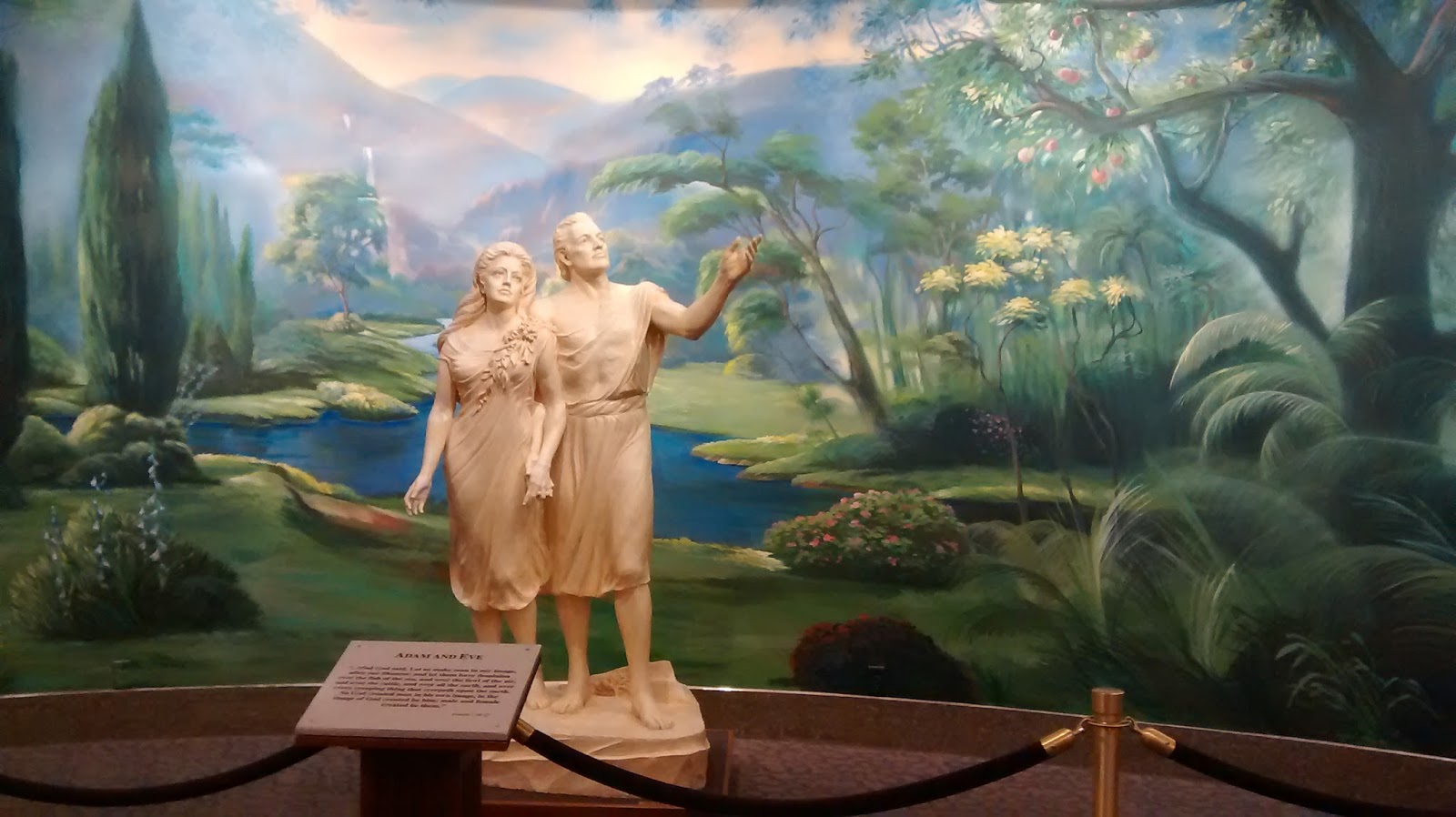
We strolled upon the grounds; we peeked into the building where the famous pipe organ sits. The Temple itself cannot be accessed, but a 3-D model of its innards can be viewed in the South Visitors’ Center. In the North Visitors’ Center we looked at some religious art. I tried to photograph a scene of the Garden of Eden, but, no matter how I adjusted the camera, Eve & Adam came out blurry.
Was this a trick of the lighting? Was it something supernatural?
Wipe your camera lens, said Karin.
Oh.
The next day we rode the public transport out to the suburb of Lehi, where there’s a tourism complex called Thanksgiving Point. It has museums, gardens, and a petting zoo. We began with the Museum of Ancient Life, where we looked at dinosaur skeletons and browsed through a gift shop that had all sorts of plush and plastic dinosaurs. We viewed a video, from 1991, of the dinosaurs’ extinction. … Next we visited the petting zoo, which was rather crowded: there were numerous Mormon mothers, blond, thin, carefully made up, pregnant, with three or four small children in tow.
The real challenge was presented by the next site, a children’s museum/playground. Getting there required a couple of miles of walking in the harsh desert sunlight. We’d forgotten our sunscreen, and we’d already been on our feet for a long time. I was getting grumpy.
Walk, walk, walk. We passed office parks. The sun glinted off of the windows. SUVs full of children drove past us.
The mountains began to look rather different.
Are you sure you want to see this museum?, I asked Karin.
Yes. She was sure.
When we got there, I wasn’t thrilled. I felt like an adult at a Chuck-E-Cheese. There was an enormous jungle gym-type structure of mesh and slides and rope bridges. Due to my great fat, I had trouble extricating myself from the rope bridges. … What I did wish to try was the “wind room,” a small compartment through which blew gusts of up to 85 m.p.h. The children hogged the “wind room” for a long time. But when we did finally get to try it, it was truly refreshing. I decided that it atoned for the rest of the children’s museum/playground.
What remained to be visited was the garden, right next to the museum; but to enter it, we again had to walk and walk. We passed an entire golf course. It became clear that this garden was enormous, and that it didn’t have much shade. At the entrance there were golf-cart rentals of $30 for one hour. We decided to stay on foot and to see only two-thirds of the garden.
Afterward, I was very grumpy. But I told myself, this is one of the precious aspects of marriage. This is an experience with my spouse.
I looked over at Karin, and she was beautiful. “I’m tired and I’m cranky,” I admitted to her. “But this has been a lovely day with you.” We held hands. We now knew the route better, and so we cut across some parking lots.
On the train, I enjoyed looking at Karin while she listened to her audiobook.
The next day we rode out to a nearer suburb. We ate at In-N-Out Burger and bought things at a thrift shop. We returned early to Salt Lake City, did our laundry, and rested up for the following day’s journey back to South Bend.
Now we’ve had two straight nights at home. Jasper is happy to see us, though mostly he hides in cool places, because his coat is thick and it’s sweltering in our apartment.
Obviously I was present at my own wedding, and I have some things to say about it. But for now here is the Best Man’s speech.
Before I begin, I would like to thank John-Paul for asking me to come here in front of so many people to do some public speaking. So: thanks, John-Paul.
As I was thinking about what to do today, I figured that I should just keep to the main purposes of the Best Man Speech. I came up with three.
The first, I suppose, is to provide some amusement or entertainment. It’s traditional, especially if the speaker is a brother, to bring up a funny story from the groom’s childhood or teenage years. Unfortunately, I am ten years younger than John-Paul. I either wasn’t around yet or I just don’t remember much about those times. I never saw him, e.g., when he would pick up cigarette butts from the street and try to smoke them. Nor do I remember when he would pray for ten minutes at a time to put off getting his shots. I never saw him when he was in grade school, where he was known to put on short plays he had spent hours adapting from Shakespeare. By the way, those plays were pretty good. I’ve read them.
My apologies for not being able to tell you more about when John-Paul was younger and, maybe, a little wilder? But no matter. I remember plenty about when he was older.
That brings me to the second purpose: I’m supposed to highlight some of the groom’s best qualities. Here is a sampling. John-Paul is an authentic person: he will always speak candidly to you. John-Paul is very intelligent and has an informed opinion on just about everything, even different types of font, which he is surprisingly eager to talk about. John-Paul is a person of great integrity: he won’t put up with any nonsense. John-Paul is very funny: in most of our conversations we have at least one good laugh. John-Paul is a voracious reader, and will be glad to give you some book recommendations, if you ask. John-Paul will always try to see the good in other people.
Finally, I am supposed to provide some reassurance about the matter at hand: the wedding. I remember one of the first times I saw John-Paul and Karin interacting together. It was during a pickup soccer game. If you know our family, you know that soccer is of great value to us. So when Karin started coming to our weekend pickup games just to watch him play, I really should have been clued in that something out of the ordinary was going on. Fortunately, John-Paul must have noticed because he started to brag about his leg muscles even more than usual. If Karin is willing to put up with that, then I know she must be someone special.
In all seriousness, we are glad the two of them noticed each other when they did. Their support and encouragement for one another has been evident for some time now, and we are eager to officially welcome Karin to the family. We are so happy for them, and we trust that God will guide their lives together.
First, the big announcement. On Friday night I got engaged to Karin.
It’s been lovely! We’re so happy about it! And everybody else, or nearly everybody else, is happy, too!
The wedding date isn’t fixed – we’re considering May, we’re considering July – but we know that the venue will be our church ($0), that our marriage counselor will be our pastor ($0), and that the colors will be yellow and purple (“Like the Lakers?” I ask. “Yes,” says Karin). I’ll be in charge of choosing the placement-card font, among other things. My “best man” will be Stephen; the other groomsmen will be David and Martin.
“It’s just one day,” one wise person told us.
We’ll try to keep that in mind, so as not to over-plan that day. Truth is, I’m more interested in the days and years to follow.
Alex Liu, dear friend, if you’re reading this in China or wherever, please let me know, and I’ll send you an invitation.
♦ ♦ ♦ ♦ ♦
Now, the littler announcement. I’m taking a history class at IUSB: a seminar on U.S./Latin American foreign relations. The first session was today. The next session will occur in two weeks. The first reading assignment is 180 pages of Adobe Jenson, which I get tired of. But just 15 pp. per day should do the trick.
The candor of this remark is lovely. I sit down next to her on the couch.
I put on an episode of It’s Always Sunny in Philadelphia. It’s the one in which Mac is suddenly very fat. He eats chimichangas and injects himself with insulin.
Karin isn’t prepared for this. Nor is she prepared when Charlie vomits blood all over the limousine. But, on the whole, she isn’t too repulsed.
Later, she puts on Grimm – itself rather bloody, but more respectful of decorum.
Long ago, a young, pretty girl was strolling through the forest. She was an oblivious sort of girl. She had lost track of the time; worse, she had lost the track, and did not know where she was. She was starting to feel hungry. She looked up to the sky for guidance; but the foliage was dense, and she could not see beyond it.
Oh-so-hungry she saw, in a clearing, a little house with a thread of smoke curling up from its stony chimney. She tiptoed toward the house. She looked in through the window. The table was set for breakfast — but there were no breakfasters. The young girl made furtive glances through the window until she decided that truly no one was inside the house. It might be an enchanted house, she thought; perhaps that was why the food appeared so fresh. She climbed in through the window.
On the table were three bowls of porridge: one large bowl, one medium-sized bowl, and a small one. There was no cutlery, but the girl had brought a spoon from Taco Bell …
(Karin chuckles.)
She tasted the porridge in the large bowl, but it was too hot. She then tasted the porridge in the medium-sized bowl. It was too cold. But the porridge in the small bowl was just the right temperature. The girl began to eat it.
Little did she know, the house belonged to a family of three naked mole-rats …
(This, Karin can’t handle. She laughs and laughs and buries her face in my chest.)
The mole-rats had gone out for a stroll in the forest. Which was unusual …
(Somehow, this is even funnier. Karin laughs and laughs.)
The story peters out. I can’t remember what Goldilocks or the bears or the mole-rats are supposed to have done. “Let’s write a novel,” I say to Karin. “Let’s take turns writing the chapters.” She declines.
With Karin, I’m going through that stage of romance which is very visible, very ostentatious. Most people are putting up with it. But not Brianna, Karin’s little sister, who is writing thinly-veiled protest literature.
Here is some of that literature. (“Potato” is Karin’s cat, Jasper — nearly as good a cat as Bianca.)
Once there were two girls. They were nine years apart. There was a Little One and a Big One. They were not in fact twins. Little One was at home. Big One owned a Potato. Big One was at home, too. But one day, a big, mean Soccer Ball — and his family and friend [the male Sabby] — stole Big One’s love away. Little One and Potato were sad. Potato mewed, but Big One did not comprehend; she was too busy getting her love stolen away by Soccer Ball, his family, and his friend. Big One left to go see said people. Little One and Potato were sad. Big One came back home later. Little One and Potato were okay but sad. Big One said she had seen the way of errors, and she would never let a Soccer Ball, family, or friend steal her love again.
The end.
Similarities to real people, places, and settings are purely coincidental.
Brianna was my friend before Karin was: we used to babysit the church children together. She deserves much credit for my recent happiness. Also, she’s adorable.
P.S. Greetings to my other friend, the female Sabby, on holiday in Guatemala.
I wore my red rain poncho to school. The highschoolers thought I was disguised for Halloween, but no, I was just prepared for rain.
This afternoon, for the first time in the season, it snowed.
♦ ♦ ♦ ♦ ♦
Mary is on quite the Gillian Flynn kick. She watched Gone Girl in the theater. When she got home, she wanted to read my copy of the novel, but I was like, No way, I’m reading it. And so she bought a copy of her own and sped through it. Then she sneaked into my bedroom and climbed over my laundry and stole my copies of Sharp Objects and Dark Places. It took her just a couple of days to speed through Sharp Objects. Dark Places is taking her a little longer to read because she keeps on having to go to her job.
I too finished reading Gone Girl. I told Mary I thought it ended (sort of) happily, but Mary said it didn’t.
(Mary likes to oscillate between extremes of darkness, e.g. Gillian Flynn, and light, e.g. our lovely cat Bianca.)
(One night, Mary was singing “Meow Mix” to Bianca. Then she put on some *real* music for us to listen to, but soon she was combining it with “Meow Mix”:
Are you going
To Scarborough Fair?
Meow, meow, meow,
Meow, meow, meow, meow, meow?)
I digress. What an ending Gone Girl (the novel) has! (I’ll try not to spoil it, but be wary.) When the Bible says that the sheep shall lie down with the lion, it doesn’t say how the sheep and the lion shall each decide to lie together. Gone Girl describes one way that that could happen. An imperfect way. Still, for imperfect creatures, what else would be appropriate? (Or possible?)
The book has three parts:
“Boy Loses Girl”;
“Boy Meets Girl”; and
“Boy Gets Girl Back (Or Vice Versa).”
Part Three’s title is ambiguous. Is it about reconciliation? Or revenge? Or both?
Authors aren’t infallible. But Flynn insists that she likes both of her characters, the husband and the wife; and as awful as we may think those characters are, if someone likes them – even if it’s someone who happens to have created them – there just might be something about them to like.
Mary & Martin (@ Tradewinds);
Stephen & Edoarda (@ Penn Station);
David & Ana (who knows where they decided to eat. They’re in Texas).
I went to Wendy’s.
Now that it’s publicized on Facebook, I presume it’s OK to mention that Ana & David are going to be married this summer, in Indiana. Mary and I have been looking at reception venues for them. So far, my favorite is the Kroc Center, what with its soccer fields. I envision eating some cake … then going outside to play soccer … then proposing a toast … then playing soccer … then giving a speech … then playing a little soccer … then doing a little grinding …… what a good day.