Posts

Showing posts with the label David

The scholar

Samuel’ll endure his first school day tomorrow. Tonight he is being supplied, bathed, dressed, taught to put on new shoes, made to sleep earlier, etc. His backpack is so large and full, he barely can carry it and keep his balance.

What’ll I do at home all day with just Daniel?

Karin disabused me of this worry. I was shocked to learn that Samuel’s classes would end by 10:30. “Just early enough for the students to grab McDonald’s breakfast,” Karin noted.

Samuel’ll be driven to school tomorrow. Soon – we hope – the South Bend schools will assign him to a bus route.

♦ ♦ ♦ ♦ ♦

With David, I have joined a book club. Its reading list is prodding me to brush up on my Homer and my William James.

Apart from this, I’ve finished Forster’s Howards End and moved on to his stories in The Celestial Omnibus; I’ve followed the Ingallses from Wisconsin to Indian Territory and now to Minnesota, where they’re living in a hole in the ground; and I’ve reached, in Powell’s Dance to the Music of Time, a cleverly titled but labored instalment, Casanova’s Chinese Restaurant (which Evelyn Waugh disparaged, his initial enthusiasm for the series having dwindled). The narrator has spent several books detailing his acquaintances’ love mishaps. It’s some relief to think that the Blitz can’t be far off: always picturesque, the Blitz.

Picturesque, also, are the killings in the Iliad, but their sheer numerousness makes the poem tedious.
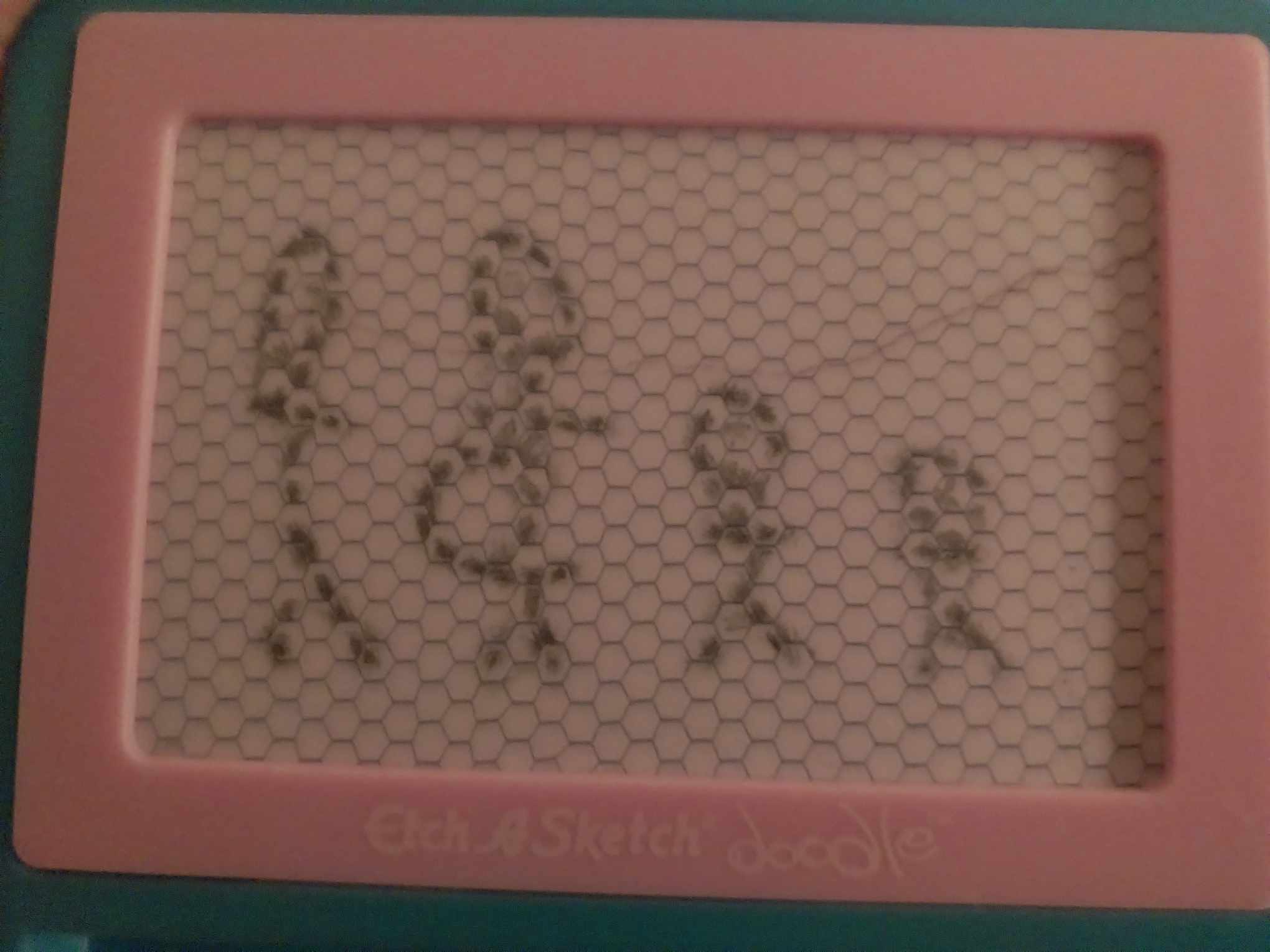
Great expectations

A portrait of our family:


Before you ask if one of the children is a prodigy: No, I drew this.

Our unborn one’s “placeholder” name is Pip.

(Permanent name TBD.)

♦ ♦ ♦ ♦ ♦

Having mostly recovered, healthwise, we’re happier tonight. The weather – lately rather droughty – has been recovering, too. Yesterday there were wild rains (and hail); the lawn is greening again.

The boys have inherited their second cousins’ trampoline. Their use of it, so far, is reminiscent of the WWE (née WWF). But with less pretending.

Ah for those proto-anglophilic days in Esmeraldas when I would cheer for the British Bulldogs, and then emulate them with David.

Celtic 4, Chelsea 1

I’m sunburnt because yesterday I attended the pre-season “friendly” between these clubs, at Notre Dame Stadium. Chelsea’s fans came in droves; Celtic’s, who were fewer, cheered better. The Chelsea faithful commenced their exodus after Celtic’s fourth goal.

Martin watched Cameron Carter-Vickers, his compatriot, perform flawlessly for Celtic.

David’s aunt- and uncle-in-law, who’ve been visiting from Honduras, saw their compatriot, Luis Palma, score Celtic’s third goal.

Kasper Schmeichel was Celtic’s best performer. As for Chelsea, Raheem Stirling, of all people, was the brightest spark. He fizzled out ten minutes after coming on.

David, Stephen, and I had hoped to see Moisés Caicedo, but he was absent. So were Cucurella, Fernández, Palmer, and others. Trevoh Chalobah, whom I consider the club’s best defender, is in the doghouse and didn’t make the trip.

I know it’s the preseason and teams aren’t giving it their all, but this was the first time I’d seen players look worse live than on TV.

♦ ♦ ♦ ♦ ♦

I also have terrible heartburn today. I ate serving after serving of chili at my niece Belladonna’s birthday party. She is two. She is a winsome little thing.

Argentina 1, Ecuador 0


I viewed the second half of Ecuador’s “friendly” match vs. Argentina, preparatory to this summer’s Copa América (which, for reasons of greed, is being held in the United States). It was played in Chicago. Ecuador lost; our coach is still clueless; we are devoid of strikers; Argentina is a cut above. Even so, I enjoyed the game. Such players as Moisés Caicedo and Willian Pacho give pleasure no matter what the rest of the team is doing. And by now I have a great liking for these Argentinians. They may not always win, but everything they do is purposeful; and the goal Di María scored tonight was pure artistry. “They teach you not to toe-poke,” the commentator said, “but this is when you toe-poke.” (Right, but who are these morons teaching children not to toe-poke?) De Paul’s pass was lovely, too, and Romero should be credited for moving to an unusual position to receive it.

I also liked that the Ecuadorians and Argentinians kicked each other hard but still joked with each other on the field. (They might not have been so friendly in, well, a non-“friendly.”)

Also gratifying (more so, result-wise): Colombia beat the USA, 5–1; and Uruguay beat Mexico, 4–0. David and I noted that the Uruguayans barely seemed to try, except for their poor wingers who had to keep running into empty space, and poor Darwin Núñez who had to stay with them to convert his tap-ins.

The accidental Hoosier

I guess it’s all right, now, to disclose that Ana, David, Ada, George, and Russell (the dog) have sold their house in Texas and will move to South Bend this weekend. So, we siblings – John-Paul, David, Mary, and Stephen – and our respective households, as well as our parents, will all have settled in the same metro area (two adjacent cities) for the first time since 2000 (the previous millennium). Odd to think that South Bend/​Mishawaka, and not, say, Quito, Esmeraldas, Guayaquil, or even Santo Domingo de los Tsáchilas, should have proved our stubbornest anchor. It’s not as if our ancestors hailed from this part of the state. My dad’s dad grew up closer to Lafayette; my dad’s mom, closer to Fort Wayne. They never lived together in the South Bend area. (Neither of my mom’s parents was a Hoosier.) My parents got together as students in Chicagoland. They became missionaries, moved to Ecuador, had their children, and spent furloughs in Illinois (twice) and Missouri. They – we – never all lived together in Indiana.

But, soon, we shall.

I’ve lived some fifteen years, off and on, in the state. Hoosiers still seem strange to me. Not as horrifying as Missourians – whom I think I actually understand better – but less relatable than, say, Upstate New Yorkers, and not nearly as endearing as Minnesotans or Wisconsinites.

I look at the institutions and positions that confer prestige here, and think, that doesn’t appeal to me at all. But then, I might think that anywhere.

I look at what people here do for enjoyment, and think, that doesn’t appeal to me, either. That’s worse.

I think how, last year, a chicken trapped itself in our yard, and the officer who removed it told me it was a gamecock. This weekend we had friends – Michiganders I’d known in Quito – in the yard. We heard roosters crowing, and I thought, I may not approve of cockfighting, but my heart is warmed to know it’s practiced in the neighborhood where I now live.

1996, the best year in movie history, pt. 74: Lost highway

David Lynch released The Straight Story in 1999. It told a tidy, linear, almost sentimental tale.

In 2001, he released Mulholland Drive. That puzzle-story was cohesive – even (shudder!) a bit affecting.

The question is whether Lost Highway (1997) belongs with this group or with such perversities as Lynch’s Blue Velvet and Wild at Heart. It does feel different from those earlier movies. Gone is (most of ) the campy cruelty. What remains is … just cruel.

Is that fatal to a movie? “It’s not the violence I mind,” Ebert says in his review of Wild at Heart, “it’s the sneaky excuses.” Lynch, in Lost Highway, seems to have done away with the excuses, but the residue sure ain’t for the squeamish.

Ebert gives Lost Highway half a star less.

What say you, John-Paul? Acquit or convict?

♦ ♦ ♦ ♦ ♦

Much happens in Lost Highway that couldn’t. People inhabit two places at the same time. People disappear from photographs and from small, locked rooms. People change into other people.


It isn’t fantasy or science fiction.

The simplest explanation is that the movie depicts the thoughts of a man whose brain is being zapped in the electric chair. Some thoughts are memories; some are involuntary hallucinations; some, perhaps, are voluntary fantasies. They needn’t perfectly cohere.

Mulholland Drive consists of a similar brainstorm before death. So, for that matter, does American Beauty (1999; not one of Lynch’s movies, but charitably interpreted in that vein). A literary precedent, noted by others who have tried to make sense of Lost Highway, is Ambrose Bierce’s story, “An Occurrence at Owl Creek Bridge” (1890).

Never mind that in California in the 1990s, condemned people weren’t electrocuted. That sort of licence is permitted because the movie is tipping its fedora to the past. It wants to be like Detour, another movie that takes place inside one character’s thoughts.

♦ ♦ ♦ ♦ ♦

Fred (Bill Pullman) and Renee (Patricia Arquette) have a frosty marriage. Videos arrive on their doorstep. Fred and Renee view them. One shows the outside of their house. Another shows them sleeping. Fred views the third tape alone. It shows him with Renee’s bloody corpse. We haven’t seen Fred murder Renee, but the movie jumps forward, and we hear his sentencing. He is condemned to die. In prison he has headaches. One day (and this is the big spoiler), the guards find another person, instead, in his cell. This is young Pete – Balthazar Getty, who looks like James, the young biker in Lynch’s Twin Peaks – a mechanic with a less serious criminal record. The authorities have no choice but to release Pete. He returns to his job, his parents’ house, and Sheila (Natasha Gregson Wagner), his girlfriend. Through his garage work, he falls in with a gangster and his mistress, Alice (Arquette again, blond, not dark-haired); they are involved with pornographers. Pete has an affair with Alice. She tells of terrible abuse. She asks him to help commit a robbery. They do so (and manslaughter, too) and drive out into the desert to sell the goods … and then things get very strange. They have intense, loveless, arid, desert sex; Alice disappears; a house burns down. Things get even stranger.

It’s generally agreed that Fred imagines most of this and that Pete is his imaginary alter ego. I dunno. Pete, to me, hardly seems the manly sort that Fred is alleged to wish to be. I have a different theory. Pete is Fred, all right – a memory, not an alter ego; and Renee is Alice, who fled the gangster with Pete⁠/Fred, taking the identity of Pete’s dark-haired girlfriend, Sheila, to throw the gangster’s minions off the trail. Sheila is sacrificed (perhaps in the fire). So Fred is guilty of his woman’s murder, but she isn’t the woman we think he’s accused of murdering. Living with Renee⁠/Alice, Fred more-or-less wilfully conflates her personality with Sheila’s (he prefers the tamer girl, it turns out). Meanwhile, one of the gangster’s associates, who has obtained a video of Sheila’s murder, uses it and other video of Fred and Renee to coerce Fred into helping him to murder the gangster; he then lets Fred be blamed. This doesn’t tie up all the loose ends, but it makes sense of some puzzles, like why Sheila is in the movie, why she looks like Renee, and why Arquette plays both Alice and Renee (they’re the same woman, although Renee, in Fred’s thoughts, behaves like Sheila, or as he wishes Sheila had behaved). Why, in prison, does Fred change back into Pete? That’s escapist fantasy à la “Owl Creek Bridge” (back to one’s ancestral home; back to one’s obliging woman). Fred’s other dying thoughts may be distorted in detail, but they’re emotionally and morally true.

This could all be wrong. But if enough of it is right, I vote acquit.

But I don’t think I’d watch it again.

♦ ♦ ♦ ♦ ♦

David saw this movie not long ago. I haven’t heard his interpretation.

Virtually everyone agrees that Fred murders his woman. Lynch has said that he was thinking of the O. J. Simpson car chase while making this movie. What bugs me is: Which woman, exactly, does Fred murder? And does he have to kill her, or would it be murderous enough to replace her, in his thoughts, with someone else?

For a different account that I’m sympathetic to, see this book.

Leverkusen

Congrats to Leverkusen for securing the club’s first Bundesliga title, in the sixth-to-last round of matches, with a five-zero rout of Bremen. After the fourth and fifth goals the fans stormed the field and had to be shooed back to the stands. My brothers and I are especially pleased for the starting left-back, the esmeraldeño Piero Hincapié. He almost scored what would have been the title-clinching goal, but Bremen’s goalie made a heroic and ultimately pointless save.

Xabi Alonso is the sport’s managerial celebrity du jour. Indeed, this team reminded me of the 2010 Spaniards who, in game after game, would keep opponents pinned back and then eke out a winning goal in the dying minutes (although this match was more like the blowout final of the 2012 Euros).


Eclipses

Karin has had a cold all week; the boys have been sick even longer. I caught it two days ago. My dad has been watching the Final Four with us; he has a cold, too.

I’ve been ill during many NCAA tournaments. I’m used to watching with blankets and medicine and tea. It must have something to do with the time of year.

My neighbors have been mowing their lawns. It’s warm enough, and our grass certainly is long enough, but I’m just not up to doing it.

And now, the business on everyone’s mind: Monday’s eclipse.

Karin had talked of traveling to Indianapolis, into the path of totality. Bad idea, she decided. The highway will be crammed.

As for me, the memory of the 2017 event is fresh. It was a time of joy and solidarity on the IUSB campus. All too brief. The recollection literally pains me; it makes me squint.

Eclipses are better to study, or to read about, or to imagine, than to view. I recently came across one in King Solomon’s Mines; it was the usual rot about science-minded explorers displaying their “magic” in front of savages. It should be noted, however, that the idea of carrying eclipse-mania through “exotic” lands has a basis in the actual history of science.

I read this, yesterday, in Herodotus (Robin Waterfield, trans.):
The war lasted for five years and although plenty of battles went the Medes’ way, just as many went the Lydians’ way too. They even once fought a kind of night battle. In the sixth year, when neither side had a clear advantage over the other in the war, an engagement took place and it so happened that in the battle day suddenly became night. Thales of Miletus had predicted this loss of daylight to the Ionians by establishing in advance that it would happen within the limits of the year in which it did in fact happen. When the Lydians and the Medes saw that night had replaced day, they did not just stop fighting; both sides also more actively wanted an end to the war. Peace between them was brokered by Syennesis of Cilicia and Labynetus of Babylon, who were anxious that the two sides should enter into a formal peace treaty and arranged for there to be mutual ties of marriage between them. That is, they decided that Allyates should give his daughter Aryenis in marriage to Cyaxeres’ son Astyages, on the grounds that strong treaties tend not to last in the absence of strong ties. These people formalize their treaties in the same way the Greeks do, with the extra feature that when they cut into the skin of their arms, each party licks the other’s blood.
Here is the famous picture of my family observing an eclipse in Esmeraldas (perhaps in 1991). David is shooting it with a machine gun.

D1 and D2; Alan Jacobs

Daniel’d been having trouble seeing through his bangs, so we gave him the most drastic haircut of his life.


“Wow … different kid,” his Uncle David remarks.

I’m inclined to agree: I’d assign metaphysical import to this haircut. One boy, D1, used to live with us; another, D2, has taken his place. The genetic, psychological, and behavioral characteristics remain unchanged; but whereas D1 was innocent (if mischievous), D2 is responsible for misdeeds.

The leading corporeal, mental, and biographical theories of personal identity fail to account for this. I have more evidence, then, for my outrageous pet theory that personhood and personal identity are response-dependent properties. … I don’t really subscribe to this but suspect it’s as defensible as any response-dependent theory of anything.

♦ ♦ ♦ ♦ ♦

People in my orbit have been quoting from and forwarding blog posts by the consistently enjoyable Alan Jacobs. I never thought I’d have much interest in Thomas Mann’s Joseph and His Brothers, but Jacobs has changed that; and here is his nice little manifesto, “Bring Back the Blog,” of which I wholeheartedly approve.

Today, reading about Goodhart’s Law (but how well does it describe sports?, I wondered), I followed links and came across, in someone’s book, a reference to Jacobs’s admission that baseball, one of his lifelong passions, has come to a dead end. And my respect for him grew tenfold.

On holiday; Bolivia 1, Ecuador 2; Brazil 1, Venezuela 1

A satisfactory little vacation in Austin. I’ve done what I said I’d do, except I haven’t ridden the bus.

I’m about to finish reading my second book.

David took me to a good Colombian restaurant in East Austin, the seedy-but-gentrifying part of town. He lives in a much-nicer-but-also-gentrifying part of town. I gather there are other neighborhoods that leave his in the dust.

My legs are sore because yesterday I hiked through a stony, scrubby forest. I’m no birdwatcher, but I was delighted when a roadrunner crossed my path. It was an idyllic morning – except that the freeway traffic near the forest was very loud.

Back where Ana & David live, we did a little tour of the Halloween decorations.


Ada, my neice, is a chatterbox. She is keen to describe all the neighborhood calaveras (skulls). She tells us about Ellison, her imaginary older sister.

George, my nephew, likes to be read to and to dribble the soccer ball around the house.

We watched Ecuador play awfully against Bolivia. To our intense relief, Ecuador scored the winning goal in the last minute. Afterward, David and I listed four or five players whom we never want to see again. The commentator was a nice man from South Africa or maybe New Zealand who clearly knew little about South American soccer or soccer in general. By the end of the game, even he was remarking on how poor these players were, and David and I were warming up to him.

The other notable result was that Venezuela rescued a point in Brazil thanks to a late bicycle-kick goal. The Brazilians were very angry.

October’s poem

A dead racoon lay in the middle of our street, in front of our house. Someone put a traffic cone next to it to alert passing cars. The racoon remained there for many hours.

No city official collected the racoon.

Our next-door neighbors – jovial young men – held a memorial service for the racoon and buried it in their back yard. I applaud the sentiment but worry. Scent of racoon attracts more racoon.

♦ ♦ ♦ ♦ ♦

It’s chilly in the house. Our brand-new furnace provided heat for two days. Then it quit.

Not that I’ll be affected much. Repairs have been comissioned, and meanwhile I’ll fly to Texas to visit David, Ana, Ada, George, and Russell (the dog). The forecast there is for temperatures in the 70s and 80s, F.

Ana & David have jobs, and Ada and George go to day-care, so I’ll have time to myself. I intend to walk, ride the bus, eat, and read – things I used to do when I was a bachelor. I’ve pared down my cargo to these texts:
  • The Bible
  • Daphne Du Maurier, Don’t Look Now: Stories (I’ll probably just read one or two longish ones)
  • R. M. Dworkin, ed., The Philosophy of Law (probably just one or two articles)
  • Dolores Hitchens, Sleep with Strangers (unless I finish it tonight)
  • Alasdair MacIntyre, The Unconscious
  • Ronald Hugh Morrieson, The Scarecrow
I’ll use the Internet to continue reading Macbeth.

So, in addition to Scripture: texts of criminality, deviance, and buried desire. My usual seasonal fare.

Ecuador and Bolivia will play in La Paz on Thursday. David and I will watch that game together.

♦ ♦ ♦ ♦ ♦

October’s poem is “October”:

⎯⎯⎯⎯⎯⎯⎯⎯⎯⎯
O hushed October morning mild,
Thy leaves have ripened to the fall;
Tomorrow’s wind, if it be wild,
Should waste them all.
The crows above the forest call;
Tomorrow they may form and go.
O hushed October morning mild,
Begin the hours of this day slow.
Make the day seem to us less brief.
Hearts not averse to being beguiled,
Beguile us in the way you know.
Release one leaf at break of day;
At noon release another leaf;
One from our trees, one far away.
Retard the sun with gentle mist;
Enchant the land with amethyst.
Slow, slow!
For the grapes’ sake, if they were all,
Whose leaves already are burnt with frost,
Whose clustered fruit must else be lost –
For the grapes’ sake along the wall.
⎯⎯⎯⎯⎯⎯⎯⎯⎯⎯

(Robert Frost)

Another mouse

We aren’t very sick anymore. I have to blow my nose a lot, but that’s the extent of it.

♦ ♦ ♦ ♦ ♦

Last night, we saw a mouse in our basement. Get it, Jasper!, we said.

A little later, we saw our champion mouser trotting along, his mouth full, a bit of brown fuzz dangling out of it. Karin followed after Jasper with an empty potato-salad container. He tried to escape into one of his hidey-holes to play with his prize, but Karin caught him and he grudgingly released the limp thing.

It was a plastic toy. The bit of fuzz was a dust bunny. We didn’t see the mouse again.

♦ ♦ ♦ ♦ ♦

This, at last, is shaping up to be the August when I read all of Light in August.

Some more August reading:

Harry Potter and the Half-Blood Prince.

The Merchant of Venice.

Operation Mincemeat, by Ben Macintyre.

Storm, by George R. Stewart.

Something crime-ey as soon as I wind up The Dain Curse.

♦ ♦ ♦ ♦ ♦

Ana & David and their children, Ada and George, will be in town from Saturday to Saturday.

1996, the best year in movie history, pt. 61: Cold Comfort Farm

Samuel recovered. But then I threw up, and Daniel threw up, and Karin had other troubles, and I had other troubles and a miserable fever. My mom came over to take care of the children while I writhed in bed. After she went home, she threw up.

We’ve started to feel better. Yesterday I ate only jello, but this morning I was able to hold down some toast and eggs. Then, tonight, I was very hungry, and I had some McDonald’s. That may have been a mistake.

♦ ♦ ♦ ♦ ♦

Cold Comfort Farm

I’ve read Stella Gibbons’s book. It has an undercurrent of, shall we say, nihilism? Anyway, it didn’t sit well.

The movie is, if not less mocking, then gentler, more humane. A lot of the same stuff happens, but it helps that the actors are so winsome in their self-inflicted despair. (A partial roll call: Eileen Atkins, Sheila Burrell, Freddie Jones, Ian McKellen, Rufus Sewell.) You could enjoy watching these people do just about anything. May as well watch them as dismal farmers trudging around in the mud, fornicating and birthing in the hay, giving themselves up to gloom and doom.

It’s funny.

It’s even funnier that a perky distant relation, a fresh-faced Londoner (Kate Beckinsale), recently orphaned, has come to live with them to learn about “life,” so that in middle age she will be able to write a novel in the manner of Jane Austen. She’s got one thing right: even though Austen’s novels are about rich people, a lot of their appeal is due to the not-infrequent trudging around in the mud that the characters are made to do. (Or maybe that’s just what I treasure from the movies.)

Flora, the city girl, proceeds to “improve” her country relations, the Starkadders. She aims to coax them out of their despair. The ruddy cheek!

No, that’s not how the Starkadders see it. They’re so insular, they don’t think of Flora as an entitled busybody. They’re likelier to suspect her of trying to steal their precious, miserable farm. Little do they realize, her ambition is more like an Austen heroine’s: she wants to arrange everyone’s life just-so.

But then, so does Ada Doom (Burrell), the matriarch who leaves her room but twice a year – in order to count her relations and farmhands – and who obsesses over a trauma of her girlhood, which is that she “saw something nasty in the woodshed.” This trauma is her justification for discouraging the other Starkadders from imagining that they could leave the farm. Only Flora’s cousin, Seth Starkadder (Sewell), spares any thought for the outside world, and that’s because he’s a devotee of the talkies. Oh, and so does old Amos Starkadder (McKellen). He preaches fire-and-brimstone sermons every week in the Church of the Quivering Brethren. His theme is that everyone is hellbound. Not hellbound yet redeemable through Christ – hellbound, full stop. The fire will never be quenched. There’ll be no salve for the burns: “There’ll be no butter in hell!” The Brethren quiver in the ecstasy of their damnation.

David, my brother, has noticed that it’s a very short step from this famous line to the Newsboys’ Christian pop lyric, “They don’t serve breakfast in hell.” One might suspect that the Newsboys are drawing from Gibbons’s book. (Or, just possibly, from this movie, which narrowly preceded the song.)

Anyway, Flora, like Austen’s Emma, channels these interests of Seth’s and Amos’s into meaningful, if not especially admirable, enterprises, and soon she is figuring out how to do the same to everyone else on the farm. But will her own destiny be tidied up so neatly? Will she detail and execute her own life-plan, or will she relinquish a little control to gain a little wisdom?


Ancestry

There is a surge of COVID-19 across the land. Even so, last night, several dozen descendants of Karin’s father’s parents gathered in the small ancestral house for a Christmas party that had been postponed by December’s storm.

This photo shows representatives of three generations. Daniel sits upon his grandfather. Standing, hunched over, is Daniel’s young granduncle. (I am almost as old as he is.) Finally, there is Daniel’s great-grandfather – Karin’s grandfather. Karin’s generation isn’t represented in the photo.


I ate barbecued meatballs and wieners and bemusedly watched the many children scurry around. Our own boys were shell-shocked by all the relatives and gifts.

Now that we are at home and things have quieted down, Samuel’s favorite present is a miniature basketball hoop-and-balls set given to Daniel. Daniel’s favorite present is a large, plush, green dragon given to Samuel, which Karin has named Draco.

♦ ♦ ♦ ♦ ♦

Karin’s grandfather was adopted. Recently, he took a DNA test and learned about some of his biological relations. He spoke last night of Scottish, English, and Irish ancestors. (He used to say he was Hungarian.)

Karin’s mom also was adopted. Much of Karin’s ancestry – and our children’s – is unknown.

As for mine: Mary’s DNA was profiled a few years ago, and it turns out that I and my siblings are largely North African. “Which is hardly surprising,” David said, “when you think of what we share with Mohamed Salah, Zinedine Zidane, et al. …”

1996, the best year in movie history, pt. 52: Rats in the ranks

A warm welcome to George, my nephew, born yesterday to Ana & David. My mom is in Texas with them. She looks after little Ada and the dog, Russell, while Ana, David, and George are in the hospital.

♦ ♦ ♦ ♦ ♦

A synopsis (not by me) of Rats in the Ranks.
Each year, as part of the democratic process all over Australia, local councillors meet to elect a mayor to lead their council for the next year. Rats in the Ranks tells the story of this process in the Leichhardt council area of Sydney in 1994. Every September, the Leichhardt council meets to elect one of their twelve members as the Mayor and another for Deputy Mayor for the following year. The election is rarely a straightforward affair.

In 1994, the current mayor, Larry Hand, was popular with the local citizens, but they don’t vote for the mayor, the councillors do – and after three years of Larry, some of them were after his job.

In Rats in the Ranks, filmmakers Bob Connolly and Robin Anderson trace the story of the struggle for the mayoralty. They had extraordinary access to the councillors who were willing for the story to be filmed in the lead up to the election.

Arms are twisted, favours are called in, people are double-crossed, damaging stories are leaked to the media and deals are done. But right up to the vote, no one knows how the numbers will stick and who will walk away from the election as mayor.
I copied this from OZmovies, a lovely website.

Another tidbit is that Rats in the Ranks
missed out on a nomination in the “best documentary” category and most other categories at the 1996 [Australian Film Institute] Awards. …

The film’s failure to make it past a pre-selection jury into general membership voting became part of a larger ongoing controversy about the AFI Awards, and eventually led to a change to the AFI’s voting system. This was the year that the AFI Awards reached the level of contempt usually reserved for the Academy Awards.
(The last sentence is a bonus, I guess.)

The documentary is basically C.P. Snow’s The Masters, with this difference: the scheming Cambridge dons of that novel are conscientious and gentle souls next to the professional politicians of Rats in the Ranks. In what follows, I’ll not reveal the outcome of the election, but I shall describe some of its participants. My opinions of these people changed as I viewed the movie. Here I’ll present my final character assessments. I thought hard about whether I could cheer for anyone to win the election, and, in the end, I decided I could; but you might reach a different verdict. I recommend you watch the movie and then read this review.

The accents and slang aren’t always easy to follow. I watched with the captions turned on. Here is a YouTube upload; the movie also can be streamed through Kanopy.


♦ ♦ ♦ ♦ ♦

There is a councilor in Rats in the Ranks who may as well be Satan. (In some scenes, he even wears a cape.)

There is another councilor who is “Satan’s” dupe – in effect, his lackey – even though she belongs to the opposing party. She spends more time with the Satan figure than with her fellow party members. After her meetings with them, she runs over to tell “Satan” everything.

In good bureaucratic fashion, this lackey has a lackey.

Meanwhile, other members of her party conspire to defeat the Satan figure by means fair or foul. (Mostly fair means, but the foul cannot be overlooked.) So, there is a potentially fatal division within that party. This makes for some outrageous caucus meetings. These scenes would be ghastly if they weren’t so entertaining.

It’s fascinating to hear such good talkers make tactical blunders, lose all sight of values, etc.

What’s most disturbing is how little the populace matters in all of this. The residents vote for their councilors, but not for their mayor; which might not matter so much, except for two things.

First, the mayor has considerably more formal and effective power than the other councilors have. (Not even the deputy mayor comes close.)

And second, the councilors choose the mayor on the basis of their personal ambitions and resentments. They give lip-service to their parties’ and constituents’ interests; but, at the end of the day, those interests don’t determine their choices.

How can these people live with themselves? How can they sleep at night?, the Satan figure asks about his fellow councilors – though he himself would betray any of them, should the winds change.

Interestingly, the Satan figure is a very good public official. (At least, he convinces me that he is a good public official.) He gets things done. He listens to the citizens. When they disagree with him, he patiently and candidly explains to them why his way is better. Were I to live in Leichhardt, and were it in my power to vote in this election, I’d be tempted to vote for this candidate.

I also was favorably impressed by his main challenger. He, too, has the makings of a good public official. He is the schlubbiest of all these schlubs (or the second-schlubbiest, after the lackey’s lackey); but he has moments of reasonableness and forthrightness.

Indeed, he may be too forthright to be a very successful politician. The Satan figure runs rings around him, gamesmanship-wise.

The two men can’t stand one another. Perhaps this is because of a class difference. Or perhaps they recognize each other as genuine threats. Or perhaps they sincerely disagree about how to govern.

Another politician, who refuses to appear onscreen, makes a crucial intervention. He is Anthony Albanese; as of May of 2022, he has been serving as the Prime Minister of Australia.

♦ ♦ ♦ ♦ ♦

The other day, I said to Karin: Isn’t it funny that I, who find politics so distasteful, should have written a dissertation about political matters. But the word “political” describes two different inquiries. One inquiry is about how a polis should be run, and the other is about how the polis is run (which boils down to a lot of scheming, backstabbing, etc.). If the gulf between should and is is too great, it’s natural to be interested in one inquiry but not the other.

This movie shows a representative democracy whose representatives aren’t chosen with regard for how it’s best to run the polis. And yet the polis is run competently enough. This suggests that we may as well choose our representatives out of a hat, as some of the more trusting politicians in this movie are inclined to do; or by having each desiring person take a turn, as some of the more self-important and envious politicians insist upon.

Margie; Somaliland; Western Togoland; Uyuni

R.I.P. Margie, a kindly old woman who went to church with us. She was famous for sending greeting cards. Word has it, before she died she prepared several dozen Thanksgiving cards, and so we may hear from her one last time. We attended her funeral; Samuel was asleep when we arrived, but he soon woke up and had to be taken outside; he and I sat on the front steps and identified passing cars. “Sports car. Truck. S.U.V. Sedan. Truck. S.U.V. Police car.” This kept us busy until the last hymn.

♦ ♦ ♦ ♦ ♦

Here’s another fine video from the YouTube channel Un mundo inmenso. This one is about Somaliland, the self-governing northwestern region of Somalia.


I hadn’t known that Somaliland is so stable, or that other countries and the UN refuse to recognize it as an independent state because they’re wary of lending credibility to other secessionist movements.

(The situation may well be more complicated than this. Even so, the video is a good starting-point; also, it got me reading about another “unrepresented nation”: Western Togoland, which has eleven million people and the world’s friendliest flag.)

But Somaliland isn’t as beautiful as “Uyuni, the Most Incredible Landscape in the World”:


One time, with David, I was looking at pictures of Bolivia, and he was like, “I don’t understand why this isn’t everyone’s main interest in life.”

I practice archaeology

I’ve been sorting through books that until recently had lain in my grandparents’ shed. Ah, yes. Here is this textbook that I had been missing. And this textbook – psychology, Wadsworth/Thomson Learning – much easier to read than I remember (and even less interesting). Here’s an anthology with some good chapters. Better keep it. And here is a Daniel Clowes comic I’d been thinking of just last week. (Is it my copy or David’s? Both of our names are on the box.) What on earth is this. It’s in German. And this is in Hebrew. I’m middle-aged now. I don’t have time to learn languages.

The finding that most excites me is a short book about the Cane Ridge revival that a Bethel teacher ordered but, ultimately, didn’t assign. I’ll probably read it. Hardly my area, but that’s OK.

Why read history? Dunno, but I continue to do it. If only my approach were more systematic than, how shall I put it, channel surfing.

Samuel is delighted with the really huge, really glossy textbooks. He especially likes the psychology textbook.

House hunting, pt. 1066 and all that

Karin & I took Samuel to the St. Joseph County fair, and, for the first time, he saw cows, chickens, horses, hogs, goats, and kangaroos. Then we drove across town and walked through a well-kept house with fifties decor. Martin, Mary, and David were with us. Everyone was very positive about this house, and so, a few hours later, we made as handsome an offer as we could; it was refused.

Tonight: two more houses.

Too tired to type

Tonight, for the third time this year, I attempted to play soccer.

I wonder if I ought to retire from the soccer.


David is in town. He’ll be here for three weeks.

More house hunting

This is turning out to be one of the most unpleasant things I’ve had to do.

Not long ago, after an evening during which Karin & I visited five houses, I woke up around 3:00am and lay in bed for two hours with what felt like electric current speeding through my body. I finally gave up and went to the living room.

Jasper took it as his cue to spread out on my lap. He must have comforted me: I promptly fell asleep.

♦ ♦ ♦ ♦ ♦

Tonight we toured another house. It was inexpensive; it seemed comfortable enough to live in; it was in an unkempt neighborhood, next to two abandoned houses. It seemed like a good “backup” option. We decided not to rule it out. On the main level were a couple of large, open rooms through which Samuel ran back and forth. “That’s the boy I know,” said our realtor, who is finally warming up to him (the realtor is a bit of a sourpuss).

We toured an abandoned house on Wednesday. Our realtor wouldn’t go inside with us. We found rotten food, dead mice, etc. I wouldn’t allow Samuel to run around in that house, though he tried to squirm out of my arms.

The house itself wasn’t bad, but the one we saw today was better, and it costs about the same amount.

Tomorrow, two more houses.

♦ ♦ ♦ ♦ ♦

In Texas, David is reading War and Peace with his book club. I said I’d read it at the same time; but, obviously, I’m finding it impossible to keep up, what with all this worrying about houses.


Before all of this, Karin & I had been planning a little vacation, but that’s on hold. I don’t think we’ve said a word about it since we visited our first house.