Posts

Showing posts with the label IT’S ALWAYS SUNNY IN PHILADELPHIA

Body-text fonts, pt. 43: Spectral

Last week: Paraguay 0, Ecuador 0.

Tonight: Ecuador 1, Argentina 0.

We concluded South America’s World Cup qualification tournament with:
  • qualification
  • a victory over the World Cup champions
  • a final position as runners-up (trailing only the aforementioned champions)
  • a total of five goals conceded in eighteen games – the joint-lowest total in the tournament’s history
  • a streak of five “clean sheets” (games with no goals conceded)
  • a streak of eleven undefeated games
I think it was after the goalless draw in Uruguay, with eight games to play, that I predicted we wouldn’t lose again.

The bad news is that tonight, Moisés Caicedo received two yellow cards and was ejected. The second yellow card was extremely doubtful. The referee, who’d been obliged to eject an Argentinian, seemed to be trying to even up the numbers.

I’m sure we’ll appeal to CONMEBOL. Let’s pray that no suspension is enforced.

♦ ♦ ♦ ♦ ♦

Having recovered from injury and illness, I mowed the shin-high backyard grass. It was slow going, but painless … until, some hours afterward, my hip and ankle began to trouble me.

Then, today, I threw out my back.

Either I get sidelined due to a foot puncture – or sinusitus – and suffer; or I recover, then mow, then suffer.

♦ ♦ ♦ ♦ ♦

The font Spectral is common on the internet, especially on Substack (which only allows, what, four fonts?).


Too small? Click here; read the “Thunder Gun Express” of Substack posts. It’s just a very long summary of Niccolao Mannuci’s very long travelogue and history of Mughal India – the “Thunder Gun Express” of books.

Which I only learned about yesterday. It’s the awesomest book I’ve heard of. I’m not kidding.

Even if the Bible were turned into a wild AI-generated movie, it wouldn’t be as spectacular as this book.

But I doubt I’ll ever read the book, so thank goodness for the Substack post.
Isla Cromartie

My new Chromebook arrived a day early. What with the Scottish TV I’ve been watching, I named her Isla Cromartie.

The good: compared to my previous Chromebooks, Isla is built like a tank.

The bad: she loses power faster. And she has a touchscreen for Samuel and Daniel to interfere with. Perhaps this feature could be disabled.

She is a Dell. I considered naming her Adelle. Also: Philadelphia, after Philadelphia Bobbin, a character in Nancy Mitford’s Christmas Pudding.

It’s unlikely but possible that one day I’ll sire girl-triplets: Philomena (“Mena”), Philippa (“Pippa”), and Philadelphia (“Dee”). Karin hopes not.

♦ ♦ ♦ ♦ ♦

The Drake Passage, in a nutshell (National Geographic).

♦ ♦ ♦ ♦ ♦

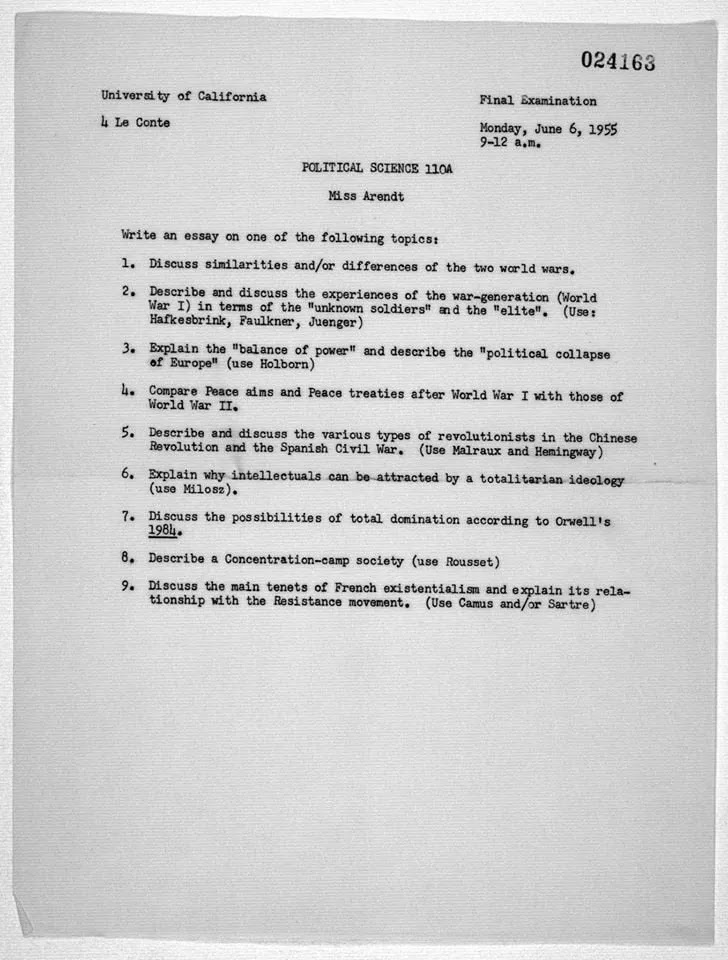
An exam from a class taught by Hannah Arendt in 1955. (Click on the image to make it sharper.)


When I was growing up and aspiring to become an academic (among other things), I read a few books from the 1970s and ’80s – whatever I could find in Ecuador – on how to teach in college. These books had sample exams. One basic type was Arendt’s: Here is your chance to demonstrate what you have learned.

For the student who’d learned little, there was nowhere to hide. For one who’d at least absorbed a few key lessons, arriving at a decent launching point for subsequent, mostly unguided study, this was an arena in which to shine.

I was enamored.

This was not what my exams were like in college or graduate school.

If memory serves, just one exam, a take-home from my second semester of college, was remotely like Arendt’s.

Poor, unfortuble souls

Modifying a song from The Little Mermaid, Samuel has coined the word “unfortuble,” as in:

“Poor, unfortuble souls.”

♦ ♦ ♦ ♦ ♦

Daniel has taken to postponing his afternoon nap as long as possible. Not that he doesn’t still need to nap.

The wilder he gets, the closer he is to sleeping. Lately, his escalation has manifested itself as repeated summersaulting, headfirst, off the couch.

Yesterday, after a particularly violent landing, he lay on the floor, smiling, and gently floated off to dreamland. I was reminded of Frank Reynolds and Charlie Kelly in It’s Always Sunny in Philadelphia, who put themselves to bed every night by scarfing down catfood until they feel so awful, they have to go to sleep.

(Daniel likes to scarf down catfood, too.)

♦ ♦ ♦ ♦ ♦

In a moment of frustration, I called Samuel a monster. He thought it was a great joke.

Later I was singing “My Son Calls Another Man ‘Daddy’,” by Hank Williams, while a child (Daniel, I think) tried mightily to push me away from the kitchen counter even as I was fixing him a sandwich.

“Your father is singing that as a threat,” Karin told the child.

I wasn’t, but I liked that reinterpretation of the song.

♦ ♦ ♦ ♦ ♦

Six Harry Potter books down, one to go. Book 6, utterly devastating, is my favorite so far.

In our household, we employ a useful phrase, “The Shocking Truth,” to refer to the last entry in a narrative series. As in: “Be quiet, children, your father & I are trying to watch The Shocking Truth of WPC 56, series 1.” I was tempted to read the last Harry Potter book as soon as I finished book 6, but then I calmed down, decided to stick to the schedule, and resigned myself to waiting until next month to read The Shocking Truth.

Some visitors from Esmeraldas

Yesterday, Karin & I went to the movie theater. The movie itself cost $6 per ticket – the only good deal in the house. Two popcorns and two drinks would’ve cost about $20. Two bottles of water would’ve cost about $10.

And then, to add insult to injury, the drinking fountains in our section didn’t work. (We did find drinking water at the other end of the building.)

We settled into our seats. The previews were uninspired.

Clearly, the movie industry is in bad decline …

… except for the Mission: Impossible series, which just keeps on getting better and better, and whose latest installment we’d come to view. (It’s one of the comforts of my old age.)

Mission: Impossible – Fallout is the “Thundergun Express” of movies. Tom Cruise hangs from a cliff, and from a tall building. He jumps out of a plane – in a lightning storm. He pilots a helicopter – in a dogfight with another helicopter, over the Himalayas. And, in Paris and London, he runs, and runs, and runs.

It’s best viewed on the big screen, what Tom Cruise manages to do.

♦ ♦ ♦ ♦ ♦

Afterward, we stopped by my Aunt Lorena’s & Uncle John’s house to borrow a book; and, lo and behold, who should be visiting but my Aunt Lorena’s own aunt and uncle, Amparo and René Bermúdez. It’s not often that I see people I knew in Esmeraldas, as a child.

We conversed in Spanish.

“How is Ruth?” they asked, referring to Mary, my sister. “Does she still have asthma?”

“No,” my Aunt Lorena said, “she has diabetes.”

“She has both,” I assured them. We all shook our heads.

“She exercises regularly and watches her diet,” I told them. “She’s in better condition than her brothers are.”

“Ah,” they said. “And little David, who wanted to play for Real Madrid?”

“Married to an hondureña.”

“And young Stephen?”

“To a nicaragüense.”

“And your wife, does she speak Spanish?”

“No.” (Karin later told me that she understood 25% of the conversation – and, yes, the, and other words like those.)

“With whom do you practice?”

“With no one.”

“You speak Spanish perfectly.”

“Yes,” I agreed. “For an esmeraldeño.”

♦ ♦ ♦ ♦ ♦

Before we took our leave, Karin & I went upstairs to greet my cousins, Annie and Vickie. Annie was in her bedroom with Johnny, her fiancé. Vickie was in her own bedroom.

After we talked to them, we came back down the stairs.

“Was Vickie in her own room?” asked my Uncle John.

“Yes,” I said.

“Annie and Johnny aren’t supposed to be in a bedroom alone together,” said my uncle.

“Well,” I told him, “you’d better go up there and drag them out.”

And then Karin & I left.

1996, the best year in movie history, pt. 3: From the journals of Jean Seberg

This is a documentary. Its subject, the actress Jean Seberg (Breathless), recounts her life story. Only, she does so from the perspective of someone who is dead – Seberg committed suicide in 1979 – and “her” words are uttered by another actress who looks how Seberg might’ve looked, had she kept on living. They aren’t really Seberg’s words, but, rather, the documenter’s. He’s pretending that Seberg would have spoken these words, had she spoken from beyond the grave.

The narration doesn’t sound as if it’s been mined from journal entries. It’s too meticulously planned out, too retrospective, too lecture-like. That’s how it’s supposed to sound. The unnaturalness isn’t in the narration but in the title.

“Seberg” (the narrator) shrewdly analyzes the lives and careers of other actresses of the 1950s, ’60s, and ’70s: Ingrid Bergman, Vanessa Redgrave, and, especially, Jane Fonda. These actresses made it to the top of their profession. The movie asks whether this was a victory or a degradation.

Just as the movie is concerned with an entire cohort of actresses, it also discusses the men who directed or acted with that cohort: in Seberg’s case, Otto Preminger, Jean-Luc Godard, Romain Gary (her husband), and Clint Eastwood. The men generally crafted their movies so that the male characters would seem powerful and the female characters would seem weak. Preminger and Gary were particularly ruthless in this respect.

There’s an episode of It’s Always Sunny in Philadelphia, “Frank Sets Sweet Dee on Fire,” in which a vile old man sets his daughter on fire to make a compelling TV scene. Well, this documentary shows how Otto Preminger set Jean Seberg on fire when she played Joan of Arc.

There’ve been lots of Joans of Arc, but none except Seberg was ever literally set on fire.

All the Joans were exploited, however (as one fascinating montage makes clear). All of them – Seberg, Falconetti, Bergman, and others – were shown burning at the stake because men enjoyed watching women suffer.

Watching the Joan of Arc scenes, I thought: This is awful. What directors do to actresses – and what audiences want to see – well, it’s just inexcusable. If movies encourage people to look at women in this way, they shouldn’t be viewed.

When a manly actor such as Eastwood is photographed, the close-up evokes alertness or grit – something active. On the other hand, when the performer is a woman, the close-up evokes longing (Greta Garbo) or piety (Bergman) or, worst of all, blankness (Seberg) – that is, some form of passivity.

As this documentary explains it, actresses don’t have much control over their own performances. The director has the control. The director can edit the shots before and after a close-up to favor a certain interpretation of the actress’s state of mind.

You might wonder if the documenter, Mark Rappaport, has contempt for his subject. After all, he puts words into “Seberg’s” mouth. He’s the one who has “Seberg” interpret her life and those of her fellow actresses chiefly in terms of victimhood. According to the documentary, Seberg is a victim of Preminger and her other directors, of her husbands and lovers, of her audiences, of the FBI. In the end, she barely has the agency to kill herself – it takes her several tries, and while she is still alive in between those tries, her friends treat her as a breathing corpse.

Rappaport has made other movies in a quasi-documentarian style (the best known is about Rock Hudson). I haven’t seen them. But it would be useful to compare them to this one. Does he always turn his subjects into victims – the men, as well as the women?


(In this shot, the narrating “Seberg” is superimposed over footage of the real Seberg. The documentary does a lot of that sort of thing. In one scene, for instance, it glues Audrey Hepburn’s head on top of Seberg’s body. It also juxtaposes footage from different movies, and it digresses from its biographical narrative to explain certain aspects of film grammar. It certainly is educational.)

In a relationship

“Come here, you fat thing,” Karin beckons.

The candor of this remark is lovely. I sit down next to her on the couch.

I put on an episode of It’s Always Sunny in Philadelphia. It’s the one in which Mac is suddenly very fat. He eats chimichangas and injects himself with insulin.

Karin isn’t prepared for this. Nor is she prepared when Charlie vomits blood all over the limousine. But, on the whole, she isn’t too repulsed.

Later, she puts on Grimm – itself rather bloody, but more respectful of decorum.

Snowed in, pt. 2

A cat and four people, confined by the weather to a smallish house. Martin occasionally goes outside to shovel snow or to turn on the cars. (It keeps him sane.) Mary and I plant ourselves in front of the TV. Stephen pines for his gf.

I swallow pills of expectorant; for a spittoon, I use an old sour cream container. I sit on the couch, coughing and spitting, reading Zlatan’s autobiography. (The writing is incredible.)

Every day, M&M watch for school closings.

Monday night, we phone restaurants. Steak ’n Shake is open! We slowly drive up Grape Road … our spirits are refreshed.

Tuesday night, we watch Always Sunny (“The Gang Wrestles for the Troops”). Stephen traces Edoarda’s plane across his laptop screen. Georgia … Tennessee … Kentucky. When the plane approaches Indiana, M&M and I reach for our coats.

“Hey, what is this!” protests Stephen. “You’re not all taking me to the airport!”

Um, yeah, Stephen: The Gang Goes to the Airport.

“No! Not that! Not ‘The Gang’!”

Yes, The Gang.

Poor Stephen: how will he and his gf attain privacy?

At the airport, M&M and I allow Stephen to go in by himself. The young lovers are reunited. M&M and I sit in the car, listening to ’80s funk. The minutes tick away. It turns out, Edoarda’s luggage has gone missing; she and Stephen are taking this opportunity to get reacquainted near the conveyer belt. … Mary becomes tired of the ’80s funk and goes inside the airport. Martin and I remain in the car, grooving; we’ve (sort of) forgotten about Stephen and Edoarda.

By the time we all get home, we’ve spent two and a half hours in the car.

♦ ♦ ♦ ♦ ♦

This morning (Thursday), after three “snow” days, M&M resume their teaching. Tomorrow I’ll also return to work.

I’m coughing less and less …
ah, this is the life.

The gym rats

Mary cancels her old gym membership, and the entire household (minus Bianca) signs up at Planet Fitness.

“There should be a sitcom episode about this.”

“Yes: ‘The Gang Joins the Gym.’”

“There already is one. It’s called ‘Sweet Dee Has a Heart Attack.’”

We tour the building. Very nice. There’s purple everywhere, and a lot of fat people.

There aren’t a lot of weights; this is to keep out the bodybuilders and the fitness nazis. A “lunk” alarm goes off whenever you grunt too much or you brag about your workout or about shedding your toxins. If you set off the “lunk” alarm very often, you lose your membership. The gym is trying to be a safe place for “regular people.”

Slogans:

NO GYMTIMIDATION

NO LUNKS

JUDGEMENT FREE ZONE

At first we wonder how we’ll manage without judging people, but soon we’re putting the ideal to good use.

At Wendy’s:

“Are you really going to eat all of that?”

“Hey, I can take it over to Planet Fitness and eat it there. It’s a Judgement Free Zone.”

The other day I was on a treadmill, running next to a very slow man. I did not judge him.

It’s kind of lovely, actually, what capitalism is achieving here. No judgment + just $10/month + free pizza + lots of purple → lots of people exercising who ordinarily wouldn’t.