Posts

Showing posts with the label Blake (William)

June’s poem

⎯⎯⎯⎯⎯⎯⎯⎯⎯⎯
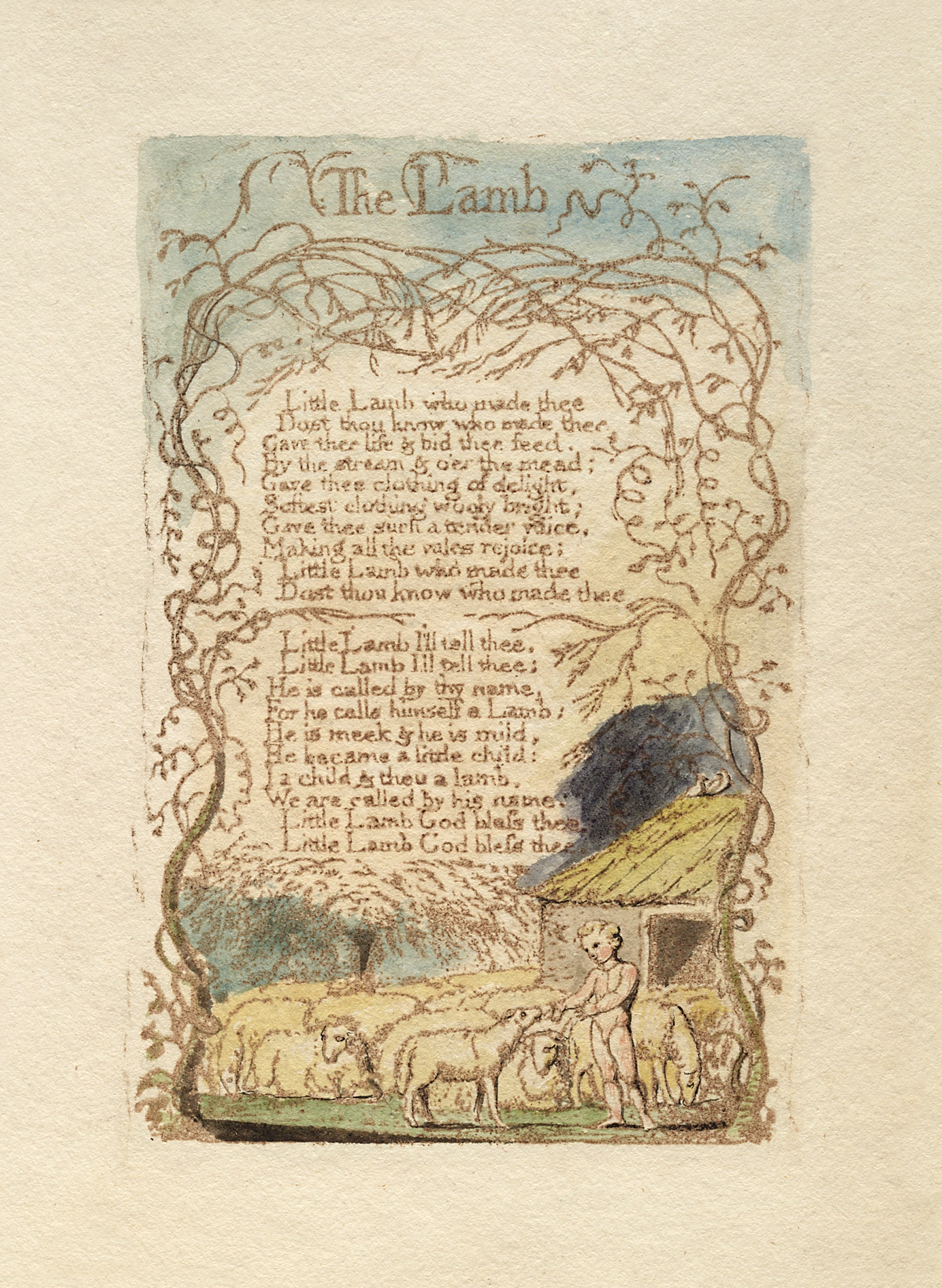
Little lamb, who made thee?
Dost thou know who made thee,
Gave thee life, and bid thee feed
By the stream and o’er the mead;
Gave thee clothing of delight,
Softest clothing, woolly, bright;
Gave thee such a tender voice,
Making all the vales rejoice?
Little lamb, who made thee?
Dost thou know who made thee?

Little lamb, I’ll tell thee;
Little lamb, I’ll tell thee:
He is callèd by thy name,
For He calls Himself a Lamb.
He is meek, and He is mild,
He became a little child.
I a child, and thou a lamb,
We are callèd by His name.
Little lamb, God bless thee!
⎯⎯⎯⎯⎯⎯⎯⎯⎯⎯

(William Blake)
Fantastic beasts

Here is an interesting note about the Ukrainian artist Maria Prymachenko. It says that her themes and artistic style, as well as her country’s circumstances, were similar to those of Pablo Picasso. (Picasso, it turns out, admired Prymachenko.)

Not an outlandish connection; but right now, I’m primed to associate Prymachenko’s art with Blake’s paintings of fantastic beasts.

(As I’ve mentioned here and here, the Polish writer Olga Tokarczuk has explicitly connected her own work with Blake’s.)

♦ ♦ ♦ ♦ ♦

An update on our infestation:

Jasper has caught and killed three mud-room mice.

Ziva also has been hunting. She caught a mud-room mouse and brought it into the house. It ran away before she got around to killing it, though.

Since then, we haven’t seen any trace of that mouse. It probably didn’t survive long.

Karin found the hole in the mud-room through which the mice have been entering from the yard. We’ll put copper wool over the hole. That should keep them out.

March’s poem

“I yuv pacifiers,” says Samuel, who has long been weaned of them. I caught him pulling a pacifier out of Daniel’s mouth and taking a little “drag” from it.

Lately he’s been reciting: “Dickory dickory dock / The mouse ran up the clock …”; and, especially, “Dickory dickory dare / The pig flew up in the air / The man in brown / Soon brought him down / Dickory dickory dare.” (Wells’s illustration shows a wallpaper pattern of pigs flying WWI planes, as in Porco Rosso.)

Today, Samuel began composing a new poem: “Dickory dickory dickens.” Karin & I extended it: “Someone let loose the chickens / The chickens were sad / Because they were bad / Dickory dickory dickens.”

But none of them is March’s poem. That is a poem of Blake’s, the one made into the hymn “Jerusalem.” Like a pop song, it pleases each person who gives it his own interpretation. Is the poem about industrialization? The C of E? You can mean it however you like, so long as it is about England (or “England”).

⎯⎯⎯⎯⎯⎯⎯⎯⎯⎯
And did those feet in ancient time,
Walk upon Englands mountains green
And was the holy Lamb of God,
On Englands pleasant pastures seen!

And did the Countenance Divine
Shine forth upon our clouded hills?
And was Jerusalem builded here,
Among these dark Satanic Mills?

Bring me my Bow of burning gold;
Bring me my Arrows of desire:
Bring me my Spear: O clouds unfold!
Bring me my Chariot of fire!

I will not cease from Mental Fight,
Nor shall my Sword sleep in my hand:
Till we have built Jerusalem
In Englands green & pleasant Land
⎯⎯⎯⎯⎯⎯⎯⎯⎯⎯

December’s poem

The Omicron COVID variant has hit Cornell hard, CNN reports. Many of the infected persons are fully vaccinated. A good number have been given booster shots.

The latest figures are here. They are worth beholding.

I’d bet that most of us, at some time or another, will get infected with Omicron or something worse.

♦ ♦ ♦ ♦ ♦

Here is the latest video of Un mundo inmenso. It’s about the hipster despot of El Salvador, the one who made Bitcoin a national currency.


I always knew hipsterdom would get out of hand. I just didn’t expect El Salvador to lead the way.

♦ ♦ ♦ ♦ ♦

This poem is by William Blake.

⎯⎯⎯⎯⎯⎯⎯⎯⎯⎯
Is this a holy thing to see,
In a rich and fruitful land,
Babes reduc’d to misery,
Fed with cold and usurous hand?

Is that trembling cry a song?
Can it be a song of joy?
And so many children poor?
It is a land of poverty!

And their sun does never shine.
And their fields are bleak & bare.
And their ways are fill’d with thorns.
It is eternal winter there.

For where-e’er the sun does shine,
And where-e’er the rain does fall:
Babe can never hunger there,
Nor poverty the mind appall.
⎯⎯⎯⎯⎯⎯⎯⎯⎯⎯

Drive your plow, pt. 2

Now that I’ve finished reading Drive Your Plow Over the Bones of the Dead, I can identify other Books as its Aunts and Uncles:
  • J.M. Coetzee, The Lives of Animals (in Elizabeth Costello)
  • Mark Haddon, The Curious Incident of the Dog in the Night-Time
  • Jean-Patrick Manchette, Fatale
Reviewers point out that Drive Your Plow is like a Novel by Agatha Christie. Well, it lacks the most important Characteristic of those Novels, which is Self-Effacing Narrative Voice.

Voicewise, Drive Your Plow is much more like the two aforementioned Works (which, though not Arrogantly narrated, are not Self-Effacing).

But yes, Drive Your Plow is a Whodunnit.

♦ ♦ ♦ ♦ ♦

There is one Christie Novel that may be ancestral to Drive Your Plow, and that is the great Endless Night. Its Title, also, is from Blake:

Every Night & every Morn
Some to Misery are Born.
Every Morn & every Night
Some are Born to sweet delight.
Some are Born to sweet delight,
Some are Born to Endless Night.


(These Lines, from “Auguries of Innocence,” are mentioned in Drive Your Plow.)

Drive Your Plow is a Good Read, but I’ve seen a lot of it before, in other Books.

Drive your plow over the bones of the dead

Scant rain has fallen the last two weeks. Large sections of the lawn have become tawny.

My neighbors water their grass. I am averse to doing this, as it encourages grass to grow, which makes for more frequent mowing.

Yesterday, I sheared the back lawn down to its nubs.

The lawn already was rather short. On this occasion, such a small length was cut off the top, I didn’t have to rake any of it into piles.

This is exactly the situation I aspire to, as far as the lawn is concerned.

Tonight there is rain and thunder. I am out on the back porch with Samuel, Jasper, and Ziva. Ziva, especially, is fond of the porch. When I go back inside the house, I have to lure her with treats.

The book I am reading – Drive Your Plow Over the Bones of the Dead – is by Olga Tokarczuk, of Poland, a recent Nobel Prize winner.

In this book, villagers keep popping off, slasher-movie style. The narrator, a semiretired schoolteacher and estate caretaker, suspects that the perpetrators are Animals (she capitalizes a good many common nouns, to charming effect). In particular, she suspects the Deer, who are often poached. She alleges that their motive for committing these Murders is Revenge. (I am reminded of M. Night Shyamalan’s movie, The Happening.)

The narrator has hobbies. She translates the poetry of William Blake. She is a firm believer in Astrology. She writes letters to the Police, explaining to them who has been committing the Murders.

She is eccentric but quite self-aware, and her narration is matter-of-fact. This makes the book very funny.

Also, the book is short. And yet I’ve been reading it since before the libraries closed for the pandemic. I’m forcing myself to finish it by Friday, which is the final due date after several renewals.

I find myself wondering how the narrator would judge me. I’d like to come out well, by her lights. She’s quite a humane person. I eat meat, which perhaps she’d not condemn absolutely (it’s the Order of this poorly designed Universe that some Creatures must survive by eating Others).

The narrator also despises Lawn Mowing.

100 greatest Britons

My little boy turned six months old. See him with his mother:


Ziva is in the background, at one o’clock.

♦ ♦ ♦ ♦ ♦

Do you watch so much British TV that, occasionally, you need to be reminded that you aren’t British?

You may be helped by this BBC poll from 2002 that identifies the “100 Greatest Britons.”

Consider: who was Isambard Kingdom Brunel?

Not only had I not heard of him, the alleged second-greatest Briton (ahead of the likes of Darwin, Newton, Shakespeare, and Elizabeth I); I’d be surprised to encounter five non-Britons who could tell me who he was.

(Reading about him, it’s obvious that he was a tremendous figure. It’s just that, on this side of the Atlantic, the Industrial Revolution looms less large in the imagination.)

I understand the high rating of Diana, Princess of Wales, even if I don’t agree with it. I even understand the inclusion of J.K. Rowling to the detriment of Agatha Christie, Arthur Conan Doyle, and other genre fiction writers. People get fixated upon recent figures.

It’s surprising, though, to see a 17th-century terrorist such as Guy Fawkes rated so well (30th). Not that I object. I think I understand his appeal. But it wouldn’t have occurred to me to make it a criterion for “greatness”; no, not even though I love to watch Midsomer Murders, which is close in spirit to how Guy Fawkes Night is celebrated. (And since Fawkes is included, why not Jack the Ripper?)

The list has no philosophers unless Darwin and Newton are counted as such. Hobbes? Hume? Absent. Locke? Adam Smith? They must have been reserved for the U.S. list.

Blake, not Turner, is the only painter.

No Yeats; no Joyce. Instead: Bono. Pop singers abound.

Actors abound: Richard Burton the actor makes the cut above Richard Burton the explorer. (Explorers abound, too.)

August’s poems

… are from Blake’s Songs of Innocence and of Experience.


⎯⎯⎯⎯⎯⎯⎯⎯⎯⎯
The Divine Image
(1789)

To Mercy Pity Peace and Love
All Pray in their distress:
And to these virtues of delight
Return their thankfulness.

For Mercy Pity Peace and Love
Is God our father dear:
And Mercy Pity Peace and Love
Is Man his child and care.

For Mercy has a human heart
Pity, a human face:
And Love, the human form divine.
And Peace, the human dress.

Then every man of every clime
That prays in his distress,
Prays to the human form divine
Love Mercy Pity Peace.

And all must love the human form.
In heathen, turk or jew
Where Mercy, Love & Pity dwell
There God is dwelling too.

A Divine Image
(1794)

Cruelty has a Human Heart
And Jealousy a Human Face
Terror, the Human Form Divine
And Secrecy, the Human Dress

The Human Dress is forged in Iron
The Human Form, a fiery Forge
The Human Face, a Furnace seal’d
The Human Heart, its hungry Gorge.
⎯⎯⎯⎯⎯⎯⎯⎯⎯⎯


Vaughan Williams’s interpretation is the ancestor of certain TV theme songs, Karin suggests.

The lamb-cat

Mary, to Bianca:
Little Lamb, who made thee?
Dost thou know who made thee?
Bianca, the lamb-cat, looks up and blinks.


My W130 section was canceled because its enrollment was too small. So the English Department assigned me to a different section — which also was canceled, for the same reason.

Thus I’m enjoying an extra week of winter break. On Tuesday I’ll begin to tutor.