Posts

Showing posts with the label Mitford (Nancy)

Body-text fonts, pt. 56: Guardian Egyptian

Guardian readers will be familiar with the house font.

Matthew Butterick:
It’s counterintuitive, but a well-designed font can have a lot of subtle variation between letters and still look consistent on the page. The converse of this principle is that a font with too much consistency can be numbing to read. Cambria is an example of this problem. It works well on screen, but on the printed page, it’s a skull-clutcher. Guardian Egyptian … [is] similar to Cambria but [avoids] monotony.
An example of Guardian Egyptian:


This is hardly the best type specimen. The quote marks are “straight” rather than “curly,” and the dash in the second line appears to be a mere hyphen.

But I exhibit it because it’s an outstanding passage from one of my all-time favorite reviews: a pan of the great Kazuo Ishiguro’s When We Were Orphans. It gets at what’s so elegant and so disconcerting – so craftily, poignantly removed – about Ishiguro’s prose.

(I’ve been reading Ishiguro’s books in order. Their formality is endlessly fascinating.)

The Guardian passage explains certain tendencies in my own writing.

I, too, am a kind of foreigner.

♦ ♦ ♦ ♦ ♦

Another insight along similar lines, due to Nancy Mitford (Don’t Tell Alfred):
You must remember, with Americans, that they are fighting to express themselves in a language they’ve never properly learnt. They need the dissertation; the kind of shorthand that we talk would be useless to them.
Recall, also, C. S. Lewis’s remark in Studies in Words:
It was better to have the older English distinction between “I haven’t got indigestion” (I am not suffering from it at the moment) and “I don’t have indigestion” (I am not a dyspeptic) than to level both, as Americans have taught most Englishmen to do, under “I don’t have.”
If you introduce many non-natives into an English-speaking country, then – naturally enough – phrasal verbs will get phased out: got will be dropped from I haven’t got.

Suppose that, over time, that country’s influence is inflated. Eventually, the blood will be siphoned out even from the Mother Country’s speech.

♦ ♦ ♦ ♦ ♦

See, also, David Lodge’s chapter, in The Art of Fiction, on Ishiguro’s Remains of the Day:
Stevens [the narrator] speaks, or writes, in a fussily precise, stiffly formal style – butlerspeak, in a word. Viewed objectively, the style has no literary merit whatsoever. It is completely lacking in wit, sensuousness and originality. Its effectiveness as a medium for this novel resides precisely in our growing perception of its inadequacy for what it describes.

Closing credits

Merry Christmas!
Rejoice, rejoice, daughter of Zion,
shout aloud, daughter of Jerusalem;
for see, your king is coming to you,
his cause won, his victory gained,
humble and mounted on an ass,
on a foal, the young of a she-ass.
He shall banish chariots from Ephraim
and war-horses from Jerusalem;
the warrior’s bow shall be banished.
He shall speak peaceably to every nation,
and his rule shall extend from sea to sea,
from the River to the ends of the earth.
Zecharaiah 9:9–10 (The New English Bible – the translation I read this year).

♦ ♦ ♦ ♦ ♦

Farewell, for the time being, to my step-grandma, who has gone to live with her daughter in southern Illinois; and to my grandpa (R.I.P.).

“He is not God of the dead but of the living” (Matthew 22:32).

♦ ♦ ♦ ♦ ♦

Welcome, Abel Barnaby, my littlest son. How celebrated he is, everywhere we take him.

Daniel and Samuel seem untroubled by him. The cats seem downright unaware of Abel, although Abel himself, so young, sounds like a cat (that’s how I distinguish him in a crowd of children).

Karin said today that she had one aim this year, which was to have this child. Abel, so-called, has been with us a short time. As “Pip,” however, he was ever-present in our talk.

♦ ♦ ♦ ♦ ♦

Samuel has begun school spectacularly. We’ve been given to understand that he’s popular – a shock to us. His classmates look out for him. One friend follows him around and pulls his sagging pants up for him.

If Samuel is our introvert, Daniel is our good-natured scene-stealer. He’s the one with whom librarians and store clerks chat.

Winsome or taciturn, whatever you are or do, do it for the Lord.

♦ ♦ ♦ ♦ ♦

Sports. Ecuador finished with a great victory that cast a nice glow over a frustrating year. (Indeed, this summer’s Copa América showing was rather good.)

At the club level, Moisés Caicedo and Piero Hincapié proved their worth.

Our Olympians also triumphed.

♦ ♦ ♦ ♦ ♦

Politics. Ha!

Exercising. Ha!

Music. The song I listened to the most, by far, was “Style” by Taylor Swift: both versions: hers (re-recorded), and the original with copyright ajeno. I’d often choose “Style” as my lead housecleaning song.

I listened to almost nothing else by Taylor Swift.

Honorable mention: Dettinger.

Viewing. I subscribed to the Criterion Channel.

I’d often fall asleep viewing true crime shows on Tubi. I may write about Australian vs. Canadian crime.

♦ ♦ ♦ ♦ ♦

Reading. I joined a club and was forced to read books I’d never choose so that I might force others to read books they’d never choose. This is salutary. Everyone needs reminding that there are other consciousnesses in the universe. “We read to know we’re not alone” (misattributed to C. S. Lewis). More like, we join book clubs to learn that, alas, one is not alone.

That said, what follows has to do with my private reading choices. I read two or more titles by these authors:
  • E. M. Forster
  • Jon Fosse
  • C. S. Lewis
  • Nancy Mitford
  • Anthony Powell
  • Peter Temple
  • J. R. R. Tolkien
  • Laura Ingalls Wilder
They’re all good authors, but whom you mightn’t’ve read but really should is Mitford. And, for linguistic virtuosity, Temple.

I’m probably the last grownup among my blood relations to have finished reading The Lord of the Rings. I made my first attempt in the fourth grade. That year, my parents bought me an extra birthday gift – a t-shirt – on the condition that I’d finish Tolkien’s series. That albatross has finally been cast off. It was necessary, first, to outgrow the shirt; to obtain the Ph.D. and sire three children; to read through the Bible several times; to read Beowulf, and the eleven Strangers and Brothers novels (for a better feel for Oxbridge). To learn to slog. It was no small victory, gaining the knowledge and courage and endurance to leave the Shire and cross Middle Earth.

Proust is on the docket for 2025, once I’ve finished Powell; after Proust, possibly Trollope or Balzac. But I doubt I’ll ever read The Silmarillion. Too few hobbits; too many elves.

We feed our children

Another “dine-in” attempt – this time with Daniel and Samuel, at a Chinese buffet. It was a success. Buttery cabbage on buttery whitefish on buttery, spicy, sugary chicken, on buttery noodles, with dumplings. Daniel ate for free; Samuel’s rate was reduced; the boys mostly stayed in their chairs. You could see the calories rushing through their arteries and veins, draining away their consciousness.

Not the fetus’s, though. “ ‘Pip’ loves this food,” Karin said. “He’s dancing around.”

Daniel heard a very tiny baby crying in the restaurant. He smiled. “Meow, meow,” he said.

♦ ♦ ♦ ♦ ♦

I’m sorry to admit, our sons have terrible eating habits. Daniel wakes up at 6:30 or 7:00 and begs for candy. (No, I don’t give him any.)

He may have finally turned a corner. He’s been asking for meals with more balance: today, peanut-buttered toast, strawberries, and Spanish rice.

Now that Karin is “in pig” (Nancy Mitford’s phrase), our WIC allowance has been raised: At the end of each month, we realize we haven’t claimed anything like our full share of vegetables. So, half-panicked, we go to the store and pick out avocados and other “costly” free items. This month it was dragon fruit, from Ecuador. I wondered if any of the fruit we looked at was descended, nearly or distantly, from Hoku’s parents’ farm.

June’s poem


Alas, this is how I often feel, re-reading The Fellowship of the Ring.

♦ ♦ ♦ ♦ ♦

From Nancy Mitford’s Highland Fling:
Receiving no answer beyond a frigid stare, Albert, with a deep sigh, disposed himself upon the stone, sitting cross-legged like an idol. He then produced a slim volume from his pocket. “I presume you have read ‘The Testament of Beauty,’ sir?”

“Never heard of it.”

“Oh, sir, you must have heard of it. A very great poem by our Poet Laureate.”

“No, I haven’t; I expect it’s immoral stuff, anyway. Kipling ought to be the Poet Laureate, to my mind.”

“Alas! Philistine that I am, I must disagree with you. I cannot appreciate Sir Rudyard’s writings as no doubt I should. ‘Lest we forget, lest we forget,’ ” he chanted. “Have you a favourite poem, sir?”

The general remained silent, his eye on the horizon. As a matter of fact he had a favourite poem, but he could not quite remember how it went –

Under the wide and starry sky
Dig my grave and let me lie.
Home is the hunter home from the hill,
And the hunter home from the hill.

Something more or less like that.
The actual poem (Stevenson’s “Requiem”):

⎯⎯⎯⎯⎯⎯⎯⎯⎯⎯
Under the wide and starry sky,
Dig the grave and let me lie.
Glad did I live and gladly die,
And I laid me down with a will.

This be the verse you grave for me:
Here he lies where he longed to be;
Home is the sailor, home from sea,
And the hunter home from the hill.
⎯⎯⎯⎯⎯⎯⎯⎯⎯⎯

Mitfords, pt. 8; body-text fonts, pt. 26: Dante; effects of nuclear attack

N. Mitford’s seventh novel, The Blessing (1951), is about an Englishwoman who moves to France with her promiscuous French husband and their son (and their son’s English, xenophobic nanny, who once was the Englishwoman’s nanny).

France-Britain comparison had been creeping into Mitford’s previous novels and here is “on at full blast.” Mitford lived her last years in France.

The dedication is to Evelyn Waugh.

My reading copy is The Penguin Complete Novels of Nancy Mitford: nearly 1,000 large pages set in teeny-tiny Dante (a font with pleasing apostrophes). What follows is a rather atypical passage for Mitford, since the main speaker is from the USA. The setting is a dinner party. The New Worlders want to talk global politics; the Old Worlders want to forget warring and get back to bedroom politics.


– let me finish –
what they ought to do in the case of atomic explosion, such explosion is robbed of half, or one-third, its terrors.’

‘Thank you, Charlie,’ said Mr Dexter. ‘I for one feel a lot easier in my mind. There is nothing so dangerous as a policy of lassair-aller, and I am very glad that the great American public, if I may say so, M. de Valhubert, without offending your feelings, is not hiding its head in the sand, but is looking the Bomb squarely in the eye.’
(“Heck” – para. 3 – is not an expletive but a British-conceived U.S. diminutive of “Hector.”)

This is hardly my favorite N. Mitford passage. But it goes nicely with this remarkable essay in the Daily Mail, also read by me today, which gives “macabre minute-by-minute detail” about what would happen during a nuclear attack. (Hat tip: Leiter.)

Sobering stuff, even if flanked by links to articles about celebrities, conjoined twins, sea monsters, and UFOs.

My bracket; Mitfords, pt. 7

Well, obviously, I picked: (1) UConn, to repeat (one of every three bracket-fillers has done so); (2) Creighton – UConn’s conference rivals – to reach the final; (3) Nebraska, because wouldn’t it be silly if two teams from that state reached the Final Four; and (4) New Mexico, so that the UConn Huskies might compete against other “canines” (it was a toss-up between New Mexico and Nevada).

When these four pieces have fallen into place, the windfall will be mine.

♦ ♦ ♦ ♦ ♦

Daniel tipped himself headfirst off the bed, but I caught him just in time. I had been absorbed in Mitford novel no. 6, Love in a Cold Climate; when I lurched after Daniel the volume flew out of my hands and across the room, landing hard.

“My book!” I cried out.

“See, your father loves you dearly,” Karin told Daniel, “he dropped his book to save you.”

I rushed to my book; the landing had cracked its spine. But not fatally.

More marriage-woes in Mitfordania. Jane Austen has her detractors, notably Mark Twain; I think she’s fine to read, but not by herself (not even within her narrow field). N. Mitford is a necessary corrective.

Warning: oblique spoiler (but no worse than on dust-jackets).

Think of LCC as if the respectable Jane Bennet, not Lydia, were to have run off with Wickham – not Austen’s dashing Wickham but a dowdier one, more like Mr. Collins, with pedophilic urges.

Awakenings; parks; Seusses; Mitfords, pt. 6

Warm-ish temps; constant rain patter. There’s nothing quite like reading Beowulf on the sofa, then dozing off, then waking – gradually and painfully – to the 1⁠-2⁠-3 punch of Modern Talking’s “Geronimo’s Cadillac,” “Brother Louie,” and “Cheri, Cheri Lady.” (The other songs in the queue were more soothing.)

♦ ♦ ♦ ♦ ♦

Karin obtained a puzzle with “thumbnail” sketches of the U.S. National Parks. Samuel spent hours gazing at the sketches and deciding which parks to visit. He’s keen on the Channel Islands (California).

I rose in his esteem by telling him which parks I’ve been to or seen from afar:

Acadia
Arches
Bryce Canyon
the Gateway Arch, glimpsed from I⁠-⁠70
the Grand Canyon, glimpsed from aircraft
Joshua Tree
Kings Canyon
Olympic, viewed from Vancouver Island (as in this photo, but not from so high up)
Mt. Rainier, viewed from Seattle (and see, again, the photo taken from Vancouver Island; I didn’t see this mountain during my stay)
Sequoia
Zion

I promised to go with Samuel to the Indiana Dunes. Poor boy, he rarely leaves the house, let alone the city.

He and Karin put the puzzle together last night, and this morning Daniel tore it up.

♦ ♦ ♦ ♦ ♦

ThriftBooks had a Seuss sale, and I bought a few of the immoral, discontinued titles (they were in a single omnibus, hee, hee), as well as I Had Trouble in Getting to Solla Sollew, which I’d been haunted by but hadn’t looked at since age four. It didn’t disappoint. I still don’t know how it concludes, though, because Daniel keeps slamming it shut before we reach the end. But I can guess.

As for the immoral ones, I re-read Mulberry Street and found mentions of a Rajah riding an elephant and a Chinese man using chopsticks.

♦ ♦ ♦ ♦ ♦

I finished The Pursuit of Love (1945), Nancy Mitford’s fifth and best-loved novel. At last, some contrition. Aristocrats celebrated … and punished: not for being aristocrats, but for making un-aristocratic marriages.

Mitfords, pt. 5

Another monstrosity: Pigeon Pie, a war novel.

At first, it seems a subdued, almost contrite work: an about-face from the fervid, jolly cynicism of Wigs on the Green.

It doesn’t stay that way. By the end, it outdoes its predecessor.

It was written in 1939. Nancy’s sister, Unity, the Hitler enthusiast, had just tried to commit suicide. The war had just begun. Heady days.

Dunkirk … the Battle of Britain … the Blitz … all were forthcoming.

The novel mocks Germans, Lord Haw-Haw, aristocratic volunteerism, the Cabinet, the House of Lords, parachutists, and real and pretending spies. The titular pigeons are messenger pigeons. None is actually baked in a pie. Some, bearing intelligence to the Nazis, are shot down over the Channel.

A surprising number of Germans drown underneath London, in the drains.

The heroine is an utter nitwit.

I confess I am very glad to have read this book.

♦ ♦ ♦ ♦ ♦

Daniel went to the physician again today (his own doctor, not the WIC doctor) and got shots. Karin had promised him a treat. She bought him some McDonald’s. They wouldn’t sell her a chicken McGriddle (the best kind). Maybe they don’t sell chicken at breakfast-time anymore. A bore, as the characters say in Mitford. I stayed home with Samuel, who played enthusiastically and in peace.

Since last week, we have had 60-degree (F) temperatures, then snow, then 60-degree temperatures (likely to climb to 70); snow is expected two days from now.

Mitfords, pt. 4

Well, I finished reading the third Mitford book, Wigs on the Green. I kept wondering how it would earn that title.

Chapter 12 hinted that the village festival would be graced by inmates from the local madhouse for peers. (The asylum, in the deepest, darkest, most bucolic Cotswolds, is a replica of Westminster … an inspired touch.)

I thought these doddering ex-members of the House of Lords would initiate the fracas; instead, it’s contested by the village’s rival youth factions: Social Unionists (“Union Jackshirts”) and Pacifists.

One roots for the Union Jackshirts.

The fight scene is a jovial and rousing climax. Alas, the book is mean-spirited on the whole; indeed, distressingly personal.

Who writes a novel mocking one’s little sister? (Even if she is gaga for Hitler.)

A cloistered aristocrat, that’s who.

Still, the book’s scorn isn’t directed against the young fascist heroine – or even her reactionary ancestors – so much as against her cynical hangers-on.

♦ ♦ ♦ ♦ ♦

This is Daniel’s last week before his “terrible twos.”

He’s into planets. He plays for hours with softballs, stress balls, and clementines.

Jupiter Planet.

Saturn Planet.

Mars.

Tune (Neptune).

Key (Mercury).

He loves to remove his pants and diaper and streak through the house. We’ve gone back to dressing him in bodysuits, which he can’t take off by himself. We’ve had to buy larger bodysuits to cover his growing frame. He’s less than a head shorter than Samuel.

Mitfords, pt. 3; body-text fonts, pt. 24: Sabon

Watching Branagh’s Much Ado, in installments. Samuel runs around yelling, “Hey, nonny nonny.”

Reading N. Mitford’s Wigs on the Green, a comic novel about an aristocratic teenage fascist. Somehow I didn’t expect this kind of heroine, although I knew about the Mitford sisters: “Diana the Fascist, Jessica the Communist, Unity the Hitler-lover; Nancy the Novelist; Deborah the Duchess and Pamela the unobtrusive poultry connoisseur” (Ben Macintyre’s descriptions, although he qualifies them as “caricatures”).


The novel is Springtime for Hitler-esque, but from before WW2 (1935).

I can understand why this family has a cult following. But the more I look into the Mitfords’ background, the less fantastical and more soberly realistic the novels seem.

♦ ♦ ♦ ♦ ♦

Is there a name for the déjà vu-like feeling you get when you encounter the less recent past and relive the more recent past (or the present)? I got it today from some toilet-reading: the chapter on Andrew Jackson in Barbara Holland’s Hail to the Chiefs: Presidential Mischief, Morals & Malarkey from George W. to George W.


(The footnote says: “All except non-folks like women, blacks, and Indians.”)

The typeface is the Garamond-like Sabon.


(The footnote says: “ ‘Ignorant, passionate and imbicile’ and ‘fierce ungovernable temper’ were some of the kinder descriptions. Jefferson said he couldn’t possibly think of anyone worse to be President.”)

Notice how the italic letters are just as wide as the Roman letters. This feature is unusual for this sort of typeface. A successor, Sabon Next, has narrower italics.

Isla Cromartie

My new Chromebook arrived a day early. What with the Scottish TV I’ve been watching, I named her Isla Cromartie.

The good: compared to my previous Chromebooks, Isla is built like a tank.

The bad: she loses power faster. And she has a touchscreen for Samuel and Daniel to interfere with. Perhaps this feature could be disabled.

She is a Dell. I considered naming her Adelle. Also: Philadelphia, after Philadelphia Bobbin, a character in Nancy Mitford’s Christmas Pudding.

It’s unlikely but possible that one day I’ll sire girl-triplets: Philomena (“Mena”), Philippa (“Pippa”), and Philadelphia (“Dee”). Karin hopes not.

♦ ♦ ♦ ♦ ♦

The Drake Passage, in a nutshell (National Geographic).

♦ ♦ ♦ ♦ ♦

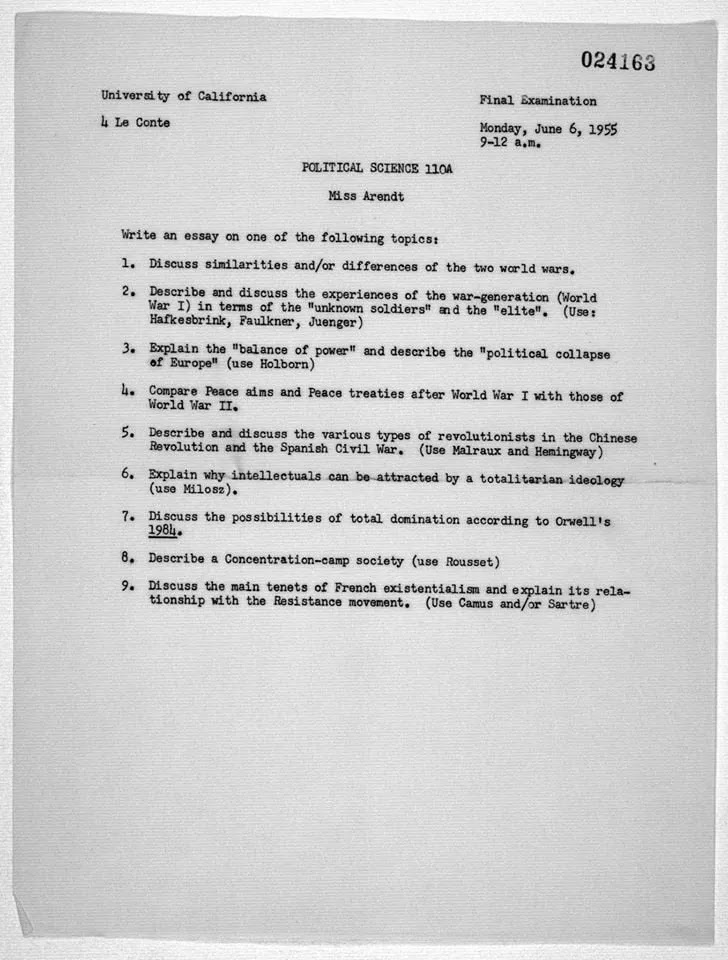
An exam from a class taught by Hannah Arendt in 1955. (Click on the image to make it sharper.)


When I was growing up and aspiring to become an academic (among other things), I read a few books from the 1970s and ’80s – whatever I could find in Ecuador – on how to teach in college. These books had sample exams. One basic type was Arendt’s: Here is your chance to demonstrate what you have learned.

For the student who’d learned little, there was nowhere to hide. For one who’d at least absorbed a few key lessons, arriving at a decent launching point for subsequent, mostly unguided study, this was an arena in which to shine.

I was enamored.

This was not what my exams were like in college or graduate school.

If memory serves, just one exam, a take-home from my second semester of college, was remotely like Arendt’s.

Reading report

Due to all the snow, it’s time to list the most entertaining books I’m reading.

(1) Henry Fielding, Tom Jones. This’ll last forever. I average just one or two little chapters each day. I believe there are over two hundred. Daniel, roughhousing, caused me to drop the unread paperback I’d owned for twenty years; the cover and spine broke. The cover of my replacement copy shows Tom leching. I haven’t gotten there in the story. Tom is still an infant nearly a hundred pages in. He’s clearly on his way to ignominy, due to the circumstances of his birth. I plan to alternate between Fielding and Richardson: Tom Jones; Pamela; Joseph Andrews and/or Shamela; and, finally, the grandmommy, Clarissa. Wish me luck.

BTW, Daniel says dozens of words but just started saying “no!” this week. It’s his favorite word.

Back to the books.

(2) Michael Lewis, Going Infinite, about Sam Bankman-Fried. One chapter per day, most days. It’s a library book, so I can’t dawdle over it indefinitely.

(3) Nancy Mitford, Highland Fling (just completed) and now Christmas Pudding. Delightful. The scenes of old nobles and ex-military shooting grouse are especially compelling. I may race through all these novels and Mitford’s aristocratic histories and then finish reading the journalism and memoirs of her sister, Jessica, which I began some years ago and then put off. I think I’ve got the correct order now. One ought to read Nancy to appreciate Jessica, not vice versa.

(4) H. Rider Haggard, King Solomon’s Mines. I read half of this many years ago. I enjoyed it but am a chronic unfinisher of books. Until I’m not. It can take decades.

(5) Dolores Hitchens, Sleep with Slander. I read Sleep with Strangers in October. This second novel is ten times better. The private eye is hired to track down a young adoptee who may or may not be suffering abuse. The search should be straightforward. But everyone lies to the P.I. – even the people who have the child’s interest at heart. I dread what’s to come.

I regret to say I’m dragging my feet over the not-very-entertaining Coriolanus. It does have this going for it, that although the hero’s friends and enemies alternately tediously praise and condemn him, he isn’t very interested; he shows up, hears some praise or condemnation, and then is like, I’m bored with you morons, and exits. The Shakespeare-hating Sam Bankman-Fried might have enjoyed this. No, probably not.