1996, the best year in movie history, pt. 32: The rock
R.I.P. Sean Connery.
People declared him, in 1999, to be the “Sexiest Man of the Century.” And until today he was “Scotland’s Greatest Living National Treasure,” according to some European betting company I’d never heard of.
♦ ♦ ♦ ♦ ♦
My high school friends had great enthusiasm for Connery’s movie The Rock. They’d say things like, “It’s so sad what happens to that Ferrari. And to that beautiful Hummer.”
The movie has car chases, explosions, fighter jets, machine gun fights, handgun fights, hand-to-hand fights … and three dudes: Connery, Nicolas Cage, and Ed Harris. It’s not unlike that scene in The Office in which three employees stand around the water cooler agreeing that they’re all “alpha” males. The characters played by Cage, Connery, and Harris must learn to acknowledge one another as fellow badasses who are worthy of mutual respect.
This would be no small feat. One of these characters is a terrorist. Another is a jailbird. Most shamefully, the Cage character is a nerdy scientist.
Never mind that this scientist is a “field” agent, not a “desk” agent, for the FBI. Never mind that his job is to disarm chemical weapons.
He still has trouble remembering to carry a gun.
Only recently did he impregnate his girlfriend.
He is assigned to San Francisco to deal with what turns out to be a threat to national security. Unwisely, he brings along his girlfriend and unborn child, putting them in harm’s way.
♦ ♦ ♦ ♦ ♦
PRAY TELL, what is this threat to national security?
A dozen or so members of the U.S. Armed Forces have gone rogue. They’re led by a USMC general – Harris – who is acknowledged by all parties to be thoroughly honorable; and yet he and the other rebels have taken some innocent tourists hostage in the disused prison on Alcatraz Island (“the Rock”).
Worse, they’ve stolen four rockets filled with pellets of a lethal gas.
They make two demands:
First, that the government officially recognize one hundred military heroes who’ve died while performing tasks of a clandestine nature.
Second, that it pay reparations to the heroes’ families.
If these honorable, terroristic demands are not met, the rockets will be launched. The poison gas will kill 70 or 80 thousand San Franciscans – as well as Cage’s girlfriend and unborn child.
♦ ♦ ♦ ♦ ♦
So much for Cage and Harris. Enter Sean Connery.
His character has made a distinguished career as an escape artist. But now he’s under lock and key in an ultra-modern federal prison. He spends his days reading philosophy and Shakespeare and growing out his hair …

… until the FBI comes asking for his help. You see, many years ago, he was the only prisoner to escape alive from the Rock. Now he’s the only person who can find his way through Alcatraz’s maze of tunnels. Only he can guide Nicolas Cage and the team of impatient Navy SEALs who have been tasked with neutralizing the chemical weapons and rescuing the hostages.
The Bureau doesn’t like Connery one bit. He’s too cocky and too British. He knows too many U.S. government secrets. But, in this situation, he’s indispensible.
Whether he can get along with Cage is another matter.
They expertly hurtle wisecracks at one another. This is the best thing about the movie.
It’s almost worth the two hour, sixteen minute runtime. Almost.
♦ ♦ ♦ ♦ ♦
Let’s skip ahead:
Car chase …
Car crash …
San Francisco streetcar crash …
Explosion …
Scuba diving peril …
Gunfight …
So, there are a lot of action sequences, but they aren’t very gratifying. In a good action sequence, you can see why each character comes to make each move. The action sequences in The Rock are mostly haphazard. The protagonists point and shoot at nameless enemies who may as well be zombies. Complications don’t emerge from the logic of the situation. They are random. They are often played for laughs. (Consider the early chase sequence in which a little old lady crosses the street in front of a speeding car.)
The Rock is dressed up as an action movie, but, fundamentally, it’s a buddy comedy. Its physical wit is undistinguished.
Its verbal wit is better.
In the bowels of the Alcatraz prison, after the SEALs have all been killed, Connery and Cage achieve mutual understanding:
I would’ve said that the poison-gas scenario is ridiculous, except I’ve been reading Michael Lewis’s book The Fifth Risk. It’s about how the U.S. government keeps in check lots of security threats comparable to the one in this movie. (It’s also about how the current administration has been foolishly defunding scientific research that most politicians don’t even begin to understand.)
So, it turns out, the movie is probably more realistic than most people would have guessed.
♦ ♦ ♦ ♦ ♦
The Rock was the high point of Michael Bay’s directorial career. His Armageddon (1998) was worse. I haven’t seen his Transformers series, but I gather those movies were much, much worse.
So, even the lousy movies of 1996 were much better than their more recent counterparts.
 (Link.)
Thank you, Sir Sean. Thank you.
Rest in peace.
P.S. See, also, my review of DragonHeart.
People declared him, in 1999, to be the “Sexiest Man of the Century.” And until today he was “Scotland’s Greatest Living National Treasure,” according to some European betting company I’d never heard of.
♦ ♦ ♦ ♦ ♦
My high school friends had great enthusiasm for Connery’s movie The Rock. They’d say things like, “It’s so sad what happens to that Ferrari. And to that beautiful Hummer.”
The movie has car chases, explosions, fighter jets, machine gun fights, handgun fights, hand-to-hand fights … and three dudes: Connery, Nicolas Cage, and Ed Harris. It’s not unlike that scene in The Office in which three employees stand around the water cooler agreeing that they’re all “alpha” males. The characters played by Cage, Connery, and Harris must learn to acknowledge one another as fellow badasses who are worthy of mutual respect.
This would be no small feat. One of these characters is a terrorist. Another is a jailbird. Most shamefully, the Cage character is a nerdy scientist.
Never mind that this scientist is a “field” agent, not a “desk” agent, for the FBI. Never mind that his job is to disarm chemical weapons.
He still has trouble remembering to carry a gun.
Only recently did he impregnate his girlfriend.
He is assigned to San Francisco to deal with what turns out to be a threat to national security. Unwisely, he brings along his girlfriend and unborn child, putting them in harm’s way.
♦ ♦ ♦ ♦ ♦
PRAY TELL, what is this threat to national security?
A dozen or so members of the U.S. Armed Forces have gone rogue. They’re led by a USMC general – Harris – who is acknowledged by all parties to be thoroughly honorable; and yet he and the other rebels have taken some innocent tourists hostage in the disused prison on Alcatraz Island (“the Rock”).
Worse, they’ve stolen four rockets filled with pellets of a lethal gas.
They make two demands:
First, that the government officially recognize one hundred military heroes who’ve died while performing tasks of a clandestine nature.
Second, that it pay reparations to the heroes’ families.
If these honorable, terroristic demands are not met, the rockets will be launched. The poison gas will kill 70 or 80 thousand San Franciscans – as well as Cage’s girlfriend and unborn child.
♦ ♦ ♦ ♦ ♦
So much for Cage and Harris. Enter Sean Connery.
His character has made a distinguished career as an escape artist. But now he’s under lock and key in an ultra-modern federal prison. He spends his days reading philosophy and Shakespeare and growing out his hair …
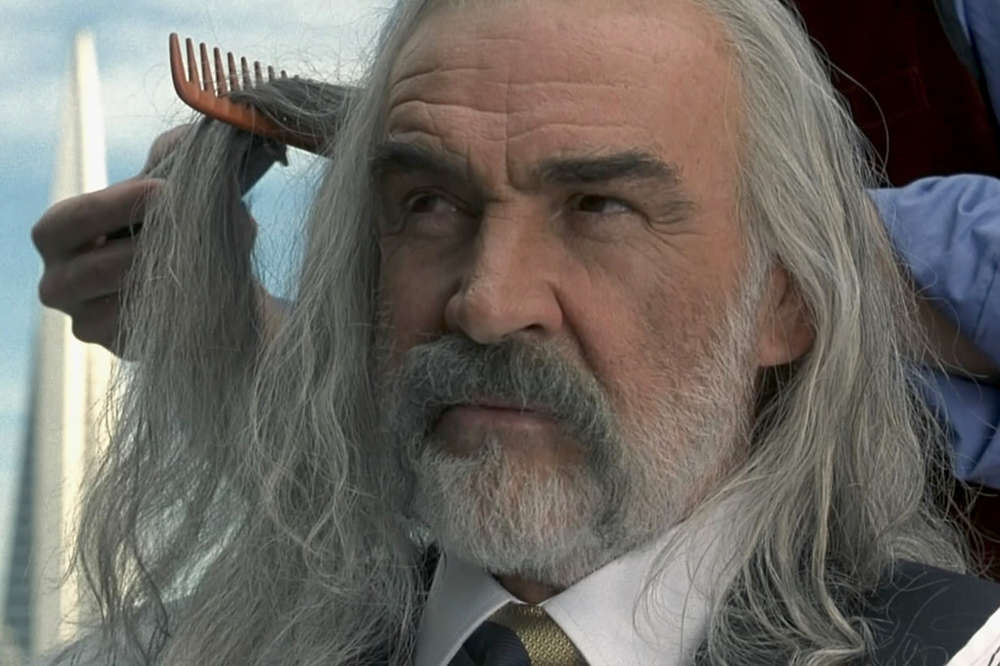
… until the FBI comes asking for his help. You see, many years ago, he was the only prisoner to escape alive from the Rock. Now he’s the only person who can find his way through Alcatraz’s maze of tunnels. Only he can guide Nicolas Cage and the team of impatient Navy SEALs who have been tasked with neutralizing the chemical weapons and rescuing the hostages.
The Bureau doesn’t like Connery one bit. He’s too cocky and too British. He knows too many U.S. government secrets. But, in this situation, he’s indispensible.
Whether he can get along with Cage is another matter.
They expertly hurtle wisecracks at one another. This is the best thing about the movie.
It’s almost worth the two hour, sixteen minute runtime. Almost.
♦ ♦ ♦ ♦ ♦
Let’s skip ahead:
Car chase …
Car crash …
San Francisco streetcar crash …
Explosion …
Scuba diving peril …
Gunfight …
So, there are a lot of action sequences, but they aren’t very gratifying. In a good action sequence, you can see why each character comes to make each move. The action sequences in The Rock are mostly haphazard. The protagonists point and shoot at nameless enemies who may as well be zombies. Complications don’t emerge from the logic of the situation. They are random. They are often played for laughs. (Consider the early chase sequence in which a little old lady crosses the street in front of a speeding car.)
The Rock is dressed up as an action movie, but, fundamentally, it’s a buddy comedy. Its physical wit is undistinguished.
Its verbal wit is better.
In the bowels of the Alcatraz prison, after the SEALs have all been killed, Connery and Cage achieve mutual understanding:
CONNERY: Are you sure you’re ready for this?
CAGE: I’ll do my best.
CONNERY: Your “best!” Losers always whine about their best. Winners go home and ---- the prom queen.
CAGE: Carla was the prom queen.
CONNERY: Really?
CAGE [cocking his gun]: Yeah.

I would’ve said that the poison-gas scenario is ridiculous, except I’ve been reading Michael Lewis’s book The Fifth Risk. It’s about how the U.S. government keeps in check lots of security threats comparable to the one in this movie. (It’s also about how the current administration has been foolishly defunding scientific research that most politicians don’t even begin to understand.)
So, it turns out, the movie is probably more realistic than most people would have guessed.
♦ ♦ ♦ ♦ ♦
The Rock was the high point of Michael Bay’s directorial career. His Armageddon (1998) was worse. I haven’t seen his Transformers series, but I gather those movies were much, much worse.
So, even the lousy movies of 1996 were much better than their more recent counterparts.

Thank you, Sir Sean. Thank you.
Rest in peace.
P.S. See, also, my review of DragonHeart.
